
Years ago, in my early 20’s, I took out an ad in a long-gone Seattle area music magazine called The Rocket to find a songwriting partner. It was a fertile time in my life in that I had an easy-going job and little responsibility.
A girlfriend had recently broken up with me, something that, as it turns out, can generate a lot of angsty, post-adolescent song lyrics. I got a couple of replies to my ad, including one that yielded several meetings with a young singer about my age. We wrote several songs together, including one that he told me some relative of his started playing in a band in Europe.
 I never really knew where that went…
Anyway, our partnership ended when my job was lost to technology and I moved from Seattle to start college. I’ve kept writing song lyrics on and off as time has passed, though. And a few years ago I reached out via an online site to Seattle-area musicians looking for a lyricist. Again, I got a couple of replies. And again, one yielded a couple of rough demos, this time of some song lyrics I wrote while in college.
Like before, other things took precedence and the potential songwriting partnership drifted away before it could solidify. About a year ago, while cleaning up some email, I found one of the demos. I listened to it and found it kind of engaging, reminding me that this itch for my creativity still wants to be scratched.
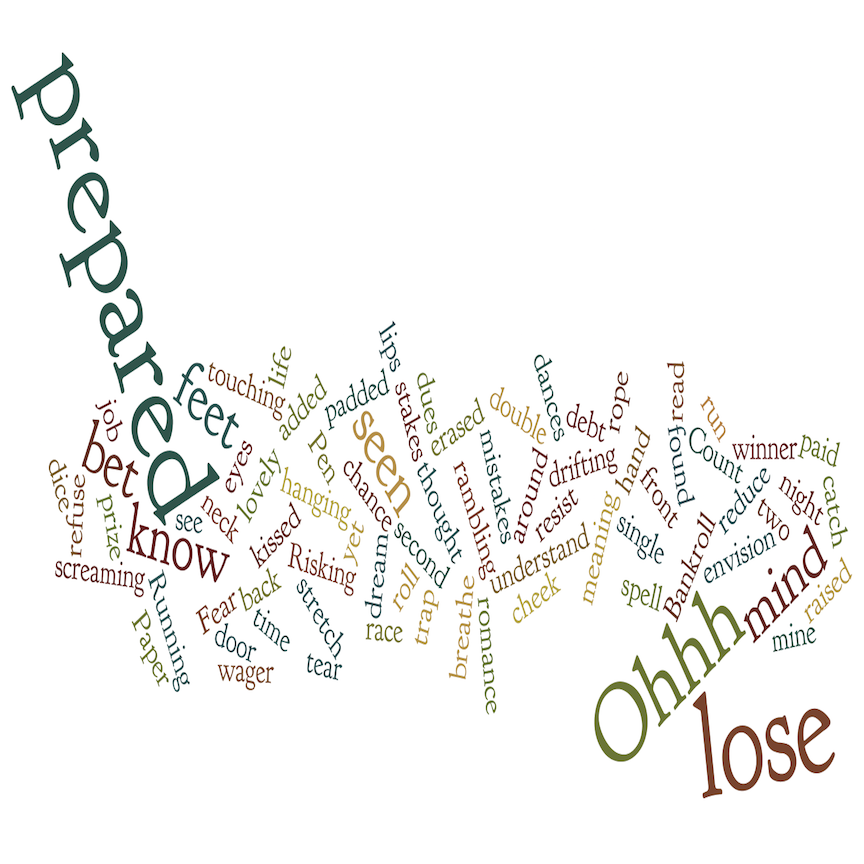
The song is called “Not to Prepared to Lose.” I wrote the original lyric in 1985 and it’s been sitting in a notebook with dozens of other songs, some pretty horrible and others with some potential merit, since. My co-writer is Bob Kopatich. He wrote the music and is doing the singing and guitar playing. He changed a couple of lines to suit his phrasing and his understanding of the song.
Take a listen:
NOT PREPARED TO LOSE — Lyrics
Here I am hanging on,
A rope around my neck
A trap door under my feet
I’ve been here a time or two
Didn’t mean to hurry back
As a single tear dances on my cheek.
Running the race
I know the next step
Can’t resist
So I double the bet
Ohhh
And I’m not prepared to lose.
Here I am rambling on,
Pen in my hand
Paper in front of me
You can’t read my mind
if I don’t write it down
So I spell it out for you to see.
Here’s the catch
I know the meaning
Down the stretch
I run screaming
Ohhh
And I’m not prepared to lose.
The thrill of the game was found when we kissed
Rolling the dice, I took on the risk
Risking romance, all for you
I bet on a second chance
And I’m not prepared to lose.
Here I am drifting off,
A dream in my mind
Hope in my eyes can’t be seen
I envision your lovely lips touching mine
As you breathe your life into me.
I count the mistakes
I know I’ve added
You raised the stakes
Bankroll padded
Ohhh
I’m not prepared to lose
I’m not prepared to lose
I’m not prepared to lose you.

 Andy Smallman