

When I was a little boy, the youngest of three sons, my family lived in Omaha, Nebraska. That’s where I was born so 100% of my life’s experience was developed in Omaha; that is, until my father was transferred to the Seattle area a couple of months before I turned 11.
I was raised a sports fan, most specifically baseball and hockey. While my brothers and I played sports, it was more the garden variety neighborhood pick-up games than with organized teams, albeit with some exceptions. My oldest brother, Scott, played a year of Little League baseball and I played a year of organized ice hockey. Steve, the middle brother, and I played softball through Cub Scouts and we all bowled somewhat competitively.
Perhaps more than playing sports, my family enjoyed attending sporting events. Omaha wasn’t big enough for the major leagues, but we did have some really good minor league teams during the time we lived there, the 1960’s and early 1970’s. The Omaha Knights hockey team was affiliated with the New York Rangers and we saw some pretty good players and coaches begin their professional careers inside Ak-Sar-Ben Coliseum. Most notably, defenseman André Dupont and coach Fred Shero helped guide the Knights to a Central Hockey League championship before winning a couple of Stanley Cups with the Philadelphia Flyers “Broad Street Bullies” teams in the mid 1970’s.
The top farm team for major league baseball’s Kansas City Royals was in Omaha. Also called the Royals, we saw some excellent baseball players pass through on the way to the “Show,” as the big leagues is called, including future Hall-of-Famer George Brett. Outfielder Amos Otis, pitcher Paul Splittorff, and second baseman Frank White all played in Omaha before making it big as members of some solid Kansas City teams in the 1970’s and beyond. And manager Jack McKeon ended up winning over 1000 games as a big league manager after his stint in Omaha.
My favorite baseball player was one of the older members of the team in both 1969 and 1970, an outfielder by the name of George Spriggs. I’m not really sure why Spriggs caught my attention more than the younger guys on their way up. But if I was to make a guess, I’m pretty sure it was the way he carried himself. He just looked like a baseball player to me. He wore his socks up, making his baseball pants look baggy, which I tried to emulate when I put on my replica Omaha Royals uniform. His most notable characteristic, at least to me, was how he carried his baseball glove when jogging out to take his position in centerfield. With his hand in his glove, he somehow tucked the glove into the spot between his arm and chest, the top resting inside his armpit. Of course, that’s how I carried my glove when jogging from whatever we used as a dugout to my position in the field.
Spriggs came to the Kansas City organization from the Pittsburgh Pirates where he’d been languishing in the minor leagues. I suppose the Royals, being a new team at the time, thought he might make a good utility outfielder for them. For whatever reason, though, they sent him down to Omaha where he tore up the league in 1970. I remember him being super fast and stealing a lot of bases. He helped guide Omaha to the American Association championship that year and won the league’s Most Valuable Player award. My family was there at Rosenblatt Stadium to see a lot of those games.
We’d sit on the 3rd base side of the field and arrive early to watch the players warm-up. Looking back on it, I suppose arriving early extended my parents’ entertainment dollar, which I learned later wasn’t large. What I remember at the time was loving it, going down to the rail and calling the players’ names, hoping they’d come over to autograph our programs, gloves, or anything else we might have for them to sign. For some of the more veteran players on both the Royals and whatever team was visiting, players demoted from the majors, we’d bring their baseball cards. It was always a big achievement to get a baseball card signed.
About George Spriggs, as an adult I learned that he had played in what was the remnants of the Negro Leagues in the 1960’s. It’s well-known now that there was a time in which black players were banned from playing in the “major leagues” (I put that in quotes because the so-called Negro League teams were at least as good as the so-called Major League teams of the time). Jackie Robinson broke the “color barrier” in 1947 but due to racism and other reasons, aspects of the Negro Leagues continued on until the mid 1960’s. That’s when Spriggs played.
By the way, a well-written and heartfelt tribute to George Spriggs’s baseball career can be found here. I highly recommend it.
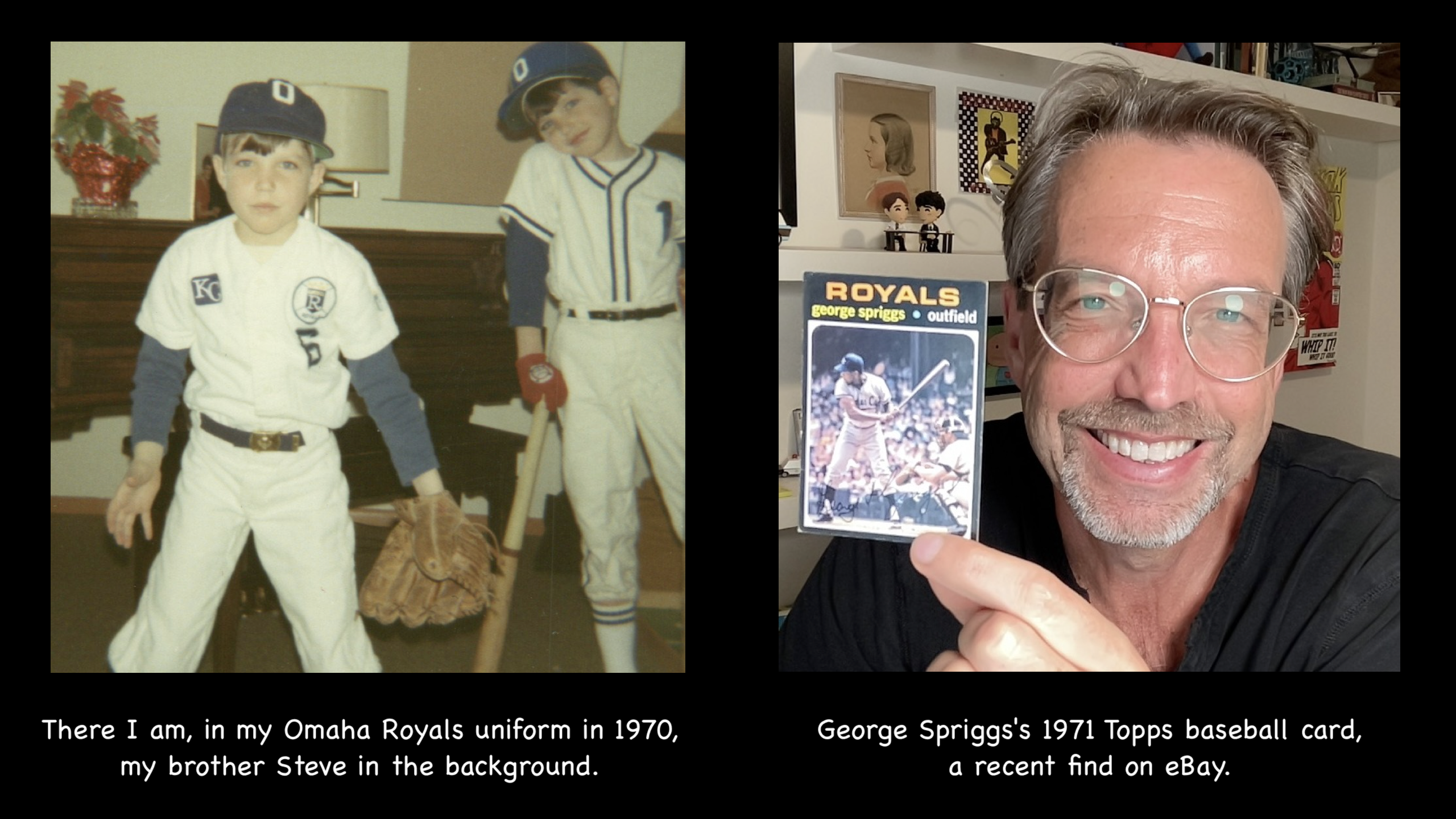
I don’t recall what made me think of George Spriggs recently but I think it had to do with reminiscing about my life in Omaha. As I often do, I was playing some songs from that time period and decided to try to create some “70’s soul ballads” on Suno, the artificial intelligence song generator that has captured my fancy for the better part of the last two years. I’ve been taking song lyrics and poems I’ve written at various points in my life and making them into songs, something that I’ve found both energizing and fulfilling.
Writing with a specific genre in mind provides me with an interesting challenge. I think I’ve been most successful with country songs, for whatever reason. But I’m such a nostalgia sap and I have a lot of warm feelings about music from the early 1970’s that I wanted to give that era a go, specifically some of the soul ballads of the time. “Midnight Train to Georgia,” “Me and Mrs Jones,” “You Make Me Feel Brand New,” and “Could it Be I’m Falling in Love” work like a time machine for me, bringing back feelings and memories from over 50 years ago. And because a couple of those years were really tough for me, punctuated by night terrors and a week-long hospitalization to try to get to the bottom of it, I think I have a need to make sense of the time.
Using Suno to create songs from different genres prompted a desire in me to come up with band names for the various styles. My country songs are “performed” by a fictional band I call Executive Estates, the name of the apartment complex in Seattle in which I lived when I started writing sappy break-up songs, perfect for country music. Two other of my “bands” are named in honor of tram stops on Line 2 in Nantes, France where my wife, daughters, and I lived for a year in 2010-11. Recteur Schmitt has an Eastern European / gypsy-punk vibe, and Motte Rouge has an alternative pop-folk feel with a female lead singer. You can find all three bands on Spotify or download some songs on Bandcamp.
Perhaps you see where this essay is going. What to name the fictional band of my new 70’s soul ballad songs, right? I got a little giddy when the idea of naming it for George Spriggs occurred to me. And given many of the songs include background singers, I decided I needed both a singer and the band in the name, you know like Gladys Knight and the Pips. So I’m pleased to announce the debut single of George Spriggs and the Omaha Royals, complete with the music video below.
END-NOTE:
I know a lot of people are understandably disturbed by AI-generated music. I’m not trying to promote it or defend it beyond saying that it brings me tremendous pleasure to create these songs. I write the lyrics and the prompts, then spend time adjusting the sound until I get what I want. The end result feels like some kind of magic to me.
 Andy Smallman