48 Card Pick-up (No Kings)

This morning, I got a funny text message from a friend of mine:

“I was watching a clip from Fox News (yes, really) where they accidentally unmuted their report of an ICE protest in Portland and an awesome AI generated disco themed song about the Epstein files is playing!”

Typical of me, I quickly offered a silly response:

“Ha! That sounds like the plot from a dream! Are you sure you’re awake?”

As I hit send on my message, I got this follow-up:

“And I thought: we need a song like that to play at our No Kings protest here, maybe Andy would write one for us!”

Challenge accepted!
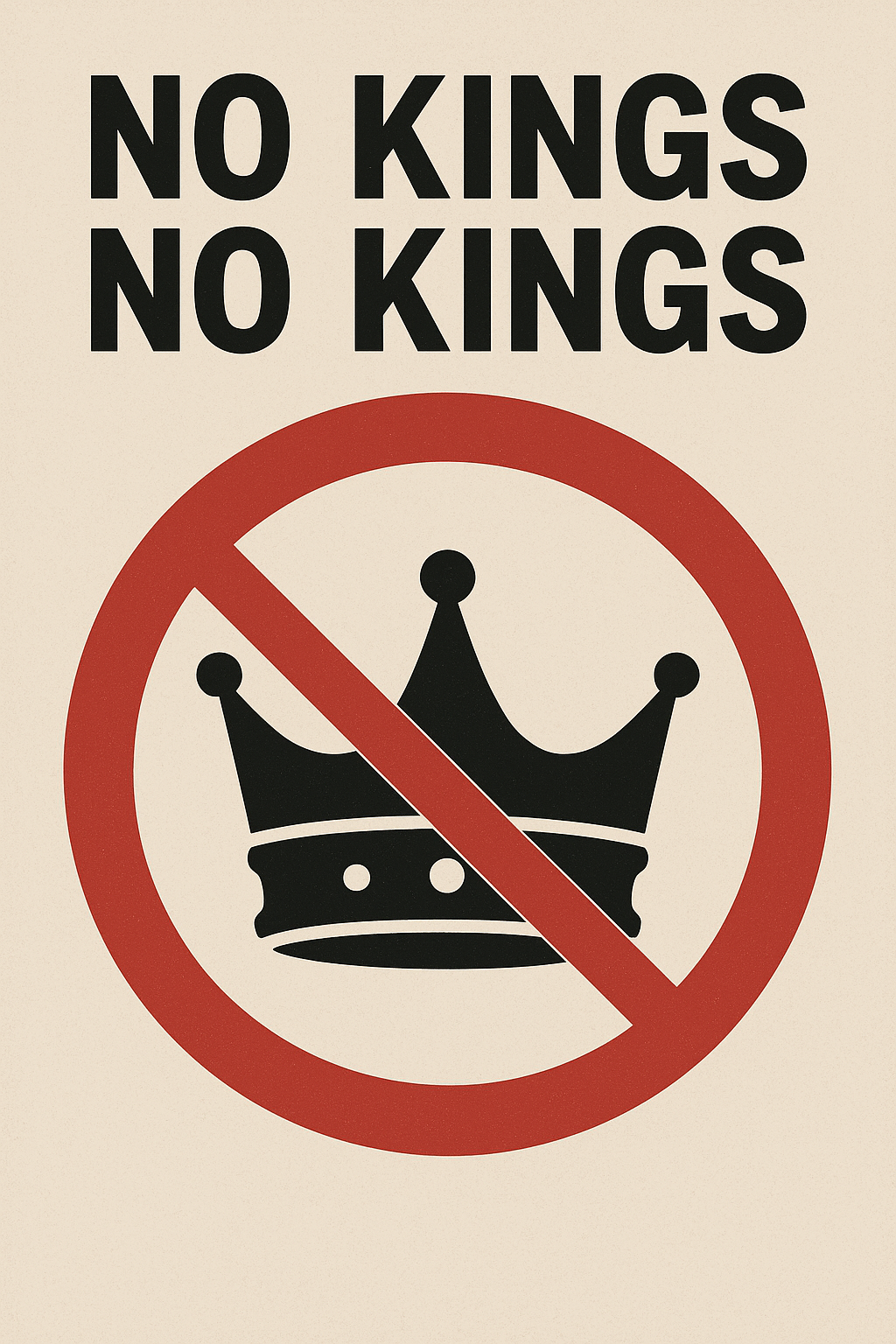
I stepped into the kitchen to fix breakfast for Senator Lloyd Bentsen From Texas (that’s the full name of Melinda’s and my maltipoo) and started thinking about what I might write. The “No Kings” concept had already planted in my head the idea of removing the four kings from a deck of cards, suggesting, perhaps, that the country wasn’t playing with a full deck. But that isn’t quite right. It’s not so much that the country isn’t playing with a full deck but, depending on one’s politics, half of the country and a number of politicians aren’t playing with a full deck.

At this point, I was breaking up Bentsen’s kibble into tiny pieces to get them ready to soak in beef broth. You see, he had dental surgery on Tuesday – 18 teeth removed – so we’re having to soften his food. He doesn’t have a lot of patience for this, especially when I’m distracted by a songwriting idea.

So distracted, I took Bentsen out to the parking strip to make room for his soon-to-be moist breakfast, if you know what I mean, and the idea of a song called “48 Card Pick-up” (52 cards minus the 4 kings) came to me. In standard 52 card pick-up, at least how I remember playing the game, you basically pinch a deck of cards so they go flying off in every direction. Once scattered, you pick them up. My idea for 48 card pick-up is you pick up, or reorganize, all the cards except the kings, getting everything in order again while leaving the kings where they’ve fallen

My creativity took off as Bentsen and I returned to the kitchen and I gave him his breakfast, along with his crushed pain pill and antibiotic. He gulped down the meal with the body language of a dog – who needs teeth, anyway, if you’re just going to swallow everything whole?

I sat down at my desk and started jotting down a few of these ideas, keeping any eye on the clock. I had a 9am meeting with 13-year-old client in California, followed by a scheduled conversation with his parents, so I wanted to capture these things before shifting my focus to the mentoring work I do on Saturday mornings. Today’s lesson with my client was on Honesty & Truthfulness, something for which I created slideshow during the pandemic. I wanted to make sure I had that all cued up so I put 48 Card Pick-up on hold.

Both my meeting with my client and the follow-up chat with his parents with his parents went long so it was about 10:30 when I got back to the song. By then, my friend who had texted me, along with her partner, had sent me several more texts, one of which was a suggestion to include something about the Epstein Files in the song.

At that point, I started to imagine how Pete Seeger might take on this assignment and typed his name into Google. I glanced through his Wikipedia page and some of the songs he helped make famous, one of which is “We Shall Overcome.” I opened a tab with the lyrics and typed “5 string banjo” at the top of my text file that at that point had nothing but my working title, “48 Card Pick-up (No Kings)” across the top.

Next, I opened a tab to NotebookLM, that’s part of Google’s AI suite and a tool I find extraordinarily helpful at condensing ideas. Notebook LM allows you to input sources – websites, random thoughts, pdfs, YouTube videos, etc. Then you enter a prompt and the AI will sort through the sources and respond to your prompt. I entered Wikipedia links to Pete Seeger and 52 Card Pickup, as well as two articles about Jeffrey Epstein, and the website to the No Kings rally. I also created a text source of my initial song ideas as I’ve summarized them above. I then prompted Notebook LM to organize the sources into an outline, highlighting overlaps between them. From the outline I got the lines “shuffle the deck” and “let the people decide” that I ultimately used in the song’s chorus.

Perhaps of interest, when writing a song lyric this way I find it helpful to start hearing some words being sung. I edited the NotebookLM outline and then uploaded it “as-is” to Suno, and used my first genre prompts:

“A protest song, children’s singalong, bouncy bluegrass, five-string banjo, upright bass”

The result was an absolute mess except for one thing. In editing the outline I had tried to create a simple chorus so my first input of words to Suno included this:

[CHORUS]
Oh, pick ’em up, pick ’em up, forty-eight cards!
We don’t need the Kings, they just stand in the yards.
Shuffle the deck, let the people decide,
A democracy built where the Kings cannot hide.

The prompts and the chorus yielded the catchy melody that you hear in the final version. And having a catchy melody allowed me to get a flowing rhythm for writing the verses and then ultimately editing the chorus.

Years ago, back in 1984 when I first started writing song lyrics, I found that the words came more easily if I could come up with a rudimentary melody. Suno provides me a more sophisticated melody and then musical accompaniment than I could ever hope to create on my own, one that helps me hear what needs to happen lyrically. And that’s what happened today.

When this happens, it’s like entering a zone or even like I’m channeling an idea from somewhere out in space. I’ve heard other people describe something similar when they’re creating something. It’s like it comes through you rather than from you. One piece of inspiration was to actually include a quote from “We Shall Overcome” in my lyric (can you find it?).

Just after noon, I had a version that I felt really good about and sent it to my friend. You can listen to that first version here. At that point, I could have been done. But once I send out a song link to someone, I click on the link and try to imagine how it might be to sit with them while they listen. And when I did that, I realized the chorus needed to be rewritten.

I had already rewritten what I had first written (remember, as inspired by the NotebookLM outline) to this:

[CHORUS]
Oh, pick ’em up, pick ’em up, forty-eight cards!
We don’t need the kings, put ’em in the discards.
Shuffle the deck, let the people decide.
No kings, no kings – that was already tried.

The “cards” and “discards” rhyme bothered me. And the 48 Card Pick-up idea, what had initially inspired the whole song while I was feeding Bentsen, really wasn’t part of this final version. But I had come up with something while writing the song’s bridge, how I could make a play on words with “The Art of the Deal” concept of the president and how I was using a deck of cards for imagery purposes. I needed a good rhyme for deal in order to have the art of the deal serve as a punchline.

I often use a lyrical bridge to enhance a point or to offer a new perspective or play on words. To get a rhyme for “deal,” I played with the “Stop the Steal” phrase that became ubiquitous with the 2020 election. I thought of “Start the Steal” as an opposite but that would give validity to the idea that the 2020 election was stolen and I didn’t want to do that. Keeping “steal” for the rhyme, I shifted focus to consider other playing card references and the concept of how in poker some cards are often announced as “wild cards” and that the king is a “face card” came to me. I knew I had the final chorus:

[CHORUS]
Shuffle the deck, let the people decide.
No kings, no kings – that was already tried.
His face card is wild, just out to steal.
No kings, no kings, that’s the art of this deal.

Having now used the best part of the bridge to complete a much improved chorus, I decided to forego writing a new bridge and set about taking what I now felt was a really good final lyric and putting it through Suno’s prompts and editing.

I had found that my original song was way too heavy on banjo (sorry, Pete Seeger) so I started using Suno’s cover feature to focus on other instruments. This takes a lot of time and tweaking, and uses a lot of the credits I pay to be able to fully use Suno. Some tweaks improved the song, some were neutral, and some didn’t work at all. What I finally liked was this set of genre prompts, covering a scaled down version of the song:

“Folk, musical hooks, male singer, alternative folk, catchy”

I recently upgraded my Suno subscription to allow me to use what they call the Suno Studio. With Studio, you basically have a recording studio at your fingertips, something that takes me back to my days at The Recording Workshop in Chillicothe, Ohio in 1983 when I learned how to record bands and mix songs on a 24 track analog console. I took my favorite version of my song and extracted the “stems,” stems being the individual instrument tracks. Then I exported a version that was just the vocal and acoustic guitar, what is kind of like a demo version.

With that version, I used Suno’s Cover feature with these genre prompts:

“children’s singalong, sparse acoustic instruments, twangy male vocal”

That’s the version I’m now promoting; in fact, I even made a simple music video of it:

“This is Not a Date!”

Turns out ‘not a date’ can last a lifetime.

Melinda, the woman who will become my wife of 35 years later this year (if we make it to December 31st still married, that is) once firmly told me, “This is not a date!” This is the story of how that happened.

  • The Setup: In September 1990, I was re-emerging into the social world after leaving a challenging job and wanted to see a concert.
  • The Cover Story: My real plan was to ask my friend Bruce’s housemate, Melinda, to a wedding later that month.
  • 💍 The Surprise: Melinda not only agreed to the wedding but also to the concert, a spontaneous trip to a racetrack, and, less than four months later, marriage.

My plan was to call my friend Bruce about seeing Nick Lowe at Bumbershoot, the Seattle music festival. This was my excuse to get an opening to ask Melinda to a wedding. As it turned out, Bruce wasn’t in town, but he put Melinda on the phone. To my surprise, she immediately agreed to go to both the concert and the wedding with me.

After the concert, as we walked and made small talk, Melinda mentioned she had recently taken up horseback riding. I had connections at Longacres racetrack and could get access to the stables, so I asked if she’d like to see the thoroughbreds sometime. Her face lit up as she asked, “When can we go?” Seizing the moment, I replied, “How about now?”

I think she suddenly realized her enthusiasm might be misinterpreted. We had just been to a concert, she had agreed to be my wedding guest, and now she’d accepted a spontaneous trip to a racetrack. She clearly felt the need to halt any romantic ideas I might be getting. With a tone that matched her words for clarity, she stated, “This is not a date!” My less-than-eloquent response was something along the lines of, “Um, okay.”

Of course, we were married less than four months later. In those three+ decades, we’ve raised two kids to adulthood, started a school, lived in France for a year, become grandparents, and spent nearly every day together.

Occasionally, I’ll ask her if we’ve had a date yet. 😉

The 57th Grade: A Half-Century of Hand-Me-Downs and Happenstance

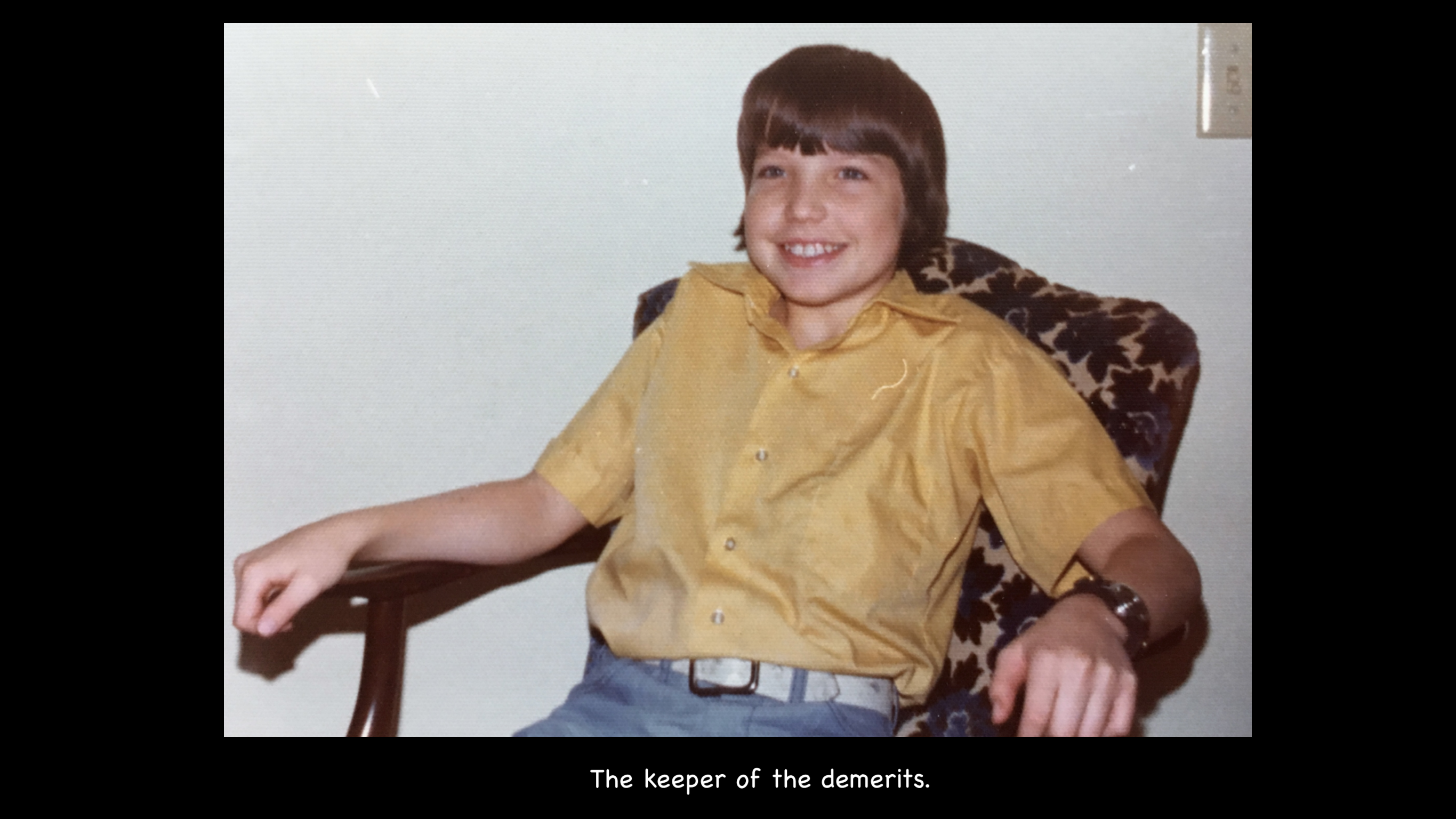
I’m pretty sure the picture on the left was taken on the first day of school in 1975, what would have been my first day of 7th grade and my very first day at Tillicum Junior High in Bellevue, WA. Stick with me while I do the math: if that was 1975 and this is 2025, well, that’s 50 years ago. By that calculation, I guess I’m now in the 57th grade, assuming I’ve not been held back (or skipped ahead, for that matter).

The picture on the right, I’m almost certain, was taken by Mrs. Martin, my 7th grade homeroom teacher. Homeroom meant having a teacher for two periods: Language Arts and Social Studies. As initially scheduled, those classes were back-to-back, periods 5 and 6 in the afternoon for me. But Tillicum had this quirky system where the class periods rotated. So depending on the day of the week, your morning classes would take place in the afternoon and vice versa. Looking back, I suppose it was meant to keep things “fresh,” maybe even based on some circadian-rhythm research. But to us kids, it mostly felt like an extra layer of confusion and stress, as if junior high didn’t already have enough of both. We’d just come from elementary school, where we basically stayed in one room with one teacher the whole day, to suddenly juggling seven classes in seven different rooms. Why not add in mixing up when the classes took place? Not to mention going to school with 9th graders, some who looked like the teachers?

So, yeah, I can just imagine the Tillicum administration saying something like, “Hey, let’s mix things up! On Tuesdays and Thursdays, we’ll put afternoon classes in the morning and morning classes in the afternoon. That ought to keep those kids sharp.”

Now, if you look closely at the picture on the right, you’ll see I’m wearing the same shirt I had on the first day of school. That makes me wonder if Mrs. Martin snapped the photo on the first day. Maybe… but I look like I’m working awfully hard for a first day, and the pencil I’m clutching is way too stubby to be a “first-day-of-school pencil,” if you know what I mean. So let’s assume it wasn’t taken on day one. That leaves us with two possibilities:
1) I really liked that shirt.
2) I only owned one shirt.

I really liked that shirt. 70’s paisley. Sign me up!

Speaking of clothes, the jacket I’m wearing in the picture on the left was handmade by my mom. She was super handy with her mint-green Singer sewing machine (which, if I remember correctly, my parents “bought” with Green Stamps back in the ’60s). The fabric design was Buffalo nickels. If you don’t know, a Buffalo nickel was a U.S. five-cent coin minted from 1913 to 1938. Since my family were collectors, we collected coins and getting a Buffalo nickel was kind of a big deal. We kept them and our other coins in those blue books where you’d press the coins into little round slots, all neatly organized by year. Half the fun was jamming the coin in without bending the cardboard. Remember those?

By the early ’70s, my brother Steve had become the main coin collector. I’d moved on to hockey cards, and our older brother Scott, well, we always said he just collected money. Not coins, not cards, just the kind you stick in a bank or invest. Steve eventually eased up on coin collecting, and I sold off my hockey cards in the early ’90s. Scott? He’s still doing a pretty good job collecting money.

You might be wondering why I’m wearing the Buffalo nickel jacket if Steve was the coin collector. Good question. The simple answer: Mom made the jacket for him. She’d sewn a hockey-themed one for me. By the time 7th grade rolled around and I needed a jacket, Steve had outgrown it, so it became a hand-me-down. Being the youngest of three boys, I got a lot of hand-me-downs. And, yes, I’m still waiting for my first “new” bike.

As for the Buffalo nickel fabric, I think Mom picked it up at a store in the old Eastgate Shopping Center in Bellevue, right next to the old Bellevue airport. The center had a Safeway where, fun fact, a pilot crashed his Cessna in 1976. There was also a drugstore called Fischer Drugs, a Dairy Queen, and I’m pretty sure a Fotomat (look it up!) in the middle of the parking lot. My dad bought his Racing Forms at a place called Lil’ Johns, and my brothers and I bowled at Sun Villa Lanes. Sometimes we even got our hair cut at Jerry’s Barbershop. Get this, Jerry was my mom’s first cousin!

I think the fabric store was called Wigwam, a name that hasn’t aged too gracefully (kind of like some old sports team names; for instance, the Seattle Mariners are playing the Cleveland Guardians as I write this – see the connection?). I liked going to Fischer Drugs as they had sports cards and candy. Wigwam, though, was a colossal bore for me back then. Add in that my mom could get lost looking at the fabric, and well, “Mom, can I go to Fischer’s and get some candy?”

Keep in mind that my dad was a candy salesman.

I think I’ve digressed. Let’s get back to 7th grade homeroom and Mrs. Martin. I really liked her as a teacher, even though she was a bit strict. I was the kind of student who could meet a teacher’s expectations, provided they were clear, and Mrs. Martin’s expectations were crystal clear. That said, I’ve been a certified teacher in Washington State for 35 years now and in retrospect, some of Mrs. Martin’s teaching strategies clash with a lot of the principles I’ve spent my career advocating.

For example, she used competition as a teaching tool, pitting classmates against each other. I remember us having spelling bees where she divided the class into two teams, one lining up on each side of the room. The person at the front of each line was given a word to spell. Spell it correctly, and you moved to the back of the line for your next turn. Spell it wrong, and you slunk back to your desk between the two lines, feeling the sting of public humiliation. The team with the last person standing was the winner

See what I mean by junior high school stress??

I was one of the last people standing during one of these epic battles and got knocked out on the word receipt. Yeah, I got the “I before E except after C” thing right, but I forgot the letter P. Give me a break, I was 12 years-old! Do YOU hear a P in the word receipt? Boy, was I humiliated when I returned to my seat, especially when a girl named Katie on the other team spelled receipt correctly. Game over. My cheeks burned.

I do have to give Mrs. Martin some credit, though. I’ve never misspelled “receipt” since that day. Not once. But seriously, at what price? Some lessons stick for life… and some stick with a little trauma attached.

As much as I think spelling bees like that are really bad teaching strategies (After all, who gets the most practice? The best spellers, of course.), Mrs. Martin did something else that was quite hard on me, specifically. For behavior management, she handed out demerits to misbehaving students. That might not sound so bad at first, though getting a demerit in front of your classmates could be pretty embarrassing. The real kicker? She didn’t keep track of them herself. Too busy teaching, she handed the job to a student.

And that student was me.

How would you like to be chosen by your homeroom teacher in 7th grade to keep tabs on your classmates? When a student distracted her or otherwise misbehaved in a way that Mrs. Martin deemed deserved a demerit, she’d turn her attention, and that of the class, to me. In a little notebook she had given me, I had to make a mark next to a kid’s name every time they got a demerit — four lines for four demerits, then a vertical line through them for the fifth, and then start over with the next group of five.

It never even occurred to me what would happen if I got a demerit. But you can bet I was on my best behavior to make sure it never happened.

I can still remember the kid who racked up the most demerits – Kurt (I’ll spare his last name for privacy, but yes, I remember it, too). Poor Kurt. So many blocks of five. It was almost like he was collecting demerits on purpose once he got started. I think many of them were for making funny noises, probably something he couldn’t control. Kurt had a talent for distraction, and apparently, for accumulating demerits.

Here’s where the story takes a wild turn. Years later, after high school (Sammamish High, if you’re keeping score at home), Kurt went to Washington State University, the same university Melinda, my wife, attended. They were there at the same time, they knew each other, and yes, they even dated. Melinda says Kurt was her first serious boyfriend. Sadly, he passed away in 1984 while on an exchange program in Sweden.

Okay, enough of the sad stuff. Let’s lighten the mood. Back in high school, Kurt, I, and a few other friends went to see the Boomtown Rats (yes, that’s a band) in Seattle on St. Patrick’s Day, 1981. What a fun night! It started with a light dinner at Debbie’s apartment in North Seattle, Debbie being my brother Steve’s girlfriend (side note – on December 30th this year, which we’ve already established is 2025, Steve and Debbie, now Deb, will be celebrating their 43rd wedding anniversary). For us high schoolers, it was a big deal because Steve and Debbie were in college and had invited us over before the concert.

I don’t remember everyone who was there, but I know for sure it included my buddies John and Marc. Pretty sure Kevin and Bruce were there too, though don’t quote me on that. After the pre-concert dinner at Debbie’s, we carpooled to the Paramount, where the show was being recorded for future radio airplay. Bob Geldof, the lead singer and main songwriter for the Boomtown Rats, cued the audience at times to get the right crowd noise.

I don’t think Geldof gave any cues to John that made him throw up halfway through the show, which scattered a few rows of concert-goers. Could I blame it on something John had eaten at Debbie’s? Let’s be honest, it wasn’t what he had eaten. It was what he drank. Well, what he drank and how much, if you get my drift. It’s become one of those stories we tell over and over. And Kurt was there. I don’t recall him getting any demerits.

Here’s an interesting twist / digression: The reason Melinda and I even know each other is because she had learned you could make a surprising amount of money working at an Alaskan cannery over the summer, enough, maybe, to cover a year of college tuition. She and a friend found out through a classified ad, maybe in The Little Nickel (a pre-Internet Craig’s List – look that up, too). Later, at a party, another guest told her they had just overheard two guys talking about the same opportunity on a Metro bus.

Melinda looked into it, and in the summer of 1982, she had the “pleasure” of hacking up salmon to prepare it for canning (to this day, the smell of canned salmon is known to cause her to behave in a way that could scatter a few rows of concert-goers at a Boomtown Rats concert). She met Kevin and Bruce at the cannery that summer. Yes, THAT Kevin and THAT Bruce, two of the people who may or may not have been at the Boomtown Rats concert a year and half earlier. And by all accounts and as wild as this sounds, Kevin and Bruce were probably the two guys the party-goer overheard on the Metro bus.

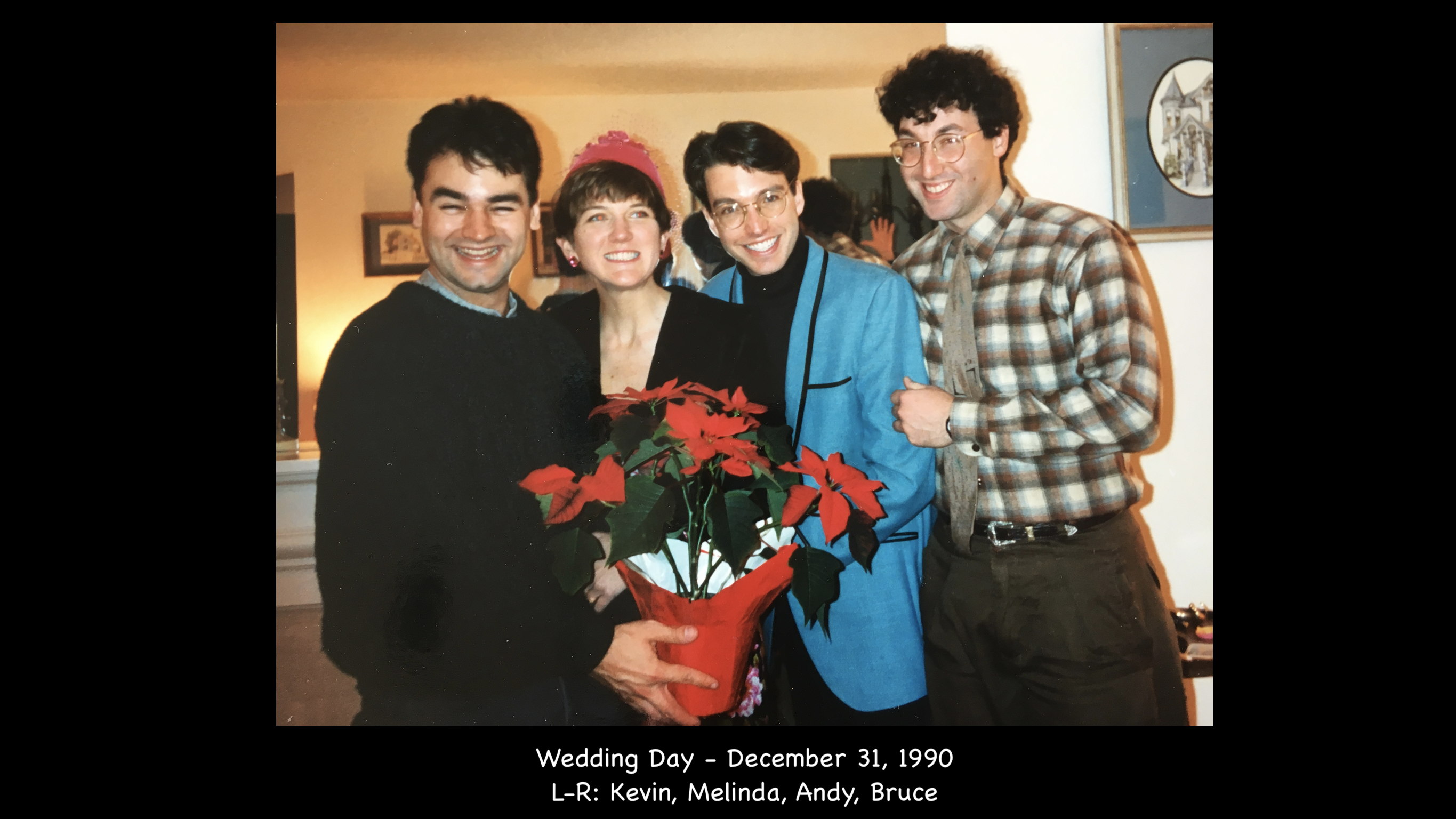
In 1984, after Kurt passed away, Kevin and Bruce helped Melinda through the early stages of her grief. Around that time, she and I met at a party, though it wasn’t until 1990 that we became, shall we say, romantically involved. On December 31, 1990, we got married. Kevin and Bruce were our witnesses.

Can we all agree that it’s a crazy world — Buffalo nickel jackets, demerits, canned salmon, and all?

So, yeah, the picture of me on the left was taken on the first day of 7th grade in 1975. And I’m pretty sure the picture on the right was taken by Mrs. Martin, my 7th grade homeroom teacher.

A Boy, a Ballplayer, and a Ballad

When I was a little boy, the youngest of three sons, my family lived in Omaha, Nebraska. That’s where I was born so 100% of my life’s experience was developed in Omaha; that is, until my father was transferred to the Seattle area a couple of months before I turned 11.

I was raised a sports fan, most specifically baseball and hockey. While my brothers and I played sports, it was more the garden variety neighborhood pick-up games than with organized teams, albeit with some exceptions. My oldest brother, Scott, played a year of Little League baseball and I played a year of organized ice hockey. Steve, the middle brother, and I played softball through Cub Scouts and we all bowled somewhat competitively.

Perhaps more than playing sports, my family enjoyed attending sporting events. Omaha wasn’t big enough for the major leagues, but we did have some really good minor league teams during the time we lived there, the 1960’s and early 1970’s. The Omaha Knights hockey team was affiliated with the New York Rangers and we saw some pretty good players and coaches begin their professional careers inside Ak-Sar-Ben Coliseum. Most notably, defenseman André Dupont and coach Fred Shero helped guide the Knights to a Central Hockey League championship before winning a couple of Stanley Cups with the Philadelphia Flyers “Broad Street Bullies” teams in the mid 1970’s.

The top farm team for major league baseball’s Kansas City Royals was in Omaha. Also called the Royals, we saw some excellent baseball players pass through on the way to the “Show,” as the big leagues is called, including future Hall-of-Famer George Brett. Outfielder Amos Otis, pitcher Paul Splittorff, and second baseman Frank White all played in Omaha before making it big as members of some solid Kansas City teams in the 1970’s and beyond. And manager Jack McKeon ended up winning over 1000 games as a big league manager after his stint in Omaha.

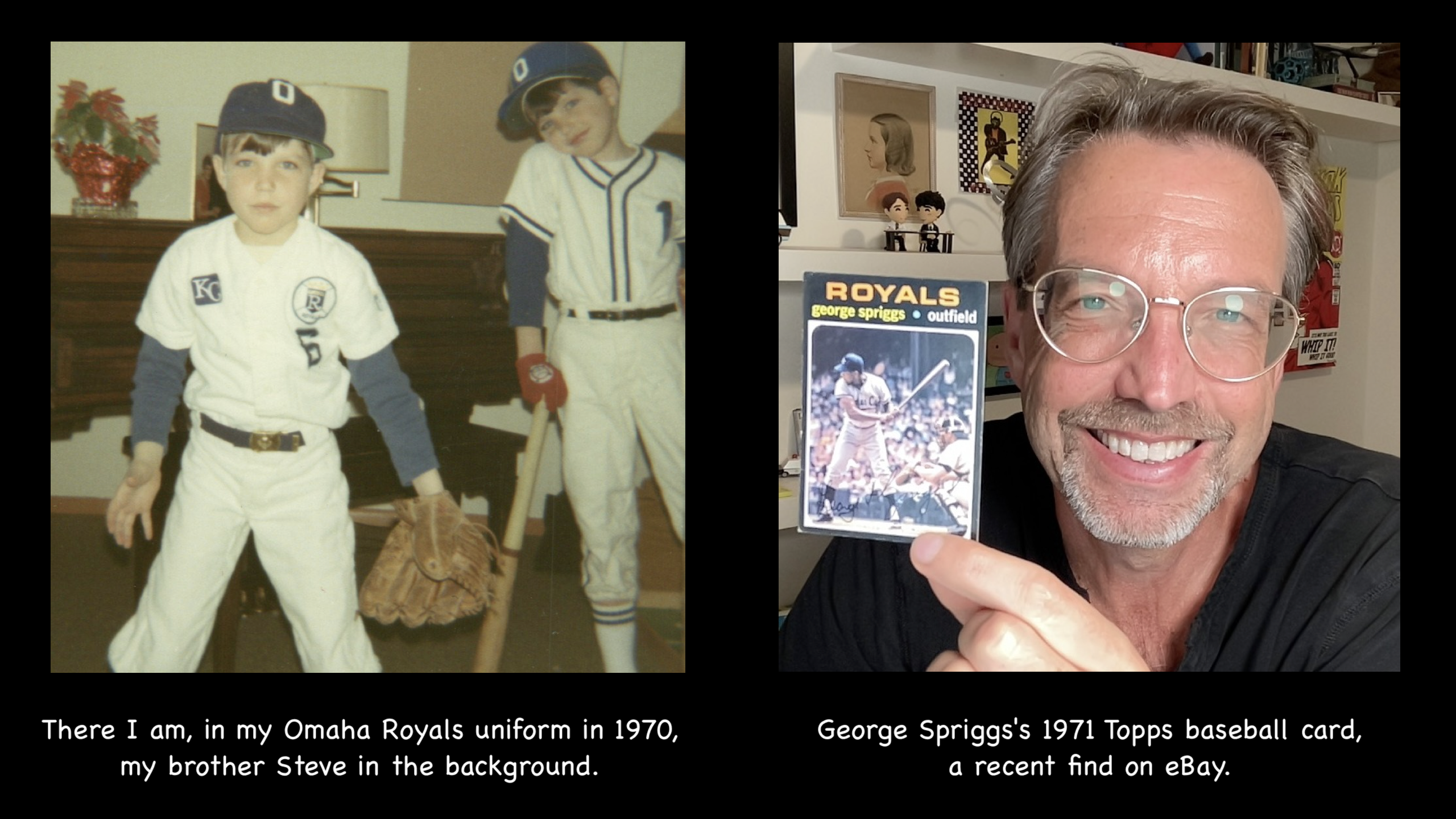
My favorite baseball player was one of the older members of the team in both 1969 and 1970, an outfielder by the name of George Spriggs. I’m not really sure why Spriggs caught my attention more than the younger guys on their way up. But if I was to make a guess, I’m pretty sure it was the way he carried himself. He just looked like a baseball player to me. He wore his socks up, making his baseball pants look baggy, which I tried to emulate when I put on my replica Omaha Royals uniform. His most notable characteristic, at least to me, was how he carried his baseball glove when jogging out to take his position in centerfield. With his hand in his glove, he somehow tucked the glove into the spot between his arm and chest, the top resting inside his armpit. Of course, that’s how I carried my glove when jogging from whatever we used as a dugout to my position in the field.

Spriggs came to the Kansas City organization from the Pittsburgh Pirates where he’d been languishing in the minor leagues. I suppose the Royals, being a new team at the time, thought he might make a good utility outfielder for them. For whatever reason, though, they sent him down to Omaha where he tore up the league in 1970. I remember him being super fast and stealing a lot of bases. He helped guide Omaha to the American Association championship that year and won the league’s Most Valuable Player award. My family was there at Rosenblatt Stadium to see a lot of those games.

We’d sit on the 3rd base side of the field and arrive early to watch the players warm-up. Looking back on it, I suppose arriving early extended my parents’ entertainment dollar, which I learned later wasn’t large. What I remember at the time was loving it, going down to the rail and calling the players’ names, hoping they’d come over to autograph our programs, gloves, or anything else we might have for them to sign. For some of the more veteran players on both the Royals and whatever team was visiting, players demoted from the majors, we’d bring their baseball cards. It was always a big achievement to get a baseball card signed.

About George Spriggs, as an adult I learned that he had played in what was the remnants of the Negro Leagues in the 1960’s. It’s well-known now that there was a time in which black players were banned from playing in the “major leagues” (I put that in quotes because the so-called Negro League teams were at least as good as the so-called Major League teams of the time). Jackie Robinson broke the “color barrier” in 1947 but due to racism and other reasons, aspects of the Negro Leagues continued on until the mid 1960’s. That’s when Spriggs played.

By the way, a well-written and heartfelt tribute to George Spriggs’s baseball career can be found here. I highly recommend it.

I don’t recall what made me think of George Spriggs recently but I think it had to do with reminiscing about my life in Omaha. As I often do, I was playing some songs from that time period and decided to try to create some “70’s soul ballads” on Suno, the artificial intelligence song generator that has captured my fancy for the better part of the last two years. I’ve been taking song lyrics and poems I’ve written at various points in my life and making them into songs, something that I’ve found both energizing and fulfilling.

Writing with a specific genre in mind provides me with an interesting challenge. I think I’ve been most successful with country songs, for whatever reason. But I’m such a nostalgia sap and I have a lot of warm feelings about music from the early 1970’s that I wanted to give that era a go, specifically some of the soul ballads of the time. “Midnight Train to Georgia,” “Me and Mrs Jones,” “You Make Me Feel Brand New,” and “Could it Be I’m Falling in Love” work like a time machine for me, bringing back feelings and memories from over 50 years ago. And because a couple of those years were really tough for me, punctuated by night terrors and a week-long hospitalization to try to get to the bottom of it, I think I have a need to make sense of the time.

Using Suno to create songs from different genres prompted a desire in me to come up with band names for the various styles. My country songs are “performed” by a fictional band I call Executive Estates, the name of the apartment complex in Seattle in which I lived when I started writing sappy break-up songs, perfect for country music. Two other of my “bands” are named in honor of tram stops on Line 2 in Nantes, France where my wife, daughters, and I lived for a year in 2010-11. Recteur Schmitt has an Eastern European / gypsy-punk vibe, and Motte Rouge has an alternative pop-folk feel with a female lead singer. You can find all three bands on Spotify or download some songs on Bandcamp.

Perhaps you see where this essay is going. What to name the fictional band of my new 70’s soul ballad songs, right? I got a little giddy when the idea of naming it for George Spriggs occurred to me. And given many of the songs include background singers, I decided I needed both a singer and the band in the name, you know like Gladys Knight and the Pips. So I’m pleased to announce the debut single of George Spriggs and the Omaha Royals, complete with the music video below.

END-NOTE:
I know a lot of people are understandably disturbed by AI-generated music. I’m not trying to promote it or defend it beyond saying that it brings me tremendous pleasure to create these songs. I write the lyrics and the prompts, then spend time adjusting the sound until I get what I want. The end result feels like some kind of magic to me.

France 2017 (From the Archives)

I often use this blog as a memory jog and one of my favorite “jogs” is to review Melinda’s and my trips to France. Melinda left PSCS in June of 2017 and that summer we took what we intended to be our annual trip to France

The idea of an annual trip to France got blown up in 2018, the year I left PSCS. Instead, we moved to the Bay Area and stayed there until 2019. We came back to Seattle and bought a little fixer-upper house. But we really hadn’t made any money over those 12 months. And living on savings and then buying a house that needed a LOT of work, well, annual trips to France were out. Besides, in 2020 there was a little thing called a global pandemic…

Still, all was quite innocent during the summer of 2017 and Melinda & I made our annual trip to France. This trip included some extended time in Amsterdam with Christine & Bérnard, celebrating Bérnard’s parents’ 60th anniversary in Normandy, and lots of fun times with Laurent & Frédérique. One downside was that my beloved tram line in Nantes, Line 2, was closed in our old neighborhood. To help me cope, Bérnard took me dumpster diving to find some Line 2 souvenirs to bring home.

To easily see all the posts from 2017 in reverse order, click this link.

France 2016 (From the Archives)

Since we had taken two trips to France in 2014, one during the summer and one in December to celebrate Ella’s 18th birthday, we didn’t make a trip in 2015.

In London, 2016.
So Melinda’s and my next return to see our friends in Nantes was in 2016. This time, to do something different, we flew in and out of London, staying for a few days both times. It was my first ever time in England and I thought it was fabulous. Even though we weren’t in France, I tagged the days we were in London with the “France 2016” moniker so they will appear when you click the link below.

While in Nantes, we rented a house in the neighborhood in which we lived during the sabbatical year, just a couple of blocks from the Bertail’s. Part of what I loved about this decision is that it put us on the same tram line (Ligne 2) that I fell in love with when we were there initially in 2010-11. It also put me in close proximity of the Nantes racetrack (the hippodrome) which is where I began running in 2011. Each morning, I’d get up and go for a jog from our house over to and around the track, plus anywhere else that suited my fancy.

Also, this was another one of those trips that consisted of just Melinda and me. While we missed having the girls with us, there was something liberating about traveling “sans enfants.”

To easily see the posts from 2016, click this link.

France – Winter 2014/15 (From the Archives)

Here’s another one of those posts designed to take the dedicated reader (I think I mean myself) back in time to revisit my family’s various trips to France. This time, the blog time machine is taking us to December 2014/January 2015 when we returned to celebrate Ella’s 18th birthday.

It’s fun to visit a familiar place at a different time of year, especially one in which you’ve experienced all four seasons. Because of our work responsibilities with a school, returning in the summer was fairly straightforward. Going in December, even over winter break, required a little more coordinating.

We began this trip in Paris which is where we celebrated Ella’s 18th, much as we had done in 2011 for Chloe’s 18th birthday. What an experience – to be able to celebrate both girls’ 18th birthdays in Paris!

We also had both the Boudeaus and Bertails visit us in Paris before we all gathered back in Nantes. This time around, Melinda & I rented a wildly cool apartment inside the Passage Pommeraye in the center of Nantes. Having access to this place allowed us to show off some hidden Nantes treasures to our friends.

To see the posts from this trip, please click here.

France 2014 (From the Archives)

Last spring, I started adding posts that included links to Melinda’s and my return trips to France, something we vowed to do each year after our brilliant sabbatical year of 2010-11. I got away from that and am committed to getting back to it. So, yes, in the summer of 2014, we again returned to France with Ella and, um, a girl named Chloe*.

Boudeau Pool in Nantes, 2014
But not our Chloe.

Ella’s best chum in high school happened to be named Chloe* so back in 2014 I joked that Chloe*, Ella, Melinda, and I were returning to France. But I added an asterisk next to Chloe’s* name to indicate that this Chloe* needed a footnote.

Pretty soon, I just called her asterisk.

The trip includes an extended trip to Normandy and the WWII beaches for anyone interested in this kind of history. To see all the posts from this summer trip to France in 2014, use this link.

* not our Chloe

Focusing Our Attention on the Profound

(I’m reviewing articles I’ve written for my professional website, narrowing them down to some favorites. Here’s the first, which focuses on a life lesson I received from a respected teacher and try to pass along to some of my students who I think might appreciate it.)

I’ve often told my students an allegory that was told to me by one of my most important teachers when I was a young adult, the story of two people walking at dawn one morning, the rising sun at their backs. One paused and turned to look at the beautiful sunrise, awed by its beauty. Wanting to share it, he tapped the shoulder of his friend, who turned to look and was equally awed.

I invite my students to stop and consider this story, to contemplate it for its meaning or meanings. One comes from recognizing the important role we have to help those in our lives be aware of meaningful things.

Related to that, however, is the truth that try as we might, we can never MAKE another person be aware of something. We may WANT to share things with others, but they still have to turn, literally and/or metaphorically, to see them. THEY have to do the physical and mental work.

If my students get to that understanding, I’m pleased.

As I’ve gotten older, interestingly, I’ve found what has become an even bigger lesson for me from this story. It’s that we all are being tapped on our shoulders all the time. Every second of every day, we are being offered the opportunity to see meaningful things.

Many of us wonder who or what does what I’m calling this shoulder-tapping. Call it Source, or Light, or Intelligence, or God, or some other name. For my purposes, though, putting a name to what taps us is not the most important thing.

What’s important is to recognize that we are being tapped and to practice focusing our attention. In other words, I have the responsibility to do the physical and mental work, to turn and look, so to speak.

As I’ve gained experience doing this, I’ve learned that there is discipline involved in the practice. Undisciplined, my attention is drawn to all sorts of things — negative news stories, certain uses of social media, drama from the sports world — each of which distracts me from what is actually meaningful.

I sometimes even fool myself into believing the distracting things are important.

Disciplined, I learn to see the difference between the distracting and the divine, between the pointless and the profound. In time, I find that I’ve started to internally filter out the things that distract me, which better enables me to gently focus on the divine and the profound.

Like a sunrise.

France 2013 (From the Archives)

So as I mentioned in previous posts, toward the end of our sabbatical year, back in the early summer of 2011, Melinda and I began dreaming of the idea of returning to France, and specifically to Nantes, for the better part of a month each summer. We worked out the details at PSCS to make this happen and in 2012 we returned with Chloe and Ella, as summarized in my previous post.

In 2013, Melinda and I returned to Nantes without the girls. At age 20 and 16, they kinda liked the idea of having time by themselves in our Seattle house.

How odd…

While not having the girls with us provided a lot more flexibility, I’d hate to suggest that we didn’t miss them. To be honest, some nine years later, I don’t really remember missing them. I do remember posting on the blog little tests for them, cryptic photos of places in Nantes that I invited them to identify. So clearly, I was thinking about them…

The point that really felt different without the girls is when Melinda and I spent extended time in Paris, just the two of us. That was, indeed, a glorious time.

To gain easy access to all the posts from our 2013 trip, use the France 2013 tag or, even easier, click here.