
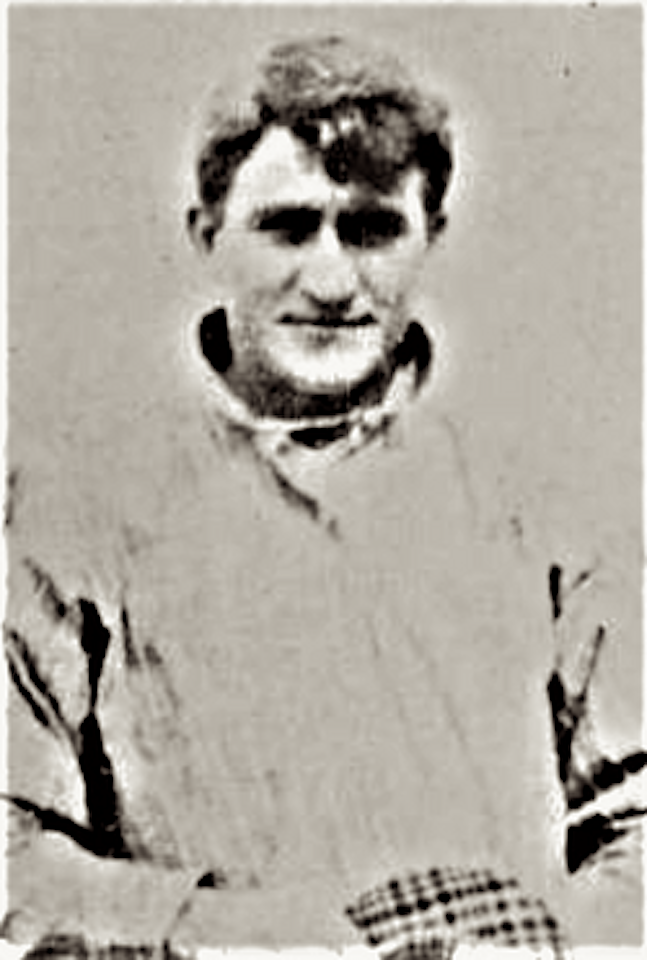
 Clifford Lane was born in Crystal, North Dakota, on April 25, 1893, and died near Gesnes, France, on September 29, 1918, one of 53,402 Americans killed in action during World War I. His obituary states:
“Private Lane acted as a message carrier, and it was while performing this duty that he was killed by shell fire on the 29th of September at Gesnes, France.”
Clifford was Melinda’s great-granduncle, the brother of Mattie Lane Erlandson, who was the mother of Melinda’s maternal grandmother. On this Memorial Day 2026, I want to take a moment to honor his life and sacrifice.
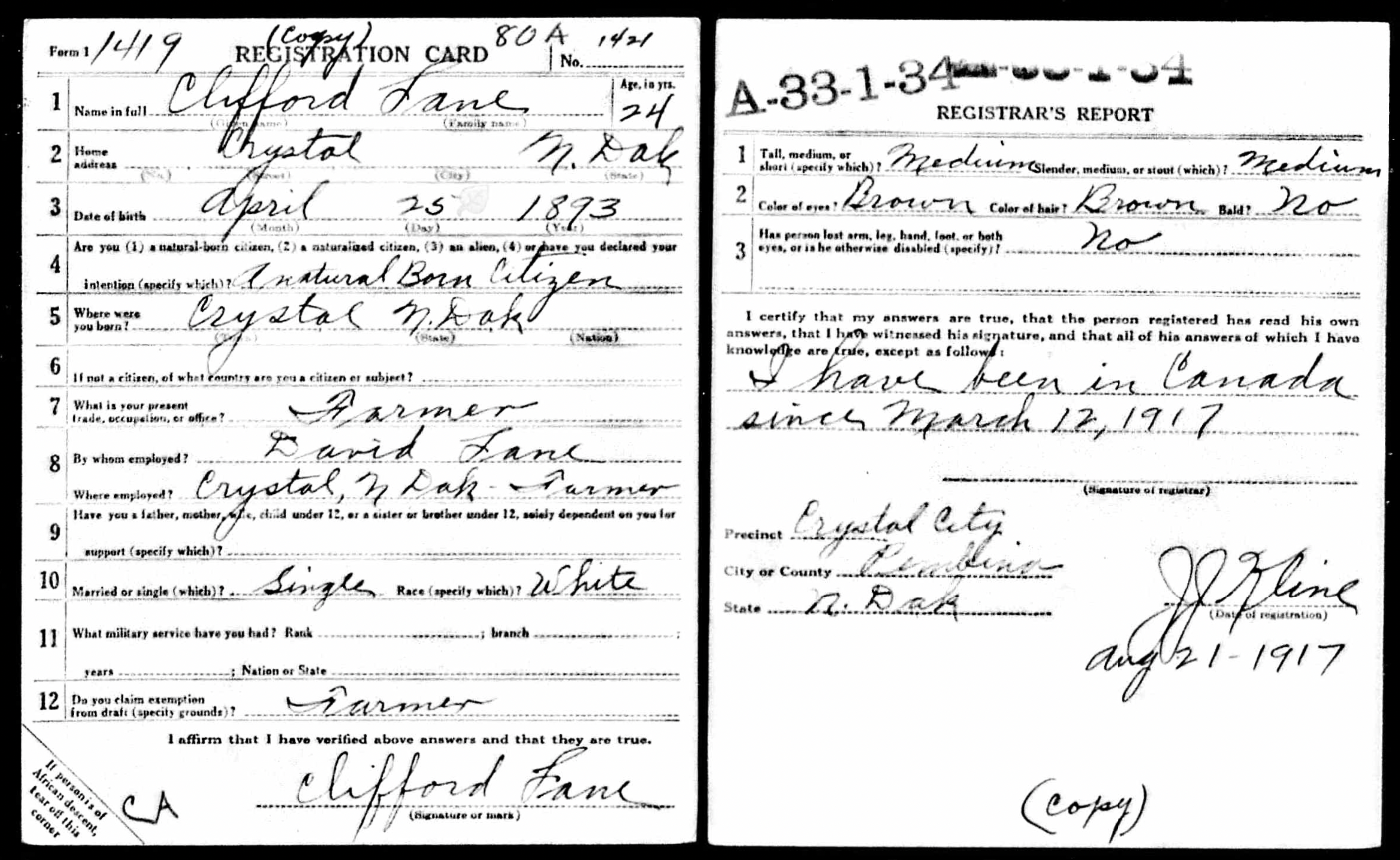
Before being drafted, Clifford spent nearly his entire life working on his father David Lane’s farm near Crystal. He registered for the draft there on August 21, 1917, entered military service on May 27, 1918, and trained at Camp Lewis, Washington (present-day Joint Base Lewis–McChord south of Tacoma). He was assigned to Company A, 362nd Infantry Regiment, 91st Division, and after only a short period of training sailed for France in July 1918 with the American Expeditionary Forces.
During World War I, Clifford served as a message carrier, one of the Army’s most dangerous and important assignments. Before reliable portable radios, armies relied on runners to carry orders and battlefield reports between commanders and front-line units. Telephone lines were often destroyed by shellfire, making message carriers essential during combat. These soldiers moved on foot through trenches, mud, smoke, and open ground under machine-gun and artillery fire. Entire attacks could depend on whether a runner successfully delivered orders or requests for reinforcements. Because they constantly crossed exposed terrain while battles raged around them, message carriers faced extraordinary risks and were regarded among the bravest soldiers in the infantry.
Clifford was killed during the Meuse-Argonne Offensive, the largest and deadliest American operation of World War I. Beginning on September 26, 1918, more than one million American troops attacked heavily fortified German positions in northeastern France. Clifford’s regiment fought near the village of Gesnes, where German forces held strong defensive positions protected by machine guns, artillery, and barbed wire. By September 29, conditions had become especially brutal. Rain and mud slowed movement, communication lines were repeatedly destroyed, and American troops suffered heavy casualties advancing across open ground under constant fire. Despite these conditions, the 362nd Infantry captured portions of the ridge beyond Gesnes at severe cost. It was during this intense fighting that Clifford lost his life near the front lines.
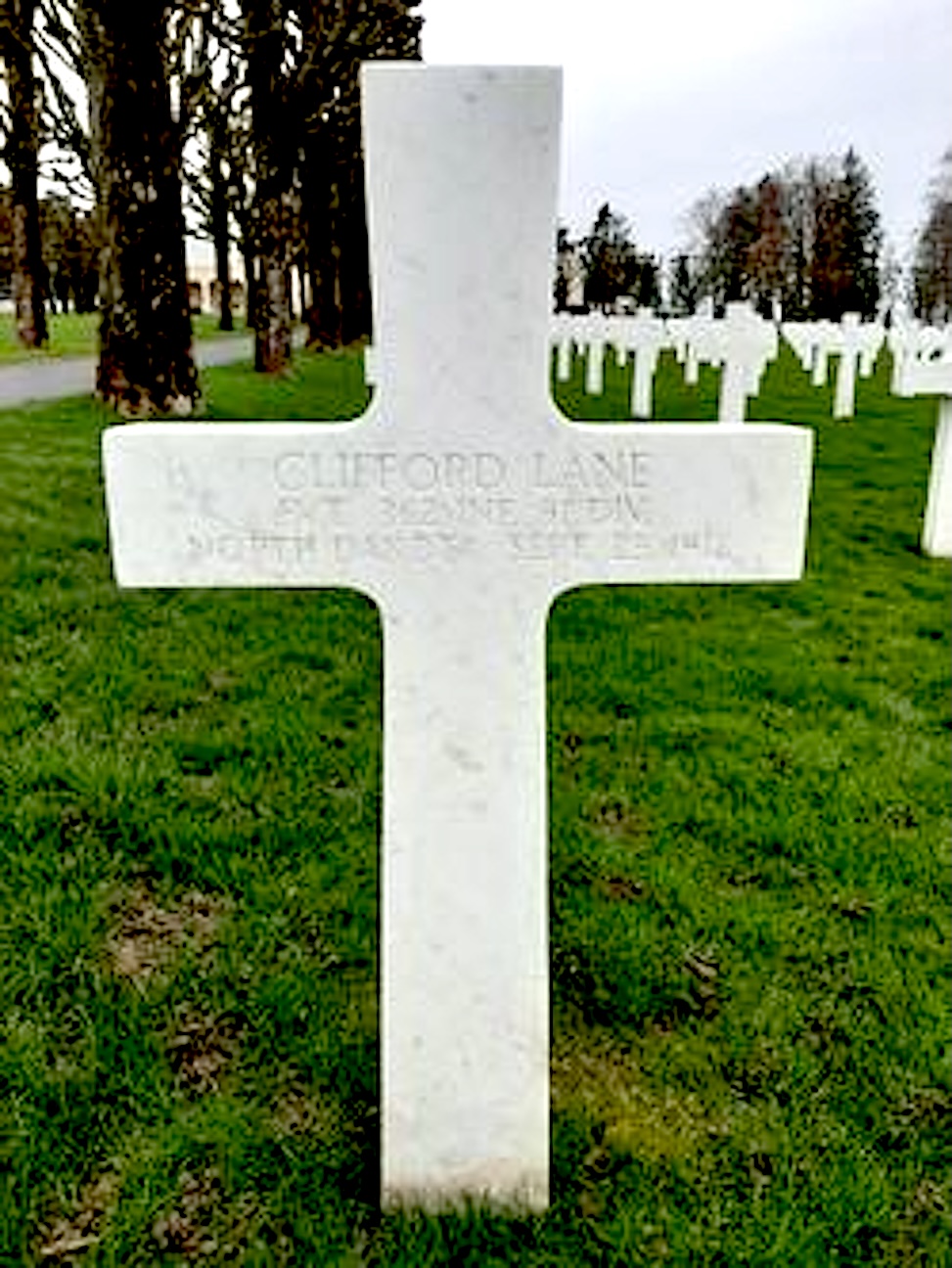
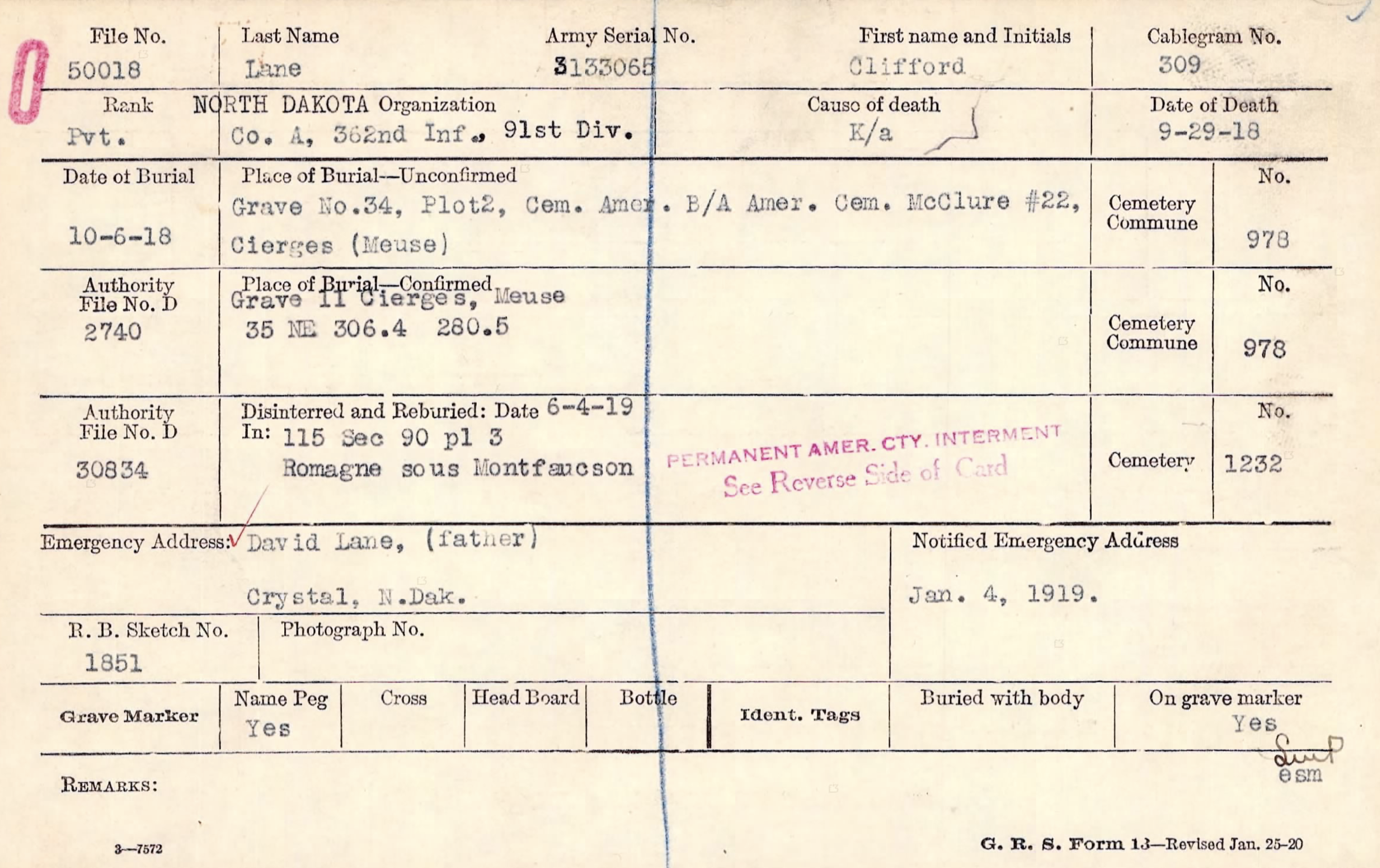
After the battle, Clifford’s body was recovered near Gesnes and buried in an American cemetery at Cierges, France, on October 6, 1918, only a week after his death. Graves Registration records show that he was positively identified and buried in a marked grave, something that was not always possible amid the chaos of the Meuse-Argonne campaign. In June 1919, his remains were moved to the larger cemetery at Romagne-sous-Montfaucon, and on November 19, 1921, he was permanently reburied in the Meuse-Argonne American Cemetery, where he rests today among more than 14,000 American soldiers. The cemetery remains the largest American military cemetery in Europe.
For those interested in the family connection: David and Mary Ellen’s daughter, Martha Evelyn “Mattie” Lane Erlandson, was born on December 29, 1889. Known as “Mom Erlandson,” she married John Erlandson on October 26, 1910. Their daughter, Janet Erlandson Stangl, was born on February 6, 1911, and married Leslie Stangl on June 17, 1934. Janet and Les had two daughters, Michele and Margo. Michele married Dwight Shaw in 1958 and is Melinda’s mother.

