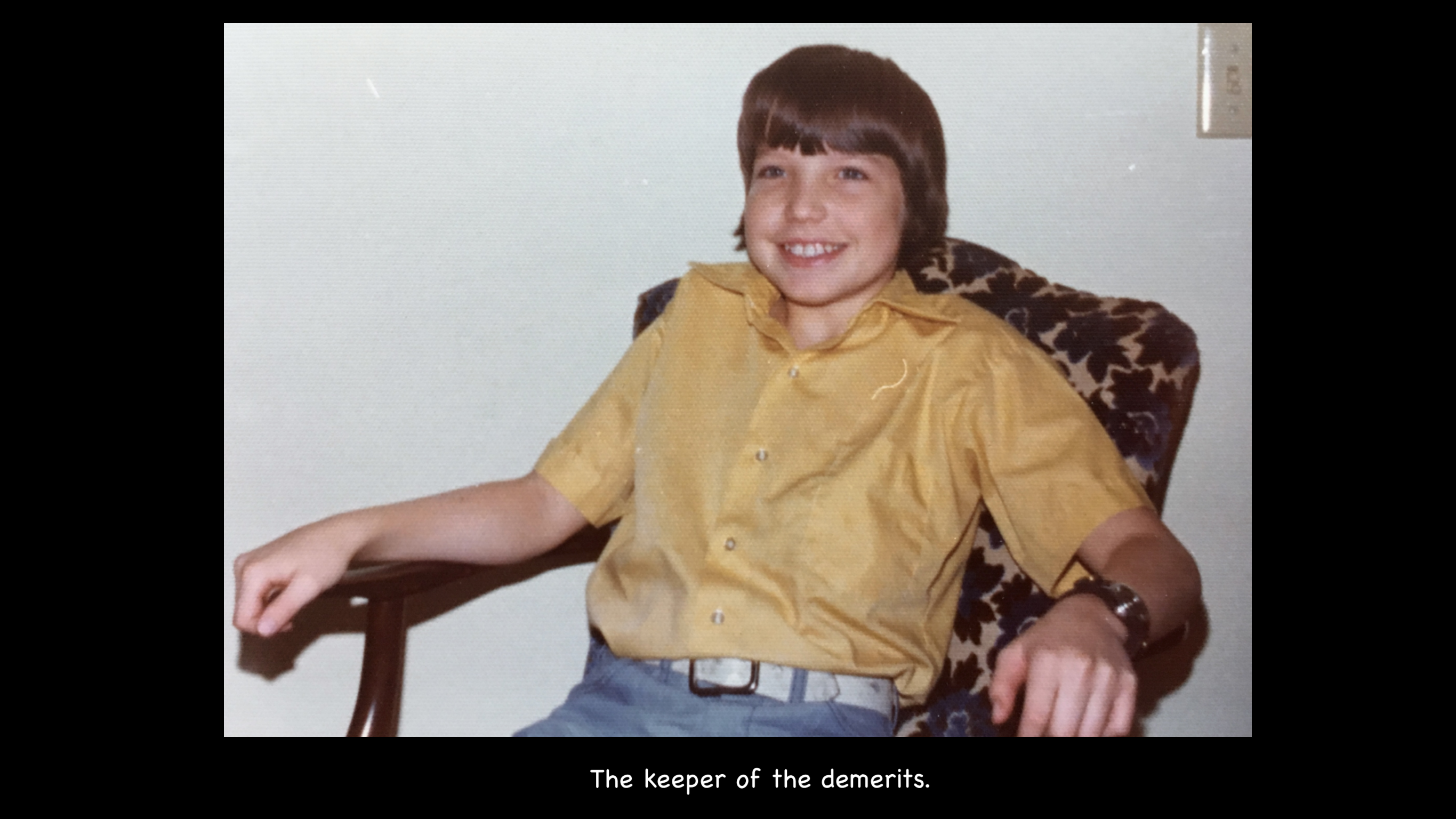
I’m pretty sure the picture on the left was taken on the first day of school in 1975, what would have been my first day of 7th grade and my very first day at Tillicum Junior High in Bellevue, WA. Stick with me while I do the math: if that was 1975 and this is 2025, well, that’s 50 years ago. By that calculation, I guess I’m now in the 57th grade, assuming I’ve not been held back (or skipped ahead, for that matter).
The picture on the right, I’m almost certain, was taken by Mrs. Martin, my 7th grade homeroom teacher. Homeroom meant having a teacher for two periods: Language Arts and Social Studies. As initially scheduled, those classes were back-to-back, periods 5 and 6 in the afternoon for me. But Tillicum had this quirky system where the class periods rotated. So depending on the day of the week, your morning classes would take place in the afternoon and vice versa. Looking back, I suppose it was meant to keep things “fresh,” maybe even based on some circadian-rhythm research. But to us kids, it mostly felt like an extra layer of confusion and stress, as if junior high didn’t already have enough of both. We’d just come from elementary school, where we basically stayed in one room with one teacher the whole day, to suddenly juggling seven classes in seven different rooms. Why not add in mixing up when the classes took place? Not to mention going to school with 9th graders, some who looked like the teachers?
So, yeah, I can just imagine the Tillicum administration saying something like, “Hey, let’s mix things up! On Tuesdays and Thursdays, we’ll put afternoon classes in the morning and morning classes in the afternoon. That ought to keep those kids sharp.”
Now, if you look closely at the picture on the right, you’ll see I’m wearing the same shirt I had on the first day of school. That makes me wonder if Mrs. Martin snapped the photo on the first day. Maybe… but I look like I’m working awfully hard for a first day, and the pencil I’m clutching is way too stubby to be a “first-day-of-school pencil,” if you know what I mean. So let’s assume it wasn’t taken on day one. That leaves us with two possibilities:
1) I really liked that shirt.
2) I only owned one shirt.
I really liked that shirt. 70’s paisley. Sign me up!
Speaking of clothes, the jacket I’m wearing in the picture on the left was handmade by my mom. She was super handy with her mint-green Singer sewing machine (which, if I remember correctly, my parents “bought” with Green Stamps back in the ’60s). The fabric design was Buffalo nickels. If you don’t know, a Buffalo nickel was a U.S. five-cent coin minted from 1913 to 1938. Since my family were collectors, we collected coins and getting a Buffalo nickel was kind of a big deal. We kept them and our other coins in those blue books where you’d press the coins into little round slots, all neatly organized by year. Half the fun was jamming the coin in without bending the cardboard. Remember those?
By the early ’70s, my brother Steve had become the main coin collector. I’d moved on to hockey cards, and our older brother Scott, well, we always said he just collected money. Not coins, not cards, just the kind you stick in a bank or invest. Steve eventually eased up on coin collecting, and I sold off my hockey cards in the early ’90s. Scott? He’s still doing a pretty good job collecting money.
You might be wondering why I’m wearing the Buffalo nickel jacket if Steve was the coin collector. Good question. The simple answer: Mom made the jacket for him. She’d sewn a hockey-themed one for me. By the time 7th grade rolled around and I needed a jacket, Steve had outgrown it, so it became a hand-me-down. Being the youngest of three boys, I got a lot of hand-me-downs. And, yes, I’m still waiting for my first “new” bike.
As for the Buffalo nickel fabric, I think Mom picked it up at a store in the old Eastgate Shopping Center in Bellevue, right next to the old Bellevue airport. The center had a Safeway where, fun fact, a pilot crashed his Cessna in 1976. There was also a drugstore called Fischer Drugs, a Dairy Queen, and I’m pretty sure a Fotomat (look it up!) in the middle of the parking lot. My dad bought his Racing Forms at a place called Lil’ Johns, and my brothers and I bowled at Sun Villa Lanes. Sometimes we even got our hair cut at Jerry’s Barbershop. Get this, Jerry was my mom’s first cousin!
I think the fabric store was called Wigwam, a name that hasn’t aged too gracefully (kind of like some old sports team names; for instance, the Seattle Mariners are playing the Cleveland Guardians as I write this – see the connection?). I liked going to Fischer Drugs as they had sports cards and candy. Wigwam, though, was a colossal bore for me back then. Add in that my mom could get lost looking at the fabric, and well, “Mom, can I go to Fischer’s and get some candy?”
Keep in mind that my dad was a candy salesman.
I think I’ve digressed. Let’s get back to 7th grade homeroom and Mrs. Martin. I really liked her as a teacher, even though she was a bit strict. I was the kind of student who could meet a teacher’s expectations, provided they were clear, and Mrs. Martin’s expectations were crystal clear. That said, I’ve been a certified teacher in Washington State for 35 years now and in retrospect, some of Mrs. Martin’s teaching strategies clash with a lot of the principles I’ve spent my career advocating.
For example, she used competition as a teaching tool, pitting classmates against each other. I remember us having spelling bees where she divided the class into two teams, one lining up on each side of the room. The person at the front of each line was given a word to spell. Spell it correctly, and you moved to the back of the line for your next turn. Spell it wrong, and you slunk back to your desk between the two lines, feeling the sting of public humiliation. The team with the last person standing was the winner
See what I mean by junior high school stress??
I was one of the last people standing during one of these epic battles and got knocked out on the word receipt. Yeah, I got the “I before E except after C” thing right, but I forgot the letter P. Give me a break, I was 12 years-old! Do YOU hear a P in the word receipt? Boy, was I humiliated when I returned to my seat, especially when a girl named Katie on the other team spelled receipt correctly. Game over. My cheeks burned.
I do have to give Mrs. Martin some credit, though. I’ve never misspelled “receipt” since that day. Not once. But seriously, at what price? Some lessons stick for life… and some stick with a little trauma attached.
As much as I think spelling bees like that are really bad teaching strategies (After all, who gets the most practice? The best spellers, of course.), Mrs. Martin did something else that was quite hard on me, specifically. For behavior management, she handed out demerits to misbehaving students. That might not sound so bad at first, though getting a demerit in front of your classmates could be pretty embarrassing. The real kicker? She didn’t keep track of them herself. Too busy teaching, she handed the job to a student.
And that student was me.
How would you like to be chosen by your homeroom teacher in 7th grade to keep tabs on your classmates? When a student distracted her or otherwise misbehaved in a way that Mrs. Martin deemed deserved a demerit, she’d turn her attention, and that of the class, to me. In a little notebook she had given me, I had to make a mark next to a kid’s name every time they got a demerit — four lines for four demerits, then a vertical line through them for the fifth, and then start over with the next group of five.
It never even occurred to me what would happen if I got a demerit. But you can bet I was on my best behavior to make sure it never happened.
I can still remember the kid who racked up the most demerits – Kurt (I’ll spare his last name for privacy, but yes, I remember it, too). Poor Kurt. So many blocks of five. It was almost like he was collecting demerits on purpose once he got started. I think many of them were for making funny noises, probably something he couldn’t control. Kurt had a talent for distraction, and apparently, for accumulating demerits.
Here’s where the story takes a wild turn. Years later, after high school (Sammamish High, if you’re keeping score at home), Kurt went to Washington State University, the same university Melinda, my wife, attended. They were there at the same time, they knew each other, and yes, they even dated. Melinda says Kurt was her first serious boyfriend. Sadly, he passed away in 1984 while on an exchange program in Sweden.
Okay, enough of the sad stuff. Let’s lighten the mood. Back in high school, Kurt, I, and a few other friends went to see the Boomtown Rats (yes, that’s a band) in Seattle on St. Patrick’s Day, 1981. What a fun night! It started with a light dinner at Debbie’s apartment in North Seattle, Debbie being my brother Steve’s girlfriend (side note – on December 30th this year, which we’ve already established is 2025, Steve and Debbie, now Deb, will be celebrating their 43rd wedding anniversary). For us high schoolers, it was a big deal because Steve and Debbie were in college and had invited us over before the concert.
I don’t remember everyone who was there, but I know for sure it included my buddies John and Marc. Pretty sure Kevin and Bruce were there too, though don’t quote me on that. After the pre-concert dinner at Debbie’s, we carpooled to the Paramount, where the show was being recorded for future radio airplay. Bob Geldof, the lead singer and main songwriter for the Boomtown Rats, cued the audience at times to get the right crowd noise.
I don’t think Geldof gave any cues to John that made him throw up halfway through the show, which scattered a few rows of concert-goers. Could I blame it on something John had eaten at Debbie’s? Let’s be honest, it wasn’t what he had eaten. It was what he drank. Well, what he drank and how much, if you get my drift. It’s become one of those stories we tell over and over. And Kurt was there. I don’t recall him getting any demerits.
Here’s an interesting twist / digression: The reason Melinda and I even know each other is because she had learned you could make a surprising amount of money working at an Alaskan cannery over the summer, enough, maybe, to cover a year of college tuition. She and a friend found out through a classified ad, maybe in The Little Nickel (a pre-Internet Craig’s List – look that up, too). Later, at a party, another guest told her they had just overheard two guys talking about the same opportunity on a Metro bus.
Melinda looked into it, and in the summer of 1982, she had the “pleasure” of hacking up salmon to prepare it for canning (to this day, the smell of canned salmon is known to cause her to behave in a way that could scatter a few rows of concert-goers at a Boomtown Rats concert). She met Kevin and Bruce at the cannery that summer. Yes, THAT Kevin and THAT Bruce, two of the people who may or may not have been at the Boomtown Rats concert a year and half earlier. And by all accounts and as wild as this sounds, Kevin and Bruce were probably the two guys the party-goer overheard on the Metro bus.
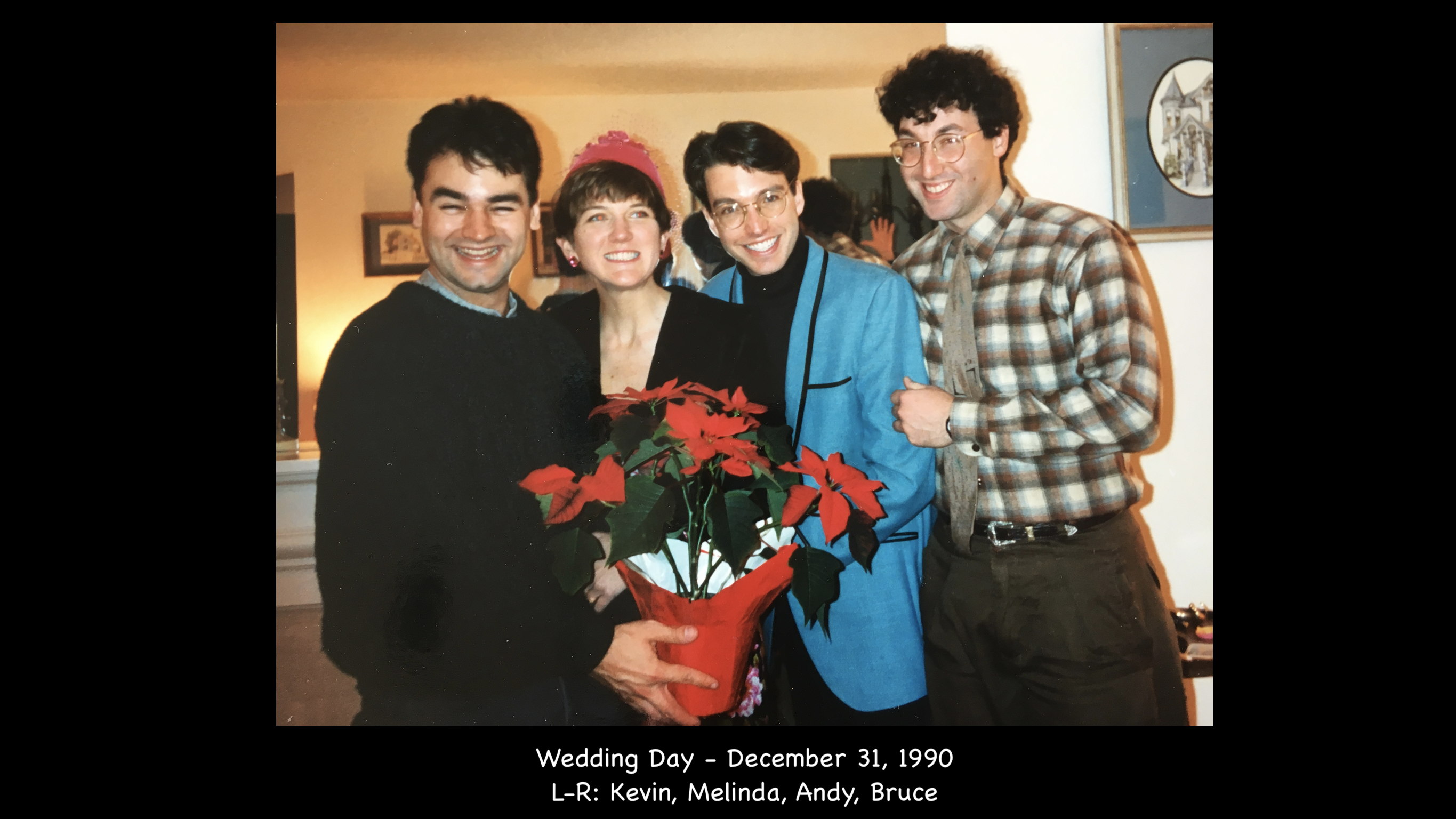
In 1984, after Kurt passed away, Kevin and Bruce helped Melinda through the early stages of her grief. Around that time, she and I met at a party, though it wasn’t until 1990 that we became, shall we say, romantically involved. On December 31, 1990, we got married. Kevin and Bruce were our witnesses.
Can we all agree that it’s a crazy world — Buffalo nickel jackets, demerits, canned salmon, and all?
So, yeah, the picture of me on the left was taken on the first day of 7th grade in 1975. And I’m pretty sure the picture on the right was taken by Mrs. Martin, my 7th grade homeroom teacher.
I’m the principal of a small school in Seattle called Spring Academy. Spring Academy serves students who, for a wide variety of reasons, have needs and/or circumstances that made things more challenging for them within a mainstream school. At Spring, we focus on building a compassionate school setting and providing the students personalized attention, thus allowing them to succeed in high school.
This past week we held our graduation ceremony and, as principal, it was my job to both facilitate the ceremony, which involved introducing the staff and addressing the graduates and their families. After personalizing the staff introductions, I addressed the graduates, of which there were five, as follows:
Here we are. You’ve done it. High school is complete. You’re finished with classes – well, you are welcome to come tomorrow, it is the last day of school, you know. Show of hands, who’s coming? No one?
Okay, you’re done. You’re about to get your high school diplomas! Whoo-hoo, right?! It feels like an ending, doesn’t it? A wrap-up. Your birthday and all the presents have been opened. Finished. You’re done.
But look at the name of this ceremony. Have you ever thought about it, the actual name of a graduation ceremony? It’s not called an ending or a termination. It’s called a commencement. Just what does that mean?
A commencement means a beginning.
This isn’t just a difference in words; it’s a powerful difference in perspective. It invites us to think about how we move through life – are we primarily moving away from something, or are we moving toward something?
Really, think about it. Moving away from something is often driven by fear, by the need to retreat. Sometimes, this is necessary – getting out of a dangerous situation, for example. But as a constant way of being, moving away can feel uncertain, heavy, and draining.
It’s an energy of retreat.
In contrast, moving toward something – a goal, a dream, a curiosity, a passion – is an act of active engagement. It brings energy, hope, excitement, and purpose. It’s like moving with a light guiding you. Moving toward something you believe in, something that inspires you, is an act of bringing positive energy into the world.
You might even call it a form of love.
Today is not just about moving away from the structure of high school. It is fundamentally about what you will choose to move toward next.
As you step out from here, into whatever comes next, I encourage you to find something to move toward. It doesn’t have to be a perfectly clear, lifelong plan. It can be a subject you want to learn more about, a skill you want to develop, a cause you believe in, a place you want to explore, or simply becoming the best version of yourself.
By actively seeking and moving toward something positive, you do two important things:
– You truly honor the spirit of a commencement ceremony, recognizing it as a beginning.
– And, more importantly, you contribute positively to the world around you.
So, Spring Academy Class of 2025, as you leave this chapter behind, go find your “toward.” Move with hope, move with energy, move with purpose. If you do, you will undoubtedly make all of us proud. And most of all, you will be proud of yourself.
Looking back on the spring and summer of 1988, it remains one of the highlight periods of my life and easily one of my favorites to that point. I turned 25 in May and earlier that spring had moved from Olympia, where I was attending The Evergreen State College, to Renton to be nearer to Longacres, a racetrack just south of Seattle.
That’s me on the far left with three of my high school friends. It’s 1980 and the dawn of our senior year. We’re cheering on our horses at Longacres.I had heard from colleagues at the Daily Racing Form that there was going to be an opening for the “call-taker” at Longacres that season. The “call-taker” is responsible for noting where the horses are at different points in a horse race using shorthand to write down the “calls” announced by a co-worker during the running of the race. Right after, the call-taker translates the shorthand into a chart that is typed up and made into the mass of data points in the Racing Form known as “past performances.” Having worked for the Racing Form prior to starting at Evergreen and after having spent my years at Evergreen working with and studying brain-injured children, as well as knowing I would soon be pursuing graduate work in education, the idea of having one last “fling” in the horse racing industry appealed to me tremendously. The job was mine if I wanted it. But I still had a number of credits to earn to meet the requirements of my undergraduate degree.
Back in 1985 when I started at Evergreen, like all first-year students I participated in a “core program,” a structure that introduces students to the school’s unique educational philosophy under a broad subject heading. I’ve sometimes referred to it as “2nd grade for college students” in that you work with the same students and teachers for the duration of the program. The core program I chose was called Human Development and was designed for students interested in future studies in education, medicine, psychology and other “helping” fields. Human Development enrolled 90 students who were supervised by four faculty members, three being part of the team all year and a fourth who changed each of the three academic terms. The head of the teaching team was a longtime Evergreen teacher named Sandra Simon.
This may be the one picture I have of me in my apartment in Olympia when I was attending Evergreen. Likely 1985 when this shot was taken.
Coincidentally, Sandra was involved in the horse racing industry as a horse owner so her name was familiar to me. Prior to Evergreen while working for the Racing Form, I had the responsibility of keeping owner records up to date. Not surprising, as my first year at Evergreen progressed, Sandra and I got to know each other pretty well, especially in the second quarter when she mentored me and approximately 20 other students directly. She was somewhat brusque in her manner but dedicated to helping her students discover our own deeper meanings. I enjoyed my conversations with her, which often started on something related to an assignment before venturing into horse racing. I clearly remember talking to her about Hester Prynne’s plight in “The Scarlet Letter” before the conversation pivoted to the ride her horse had gotten during a recent race down in California. I think I knew which topic we both preferred.
I had less contact with Sandra during the 1986-87 and 1987-88 school years owing to my off-campus work with an autistic teenager, a couple of brain-injured boys, and their parents. But with the call-taker job offer, I made an appointment to see her. Quite quickly, she got excited by the obvious “insider” status I would have at Longacres. The job involved me having a desk in the mornings near the barns, what in racetrack parlance is known as “the backstretch.” And during the races, I would be perched atop the grandstand near the stewards and the track announcer, as well as having access to the press box. In short, she recognized I would be hobnobbing with nearly every interesting personality at the track.
Sandra helped me conceptualize a study in which I would become, as she put it, a cultural anthropologist. The racetrack, she suggested, was a kind of closed culture. As an insider into this culture, she said, I could report on my observations while earning sociology and journalism credits. For spring quarter, she would assign me texts to read and reports to write. Two times per month, when racing wasn’t happening, I would travel the 60 miles from Renton to Olympia to meet with her in person to review my experience and efforts. For successful completion of the study, I would be awarded 16 credits, the maximum a student could earn for an academic term.
My dad, Al, at Longacres in the 1980’sI was completely smitten by the idea. Spending a season at Longacres with press credentials, free copies of the Daily Racing Form and other publications, as well as having access to trainers, jockeys, and race officials would be like a graduation gift to myself. An extra special bonus would be additional time with my dad, just the two of us. He was working two jobs then, one of which was as a correspondent for various horse race industry publications so he was at the track nearly every race day. With Sandra’s guidance, I wrote up what Evergreen called an “Independent Study Contract” and she signed it. I took the call-taker job and moved from Olympia to Renton.
As hoped for, my job at the track put me in contact with the inside workings of the racetrack. I would arrive at the track in the morning with a special parking pass that allowed me to drive my car into the barn area to a reserved parking spot near the race office. It was there that trainers entered their horses for races that would take place a few days later. I was given the entry information and organized it in a way that would make it easy to access each horse’s past performances for publication. In the case of a first-time starter, I would retrieve and copy the horse’s “papers,” what is in essence the horse’s birth certificate, to get breeding and other relevant information.
My desk was at the far end of the race office, just outside of where the stewards worked in the morning. The stewards at a racetrack, of which there are typically three, are like the referees in other sports. During the races, they watch for interference and can disqualify horses who negatively impact the ability of other horses from achieving their best performance. The stewards determine whether or not a violation has taken place and who is at fault, most commonly a jockey. In the morning, one of the stewards is present to meet with jockeys who have been responsible for such a violation. I could often overhear these conversations which resemble a seemingly repentant teenager listening to an authoritative parent chew them out. “Yes, sir. No, sir. Thank you, sir.”
On race days, of which there were five each week, my parking pass whisked me passed the general admission and preferred parkers to a special lot for members of the press and race officials a few feet from an employee’s entrance. I picked up a set of programs, passed through the press box, and then up to the “roof” to my desk in a special office for Racing Form employees. About an hour before the first race, I enjoyed a free meal offered to members of the press in the dining room. Before the first race and between races, I either hung out with the track announcer, the photo finisher camera operator, or with my dad in his favorite seat under the press box. During a race I was out on the catwalk with my call pad and pencil, having prepared my shorthand to identify each horse during the race. Next to me was the caller. A few feet from him was the videotape analyst and then the three stewards.
I was immediately drawn to the videotape analyst because he was my favorite jockey when I was a kid. His name was Steve Austin (yes, the same name given to the fictional Six Million Dollar man of the hit ABC TV show in the 70’s). Steve had to give up riding due to injuries but he had caught on in this role due to his good communication skills. His job was to watch the races from the perspective of a jockey and help the stewards understand what a jockey may have been been considering during a race. He would also coach and counsel jockeys to make better decisions. They listened to him because he had been in their position many times.
Steve was such a talker that it was easy to get to know him. I told him that he was my favorite jockey as a kid, regaling him with a story of how my grandmother and I liked to pick horses that he rode in a day’s final race if their running style was that of a closer, a horse that started slow and then came running past others toward the end of the race. Early in the season, I reminded him of a horse named Steelenson that he rode regularly and on whom my grandmother had cashed many $2 show tickets. I remember him laughing, his mustache smiling. He asked, “Do you remember Grandy Dandy?”
I remembered the name but not much more. Between races over a couple of days, Steve told me the Grandy Dandy story. I listened intently and when I got home each night, I wrote down what I remembered. I knew I had found a gold nugget for Sandra and my independent study requirements. What Steve told me of Grandy Dandy overlapped with when I became a huge horse racing fan. It was like pieces of a puzzle coming together in a wonderful way. I wrote an initial draft of the story and shared it with Sandra at one of our bi-weekly meetings. She enjoyed it but asked me to tighten it, focus a little bit more on the overlap and try to make the ending more profound. I drove to the office of the Racing Form to find charts of some of the races Steve recounted, worked on a final draft, and shared it with Sandra. It became one of the stand-out results of my 16-credit spring term and the one piece of writing I completed then that has survived the ensuing 35 years.
I present it here as I wrote it 35 years ago.
GRANDY DANDY
I was twelve-years-old in 1975 when Steve Austin was at the peak of his riding career. I was enjoying a leisurely summer, typical twelve-year-old fare, while Steve was earning a living guiding thoroughbred racehorses into the winner’s circle at Longacres racetrack near Seattle. Occasionally our paths came close to crossing as I was fast becoming a horserace fan and could think of nothing more entertaining than to spend an afternoon at the track with my father. He would teach me some of the finer subtleties of racehorse handicapping and over the course of the day’s ten races put up two dollars and allow me to put it on whatever horse I chose. If the ticket I bought was a winner, he’d get back his two bucks, leaving me with the profit.Steve Austin entering the paddock at Longacres, late 70’s or early 80’s.
One of the handicapping tools I found particularly useful was relating a jockey’s riding style to the running style of a horse. For instance, it became clear to me that Steve Austin was quite adept at bringing in horses from off the pace. And I always enjoyed watching a horse begin a race slowly, as if he were a rubber band slowly tightening, only to be released as the field turned for home. With a burst of speed on the outside he would catch the front-runners at the wire. I began looking for horses with this running style on which to invest my two dollars. And it was a plus if Steve Austin happened to be the rider.
That summer Steve picked up the mount on a three-year-old named Grandy Dandy. Actually, Steve had ridden the horse once before, guiding the gelding to an easy win over an average group of allowance runners in Portland. Recently, however, veteran reinsman Larry Pierce had been handling the assignment. But Grandy’s performance early in the Longacres season was below expectation and a rider change was suggested. Grandy and Steve were a perfect fit; Grandy was a loper, laying far off the early pace and Steve had the riding patience to allow for this. But when Steve asked him to run, Grandy would take off, circling the field and running them down. On June 29th, their first time together over the Longacres course, Grandy rallied from last in a stakes field of ten, catching the leaders late and paying 15 to 1!
Despite the fact that racehorse aren’t at their physical peak until about age five, their three-year-old season receives the most attention. The Kentucky Derby, the object of every thoroughbred horse owner’s dreams, is restricted to three-year-olds, as are many of the nation’s most famous races. When dreams get smaller and closer to reality, owners often turn their hopes to their state’s variation of the Derby. In Washington state that would be the Longacres Derby, run toward the end of August. Following his upset victory, Grandy’s owners were having these modest dreams. It appeared that they had a legitimate shot at capturing Washington’s biggest prize for three-year-olds but soon learned they would face one major obstacle, Dusty County.
Dusty County had been facing the top three-year-olds in northern California and had come away the kingpin. Going into the $100,000-added California Derby, he was undefeated and it took a record-breaking performance from an invader named Diablo to beat him. Still, Dusty moved on to face the best the west had to offer. In three starts at Hollywood Park, he had a second and a third, missing part of the purse only once and this due to a rough trip out of the gate. Hailing from Washington, it was expected he would be brought north to compete in his home state with the Longacres Derby as the ultimate goal. And with all variables considered, it would take a herculean effort to upset this overwhelming favorite.
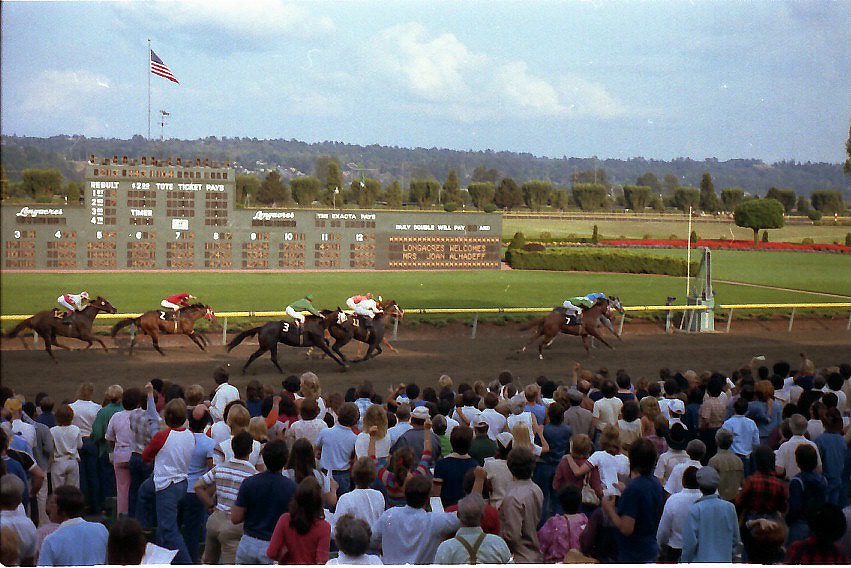
Longacres was a picturesque racetrack.
But Grandy’s connections were not going to sit idly by and watch their star get beaten. They took Grandy north to Exhibition Park in Vancouver for the Richmond Handicap on July 5th. Contested over the Longacres Derby distance of nine furlongs, it would be the perfect indicator of Grandy’s ability to handle the distance. Steve Austin ventured north to accept the mount and the tandem was bet down to 2 to 1 favoritism. Negotiating Exhibition Park’s tight bullring turns to perfection, Steve asked Grandy to move sooner than usual. Grandy responded and together they drew off to win by a commanding eight lengths.
The traditional final prep at Longacres for the Derby is the Spokane Handicap. Run the first Sunday in August and contested over 1 1/16th miles, it is the perfect tightener for the three-year-olds against stakes-caliber competition before the Derby. In the thirty-eight runnings prior to 1975’s renewal, no fewer than ten winners of the Spokane went on to capture the Longacres Derby. And it was here that Grandy Dandy and Dusty County would first meet.
The morning of the race Steve had completed his usual activities of exercising horses and was lingering a bit longer than usual in the backstretch café. He was absorbed in the Racing Form, looking over the past performances of both his horse and those of his chief competitor. A friend approached and sat down, ultimately asking Steve about the big race. Steve explained he was looking for a way to beat Dusty County.
“Can’t be done,” his friend exclaimed.
“Well look here,” Steve said. “Here’s a race where Dusty got beat. Diablo beat him and Pincay was riding. All I’ve got to do is pretend I’m Pincay.”
A beautiful summer afternoon of sunshine greeted the Northwest race fans. By the time of the ninth race they were well settled in, anxious to catch a glimpse of the superstar they had heard so much about. They bet down Dusty County to sixty cents on the dollar and weren’t disappointed when leading rider Gary Baze took the favorite right to the front. Steve allowed Grandy to assume his usual early battle position toward the end of the pack, conserving his energy for his strong late kick. As the field pounded around the clubhouse turn, Grandy was in ninth, some eleven lengths off the pace. Dusty County was running easily on the front end as Grandy started picking up some of the pack. With a half mile to run, Grandy was fifth and closing. At the top of the stretch, Baze asked Dusty County for all he had. On this day, however, it was not enough; Grandy and Steve caught them inside the 16th pole and registered an electrifying 3/4 length win. As Steve weighed in after the race his friend called out, “Nice ride, Pincay.”
The scene was now set, all that was left was to wait the two weeks for the Derby. Grandy’s dramatic victory had endeared him to the hearts of the race fans and much of the pre-race chatter was of his chances. The more seasoned handicappers were looking for Dusty County to bounce back, improving after having had a trip over the local course. But there were other horses to consider as well. Cash Your Ticket was coming south from Vancouver following a big win and was expected to push Dusty on the lead. And the game runner Auguste was expected to venture north from California where he had just won and figured to be a factor late in the race if the speed backed up. The race promised to be an exciting one.
12,902 race fans were on hand to witness the 40th running of Longacres’ premier event for three-year-olds. Each and every one was treated to a spectacular show. Dusty County broke alertly and, as expected, Gary Baze again took him right to the front. They settled in comfortably, despite early pressure from Cash Your Ticket and longshot Majestic Major, completing the first half mile in a relaxed forty-seven seconds. Grandy had settled back and was also running easily. Steve gauged the pace from atop his mount, a little concerned at its leisurely clip but reassured by the pressure Dusty was getting. Next to Grandy, just inside him, was Auguste. Larry Pierce, who had been riding Auguste in California, was also content to allow his horse to relax, saving speed for the important stretch run.
As the field rounded the far turn, Baze asked Dusty for some run and he quickly opened up a three length lead, finishing Cash Your Ticket and Majestic Major. Both Steve and Pierce knew they had better move now or the race would be over; Dusty County was running too well. Then Pierce got a break. The rail opened up and he guided Auguste through. Steve and Grandy were caught on the outside, losing precious ground as the field turned for home. Dusty was still out by three but both Auguste and Grandy were closing. At the eighth pole Steve felt Grandy shudder but the horse responded and he kept riding hard. They were four lengths back and Auguste and Dusty County had locked horns.
Studying the Racing Form at Longacres before a race, 1981.Dusty County and Auguste hit the wire together, a photo finish. Grandy was six lengths back in third, unable to threaten the top two. As the riders brought their horses back to be unsaddled, the winner was announced. Dusty County had held off Auguste’s challenge and had won by a nose. The race was all a fan could want. Two fierce competitors had waged battle in a classic confrontation and one had emerged victorious. Steve gave Grandy an affectionate pat on the shoulder and took his saddle to weigh in. Grandy was then led back to his stall as Dusty’s delirious contingent celebrated in the winner’s circle.
Later, it was learned that Grandy had blown the suspensories in a leg during the running of the race. Obviously to Steve, the injury had occurred as Grandy was making his patented stretch move. His inability to sustain this move was due to the injury and it was a testimonial to Grandy’s tremendous heart that he had continued to dig in and give it his all after having been hurt. Grandy was turned out for the rest of the season with the hope of returning him to action the following spring.
Hope springs eternal, especially at the beginning of any horse race meet. In early May of 1976, Grandy Dandy was back in training, being pointed for the inaugural running of the Lewis & Clark Handicap at Longacres. The five furlong sprint may have been a bit short for a closer such as Grandy but at least the race would be a good indicator of how well Grandy had recovered from his injury. With regular rider Steve Austin up, Grandy spotted the front-runners twelve lengths early, a huge amount in so short of a sprint. He closed well, making up over six lengths in the stretch and was only beaten by two and a half, an encouraging effort from a horse who hadn’t raced in nearly nine months. Unfortunately, Grandy came out of the race sore and was turned out again.
His second comeback began in June of 1977. Despite his having been sidelined for thirteen months, Grandy’s connections were optimistic of finding racing life in his now five-year-old form. He finished sixth in each of his first two tries, both against allowance company. Steve Austin rode him the first time but wasn’t available the second. In his third start, also without Steve, Grandy finished a fast-closing third and it was thought he could compete in the stakes ranks again. Grandy and Steve were reunited for 1977’s renewal of the Governor’s Handicap at Longacres. Grandy never got untracked and it was plain to Steve that the horse was hurting. He never asked him to run and Grandy limped home a well-beaten tenth.
At this point, the plan was to retire Grandy Dandy permanently. He had given everyone involved with him some exciting times and plenty of joy. Being a gelding, Grandy’s value was in racing, but his racing days were over. He now belonged in a picturesque pasture where he could live out his days in luxury, choosing to run when he himself wanted to.
Perhaps Grandy was one of those horses you hear about who want nothing to do with retirement. The kind who, understandably, feel useless without having a job to report to every day. For whatever the reason, in 1979 Grandy came back to the track. He came back in the claiming ranks this time, making his first start in a measly $1600 claiming affair at Playfair in Spokane. He still had his penchant for late moves and dramatic finishes, getting up at the wire to win by a nose. He was claimed out of that first start and ran eight more times in Spokane for his new owners, never finishing worse than fourth and winning twice before the Playfair summer meeting ended.
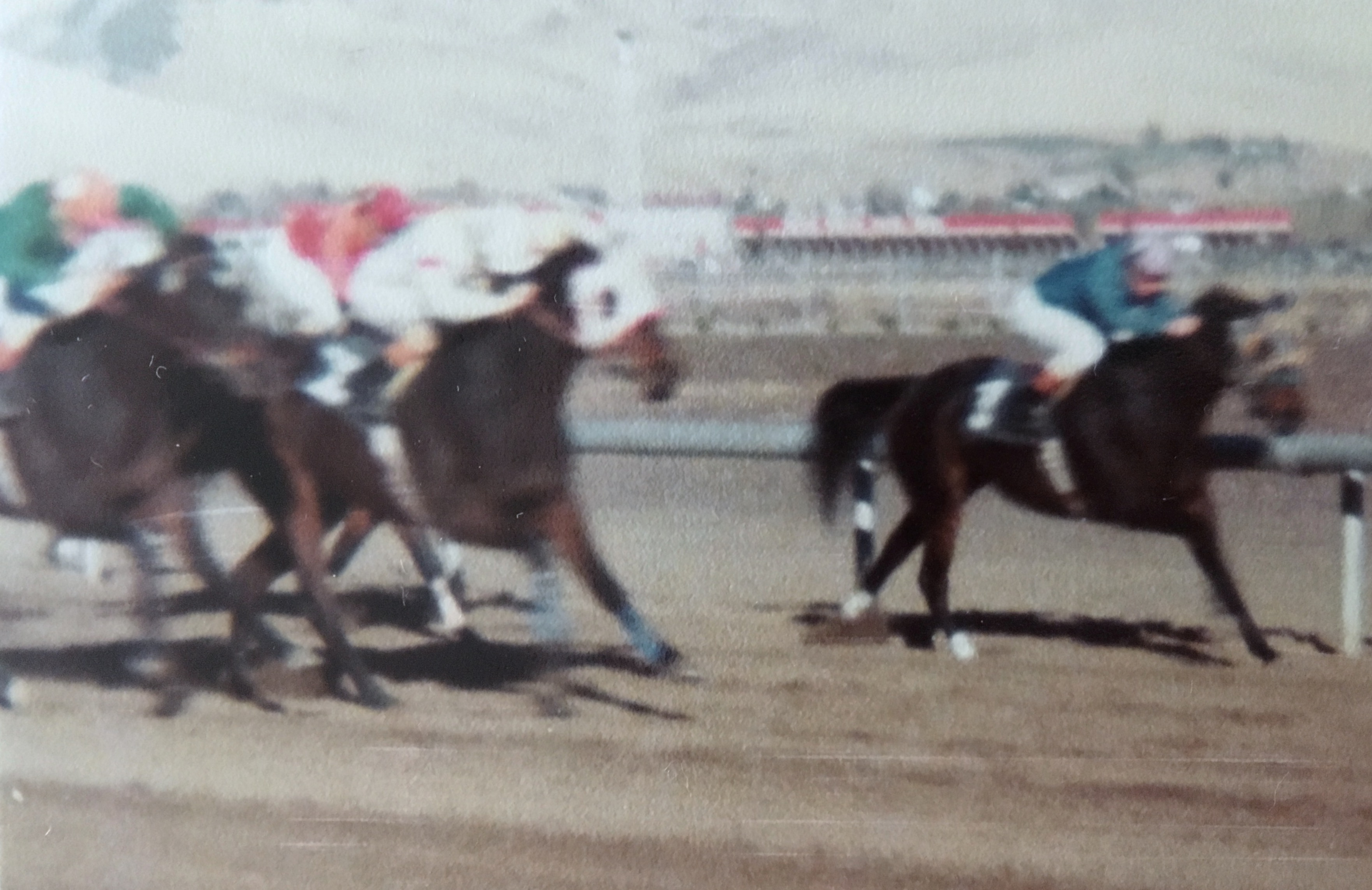
Down the stretch at Yakima Meadows, 1979.
In the fall of 1979, I was a junior in high school. My earlier enthusiasm for horse racing had escalated into a full-time hobby and my father’s two dollar investments had changed into portions of paychecks I earned while working as a clerk in a bookstore. I had a few friends who were equally smitten and on a sunny Saturday following the close of Longacres’ 1979 campaign, three of us decided to embark upon the three hour drive to Yakima and try our luck at Yakima Meadows. Our luck, mine especially, was poor as the day passed and we found ourselves with only two races left. In the first of those final two I selected Satus Springs, an even-the day’s-ledger choice at 9 to 1. When he went wire-to-wire, putting me a few dollars ahead, I decided to sit on my wallet and enjoy the afternoon’s final race, a non-descript cheap claimer for older horses going six furlongs.
Though nary a dollar escaped my wallet before the running of that all-too-ordinary race, I lost. In some great scheme of things, we all lost. For on the far turn, while making his typical move, a seven-year-old gelding named Grandy Dandy, the race favorite, broke down.
Steve Austin was there. He had ridden in the seventh race and, despite being without a later mount and having endured strong requests from his wife to head on home, had stuck around. He wanted to see Grandy one more time.
(I’m reviewing articles I’ve written for my professional website, narrowing them down to some favorites. Here’s the first, which focuses on a life lesson I received from a respected teacher and try to pass along to some of my students who I think might appreciate it.)
I’ve often told my students an allegory that was told to me by one of my most important teachers when I was a young adult, the story of two people walking at dawn one morning, the rising sun at their backs. One paused and turned to look at the beautiful sunrise, awed by its beauty. Wanting to share it, he tapped the shoulder of his friend, who turned to look and was equally awed.
I invite my students to stop and consider this story, to contemplate it for its meaning or meanings. One comes from recognizing the important role we have to help those in our lives be aware of meaningful things.
Related to that, however, is the truth that try as we might, we can never MAKE another person be aware of something. We may WANT to share things with others, but they still have to turn, literally and/or metaphorically, to see them. THEY have to do the physical and mental work.
If my students get to that understanding, I’m pleased.
As I’ve gotten older, interestingly, I’ve found what has become an even bigger lesson for me from this story. It’s that we all are being tapped on our shoulders all the time. Every second of every day, we are being offered the opportunity to see meaningful things.
Many of us wonder who or what does what I’m calling this shoulder-tapping. Call it Source, or Light, or Intelligence, or God, or some other name. For my purposes, though, putting a name to what taps us is not the most important thing.
What’s important is to recognize that we are being tapped and to practice focusing our attention. In other words, I have the responsibility to do the physical and mental work, to turn and look, so to speak.
As I’ve gained experience doing this, I’ve learned that there is discipline involved in the practice. Undisciplined, my attention is drawn to all sorts of things — negative news stories, certain uses of social media, drama from the sports world — each of which distracts me from what is actually meaningful.
I sometimes even fool myself into believing the distracting things are important.
Disciplined, I learn to see the difference between the distracting and the divine, between the pointless and the profound. In time, I find that I’ve started to internally filter out the things that distract me, which better enables me to gently focus on the divine and the profound.
In the book “The Power of Kindness,” author Piero Ferrucci talks about how human beings are able to “resonate” with other human beings.
I love this concept.
He tells us that the ability is with us from birth, but if it doesn’t develop sufficiently we are in trouble. Me, I think the ability can be cultivated at any time in our lives. It’s certainly easier when we are younger, before we’ve had years of not resonating or not resonating well. But the ability is always there inside us, waiting to be tapped. I think the means is through storytelling.
In other words, if you’re ever feeling out of sorts, alone, or untouched, try telling the story of something that has touched you.
A few years back, I developed a class for teenagers on the subject of empathy. I wasn’t at all sure how many students would be interested. And since the classes that get scheduled at Puget Sound Community School are determined by student interest, I honestly wasn’t sure if this class would make the cut. Typically, more than 75 classes are offered to the students for each of the school’s main three terms, and the maximum any student can attend is around 20.
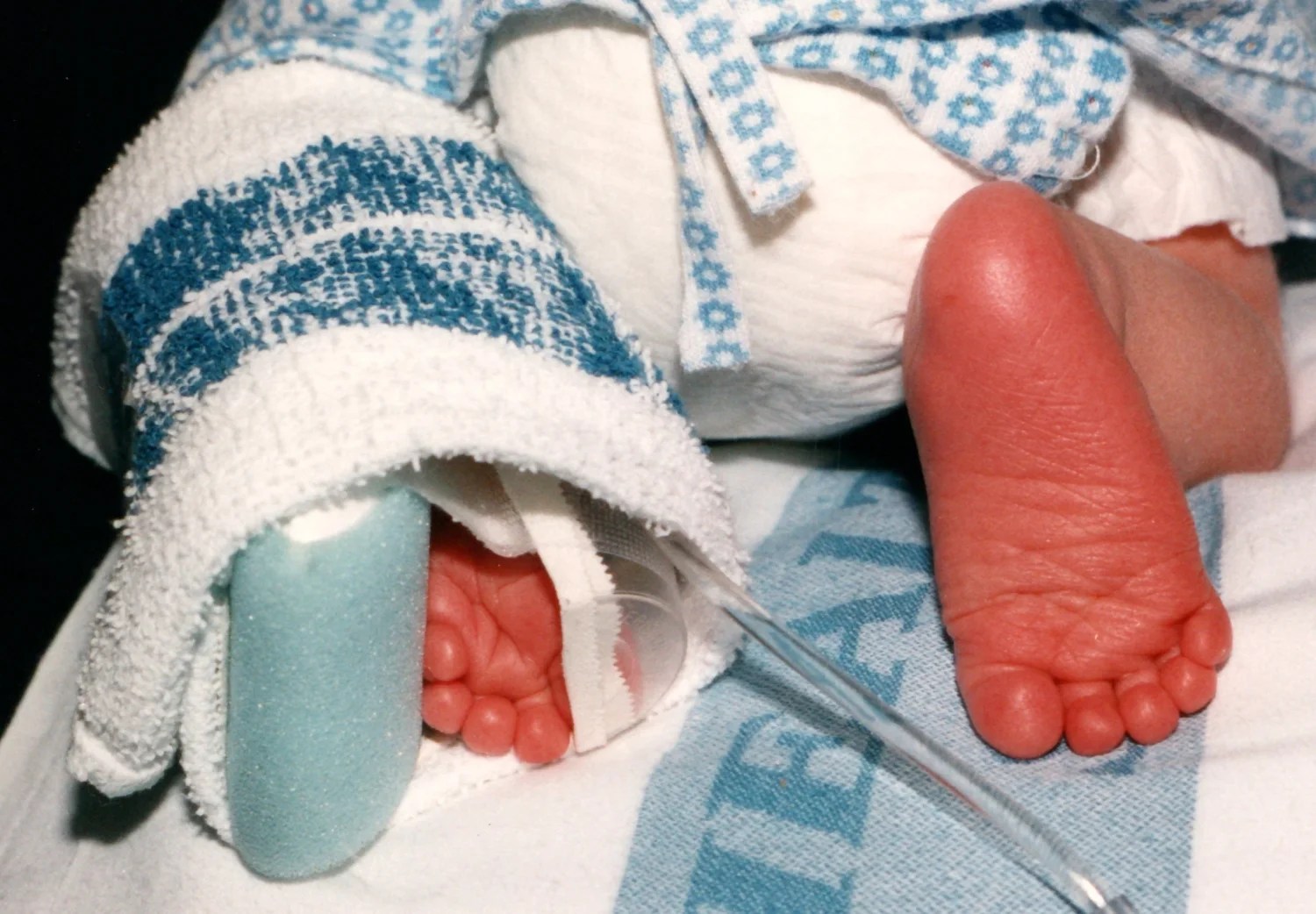
When I pitched the empathy class, I told the story of visiting my newborn daughter Ella in Children’s Hospital one Saturday morning in early 1997, she having been admitted (along with my wife, Melinda) because of a possible case of meningitis.
Ella was only 2 weeks old.
The day before, we had taken her to the doctor because of a high fever and the doctor ordered us to the emergency room. There, Ella experienced a spinal tap, during which the nurse’s assistant passed out and Melinda had to step in and hold still the crying/screaming baby Ella while the doctor inserted a needle into her spinal cord to get a fluid sample. Fearing meningitis, the doctors hospitalized Ella and treated her as if she had the illness while the fluid was tested over a period of three days. Melinda stayed with Ella while I was at home with her older sister, Chloe, not quite 4 years-old.
Two week old Ella’s IV was in her ankle.
So early that Saturday, with my mom having come to watch Chloe, I arrived at Children’s Hospital to be with Ella and Melinda. At that time of day, they have a special entrance for parents. I entered there and took the elevator to the Intensive Care Unit, where Ella was being watched.
Exiting the elevator, I encountered one of the most moving scenes of my life – a young boy playing with a remote control car. 8 o’clock, Saturday morning, playing like little boys all over the world, down the hospital hall came this pajama-clad boy directing his car, remote control in hand. Keeping up next to him was his father, pushing the IV cart, making sure it stayed attached to his little boy’s arm. It was so poignant that it took my breath away. A little boy just being a little boy on a Saturday morning. And a dad just being a dad, doing what he needed to do so his boy could play.
I told those stories to the students during my class pitch. Lots of students prioritized the class after that. It made it on the schedule.
I’m not sure if the class ever matched the stories that I think sold it, but it was a great class. The second week I brought in photographer Lynette Johnson as a guest speaker. Several years previously, when I first heard of her, she was trying to start a nonprofit organization.
The purpose?
To provide professional photographs to parents of their terminally ill children before they died. Yeah. Kind of hits you right there, doesn’t it?
Lynette succeeded in starting her nonprofit and has since been featured in People Magazine and on the TV show “Today.” She calls her nonprofit Soulumination and they’ve since expanded their services. They now take professional portraits, at no charge, of terminally ill parents so their children will have photos to help remember them.
Lynette told the students why she started the nonprofit, tearing up each time she told the story of one of the children she has photographed.
Two weeks after introducing the students to Lynette, I took them off campus to meet a couple in their 90’s who were living in the same retirement community as my parents. Both had lost their spouses and finding the other, they thought it made sense to share an apartment rather than pay for two. But the conservative retirement home wouldn’t allow this unless they married. So they got married. As it turns out, we learned the woman was at Pearl Harbor in 1941 when it was bombed.
What stories these two people had to tell a group of teenagers!
Feel the resonance? If so, did experiencing this resonance change how you were feeling? Pay attention to this.
In 1985, at age 22, I was a first-year college student at The Evergreen State College in Olympia, WA. I had spent the four years since graduating from high school trying to figure out who I was, my high school having done such a poor job of helping me do that. Having been moved by my experience mentoring a young boy as part of the Big Brothers program, I felt a calling to make a career in education and chose Evergreen as a place to begin my more formal training.
One day, while at the public library near my apartment and as part of a search on child development, I found a paperback book called “Son-Rise.” The book tells the true story of how author Barry Neil Kaufman and his wife, Suzi, helped lead their son out of his autistic world. Reading the book changed the trajectory of my college experience.
At the next academic quarter, I shifted my academic focus at Evergreen to issues in special education. I began conducting independent study projects on topics such as dyslexia, brain injury, and cross-cultural special education practices. I began working with brain-injured children as part of my studies, earning college credit in the process.
Teaching in 1995The summer of 1986 I signed up for a program of study called “Children of the World.” One of the professors was a Navajo and during one meeting with him he said something that literally stopped me in my tracks. I had been reading about dyslexia and was trying to understand if dyslexia was a condition more about a child or more about the educational settings in which a child was placed.
Sharing a Navajo perspective, but phrased in modern terminology, my professor asked me, “Andy, have you ever stopped to think that dyslexia might be an advanced form of evolution, an advanced way of seeing things?” It was a radical thought for me at the time, an example of outside-the-box thinking that I’ve tried to employ since. Instead of viewing dyslexia as a “dis”-ability, as I had been doing, what if I treated the concept as providing some kind of advantage?
That got me thinking about our school system. Certainly, being dyslexic was not an advantage in a typical American school setting. But how much of this disadvantage came from the beliefs and attitudes of those people working with dyslexic children? Couldn’t teachers learn to accept students for who they were and instruct from their strengths?
My studies continued. Evergreen allowed me to do something I had never done before as a student – study what I wanted to study, when I wanted to study it. The idea of a school allowing this never occurred to me. Such uninterrupted immersion in something could only be done after the requirements were met, and usually after the school doors were closed. A spark that had all but been extinguished began to glow brighter as I welcomed each day with an armload of books, which one day included “Son-Rise,” which I began to re-read.
When I first read the book I was impressed by its clarity. Re-reading, what Kaufman wrote made even more sense to me, opened me up and allowed me to gain access to a part of myself that was waiting to emerge. I became more accepting of myself and others; in his writing I found words for things I had never been able to express. In short, the Kaufmans developed a therapy program for their autistic son based on a lifestyle of love, trust, and acceptance. The basic principle of their lifestyle was that people were always doing the best they could based on their current beliefs, that each of us is our own best expert.
In the spring of 1987, I accompanied a family with an 18-year-old autistic son named Eric to The Option Institute in Massachusetts, the institute founded by the Kaufmans to help others learn from their experience. We spent a week there learning from the staff how to create a home-based therapy program for Eric. Returning home, I began working with Eric several days a week, hoping to join him in his world as a way of communicating that I respected him for whom he was.
Working with Eric, I came to know myself better than I ever had. The principles of love, trust, and acceptance had a natural effect in other areas of my life. I began living in the present. Instead of doing things for some future reward, I ended each day knowing I had done exactly what I wanted to do. Another thing became clear to me – I settled on wanting to be a teacher.
I graduated from Evergreen in 1988 and in 1989 entered a graduate program in Human Development, the first year of which was a teacher certification program, through Pacific Oaks College. I completed both programs, earning both a teaching certificate and a Master’s degree. Because of my work with Eric and other children with unique needs, and my independent studies done at Evergreen, I carry Special Education endorsements on my teaching certificate.
I began teaching in 1990 and have always tried to bring what I learned from my study of the Kaufman’s philosophy to my interactions with students. The creation of Puget Sound Community School in 1994 was a clear attempt to create a school that allows students to take charge of their lives. I’ve now spent decades helping young people learn that while I may be a trained teacher, I’m not an expert on who they are. I want to help them to learn to identify their goals, however trivial they may seem to others, and plot courses to achieving them. I want them to trust themselves fully, to be happy with who they are.
I believe that happy people have a burning desire to grow and develop, reach out for new opportunities and challenges, and are an asset to the world. A.S. Neill, the founder of Summerhill, wrote, “All crimes, all hatreds, all wars can be reduced to unhappiness.” Imagine a world that puts as its priority the happiness of its citizenry.
So back in 1985 I read a book that dramatically changed the course of my life. It deals with such topics as love, trust and acceptance, topics that typically aren’t discussed in books on education, in most teacher training programs, or in most faculty rooms.
I challenge you to ponder why that is, and to think of the possibilities for schools and students if they were.






 What’s important is to recognize that we are being tapped and to practice focusing our attention. In other words, I have the responsibility to do the physical and mental work, to turn and look, so to speak.



 Andy Smallman