Okay, so this post may not be so much about our time in France this summer. Feel free to file a complaint although I learned from my father when I was a child and unsatisfied about something that “The Complaint Department is not open.” Looking back, I don’t think the Complaint Department was ever open.
Perhaps there’s a lesson in there somewhere…
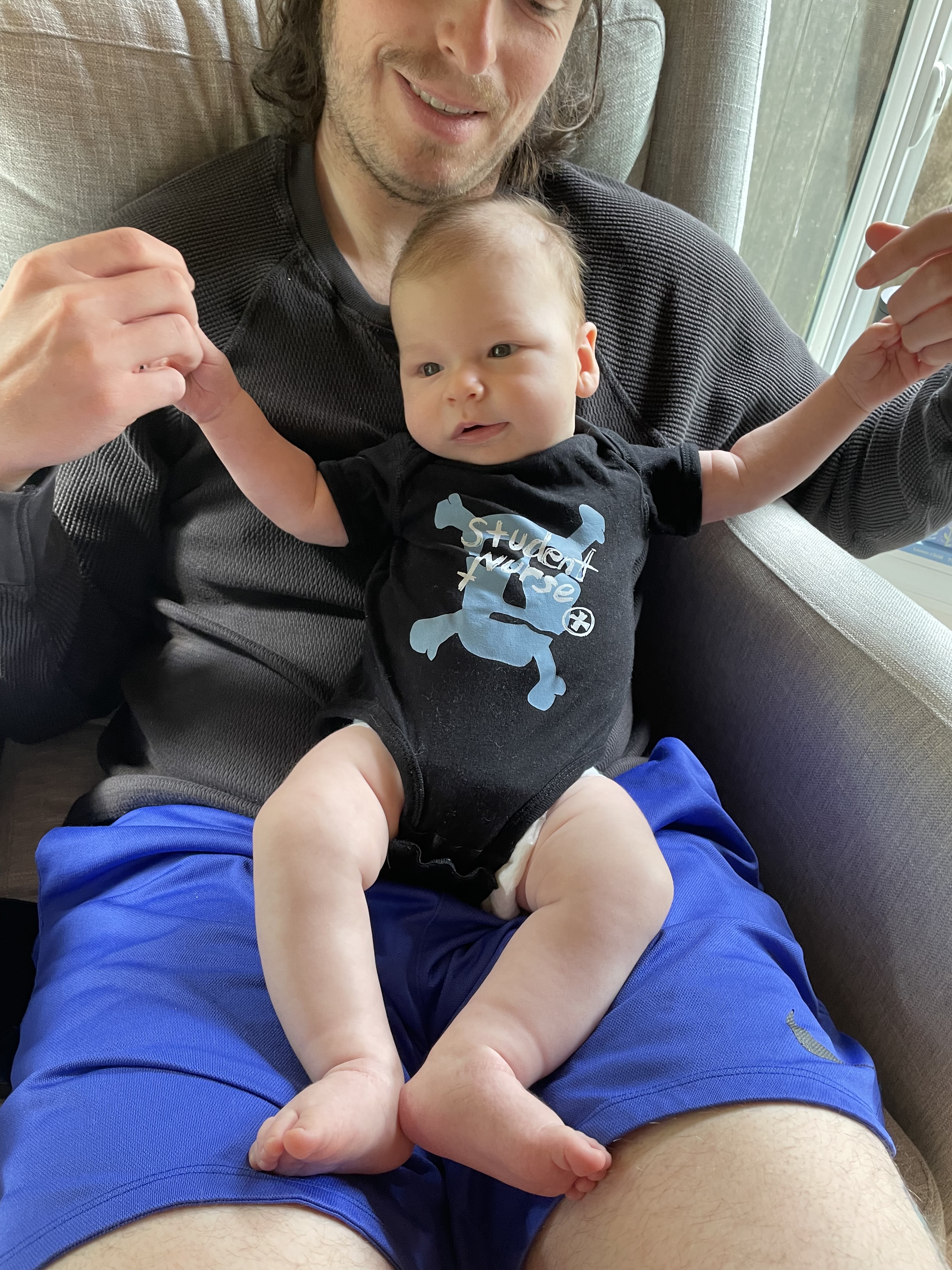
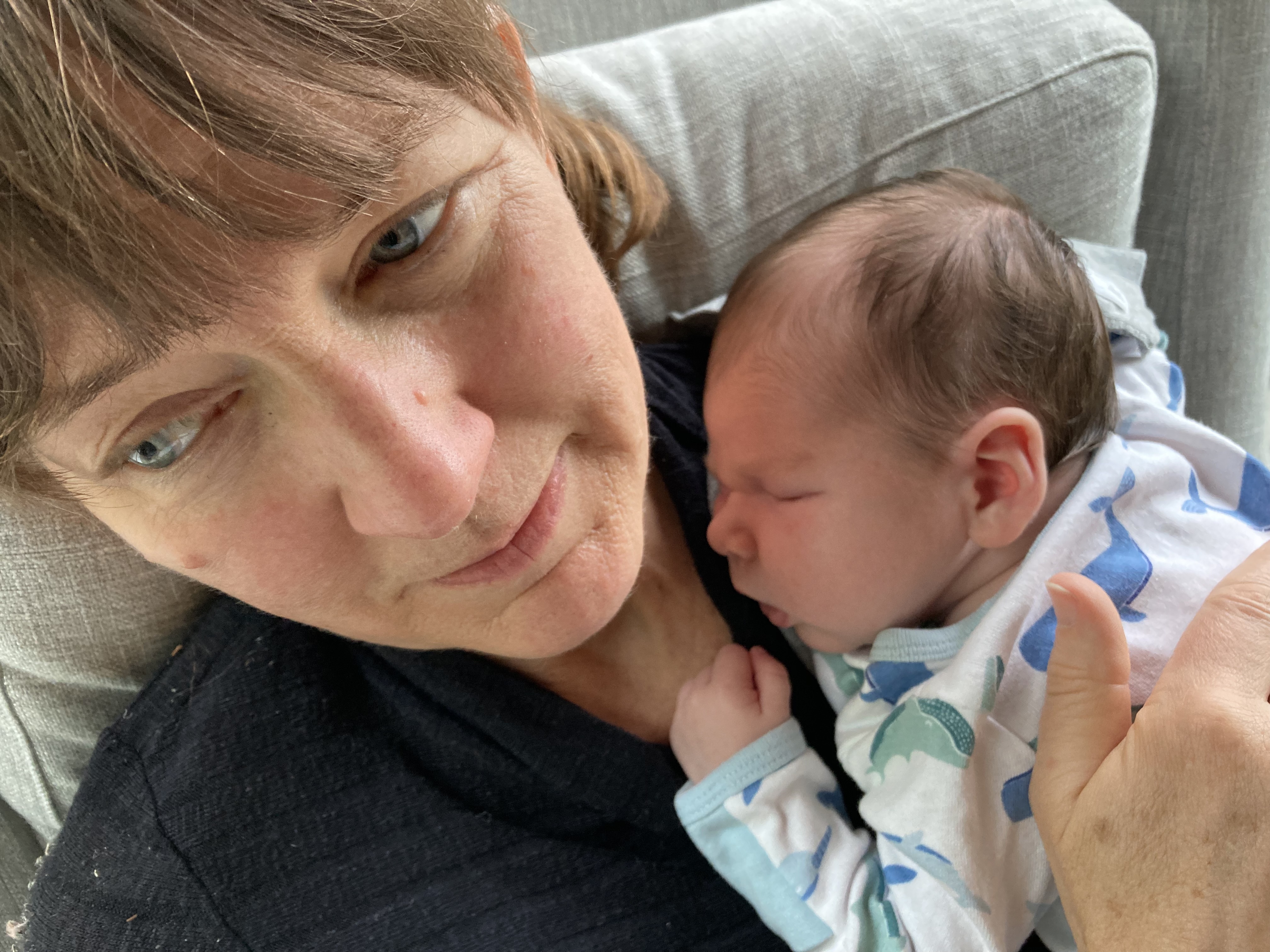
CLICK PHOTO TO ENLARGEAnyway, after going to bed (in France) last night, I received a series of photo texts from Chloe, the photos all of Rémy in an outfit I bought for him soon before he was born. As you can see in this photo (oh, that’s Rémy’s dad, Alex, in the photo, too), it’s a onesie with the name “Student Nurse” printed on it.
Student Nurse was a Seattle-area band that I appreciated when I was in high school and just after. Learn more here and here. They were founded by John & Helena Rogers, John also going by the name Johnny Rubato. I got to know both Johnny & Helena a little bit because they ran Rubato Records, what was a fabulous used record store that began in downtown Bellevue. Typically, I had to head to the Ave in the U District to shop for used records so having Rubato’s in Bellevue, where I grew up, was a great nearby alternative.
(As a quick aside, this feature from The Stranger, which includes a reference to Rubato Records, is a great read if you appreciate used record stores and the people who work for them.)
Soon before Rémy was born in May, I was listening to some music online and came across the fact that Student Nurse had reunited to play a few dates last year. One click led to another (you know how that is, right?) and I found they had released a retrospective CD, that Helena was painting and selling art (I bought an original of hers of Big Mama Thornton that now hangs in my home office), and that I could purchase some Student Nurse merchandise.
I snatched up this onesie for the soon-to-be-born baby. And yesterday, while going to bed (in France), Chloe sent me pictures of Rémy in the onesie.
If we need to make this even more French-centric to warrant the “France 2023” tag I’ve affixed to this post, here’s Student Nurse and their song “C’est Tout” (French for “that’s all”) from that retrospective CD as posted on YouTube:
So there’s this ongoing joke in my family that when I’m in France I go to the grocery store to buy clothes. And I admit, it’s technically true. I like getting SOME of my clothes at Leclerc, a large grocery store chain in France that is set up like the large Fred Meyer stores we have in the US.
You can get groceries, to be sure, and at decent prices. Both Leclerc and Fred Meyer also sell household goods, even furniture and automotive things. There are sporting goods and electronics.
And, yes, clothes.
So every time we come to France, I make plans to head to Leclerc to check out the latest in men’s fashion. Or, better put, for the bargains that I might be wearing later this year.
Staying at the Bertail’s, and with Melinda hanging out with Christine and with Bérnard at work, I decided I’d walk to the Leclerc where I did most of our family’s grocery shopping during the sabbatical year, the place where I’ve bought quite a few of my clothes over the years.
Now one thing different about this year compared to past years, this time I’m a grandfather. In other words, I never really had reason to look at the baby clothes at Leclerc before now. And, boy, did I look. In fact, I was so taken by the cuteness I saw that I sent a text to Chloe, mother of Rémy, mother of my grandson!
It was about 1pm here in France when I sent the text, what is 4am back in Seattle. And guess what? Chloe was awake, feeding Rémy. She texted me right back:
Spoiler alert – Rémy will have some clothes from the grocery store. Just like me, Grandy, his grandfather.
For those new to Melinda’s and my travels to France, let me just say that the city of Nantes is our second home. We lived here for 13 months in 2010/11 and have traveled back many times since. Some of our closest friends live here. So today, arriving in Nantes is a homecoming of significant sorts for us.
I’m tired as I write this after a short night of sleep and a long day of travel so am hoping the above photo will serve as the main happy announcement of our safe arrival in Nantes. We drove 90 minutes to the Montpellier airport this morning, arriving less than an hour before our scheduled take-off. Then it was a 75 minute flight to Paris, a 50 minute flight to Nantes, and a 25 minute taxi ride to our old neighborhood, the place where we met Christine & Bérnard in 2010 and whose home we now are at.
I walked over to the Hippodrome, one of my happiest places on earth, and snapped this selfie.
Denouement is a fine word to describe the day after a French wedding, I’m thinking. More literally, it’s the final part of a story, the point when all the plot points come together and we can close the book.
That said, I’m not really sure there is such a thing as a “day after” a French wedding, at least not the one in which Melinda & I have been enjoying since Friday. If yesterday’s reception didn’t ever end (word this morning is that Frédérique, Romain’s mom, was still dancing at 6am), and today’s brunch and pool party began at 11am, maybe there is no denouement.
Besides, a wedding is the BEGINNING of a story, not the END.
Melinda & I managed to keep dancing until 3am, at which point we (read: Melinda) drove the 15 minutes to the incredible spot at which we’re staying (well done, Melinda). We slept in until almost 10, before heading back to the venue for today’s brunch, the same spot used for Friday’s white party and yesterday’s reception.
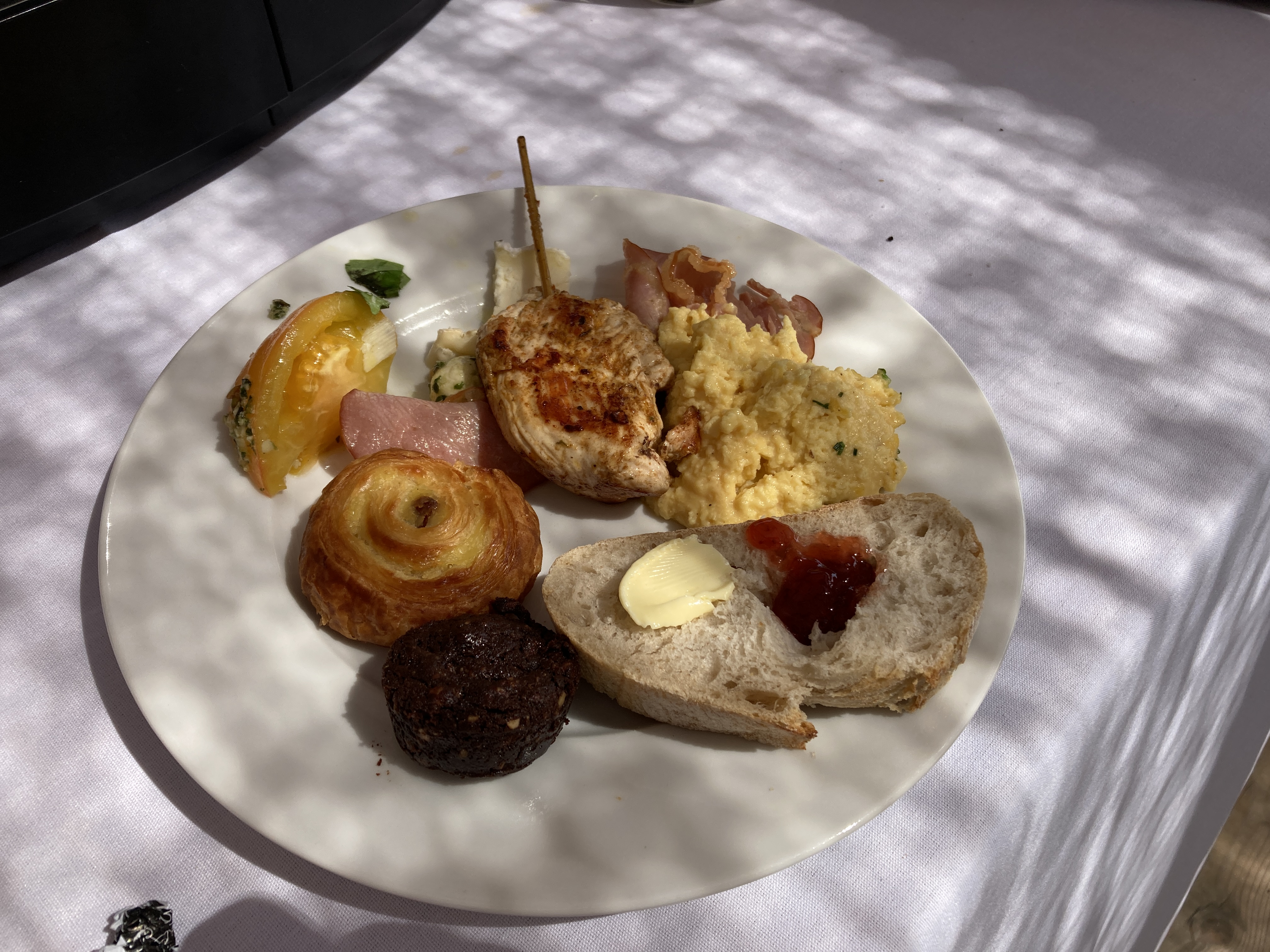
My brunch plate.We enjoyed a catered brunch, cooled our feet in the pool, and made a final connection with a number of French friends that have become as important to us as family.
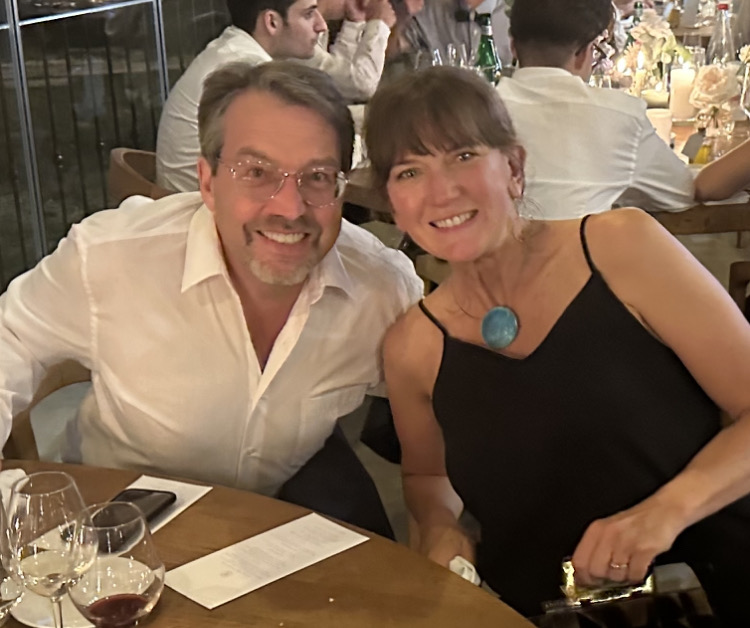
After that, we drove to Avignon, about an hour away, where Melinda spent a semester in college in 1984. We hunted for the home at which she stayed with uncertain success before entering the walled city and enjoying a festival taking place. These two photos of us come from when we stopped to cool off with a glass and a small meal.
Rosé & Ricard, aka Melinda & Andy.
Hmmm… considering we head to Nantes tomorrow to reconnect with Christine and Bérnard, denouement is the wrong word for what we’re feeling, for sure.
Okay, so there is NO WAY to fully summarize this wedding. From its 90 minute ceremony in an ancient French church in a tiny town to the reception that started at about 6pm and continued for at least 12 hours (Melinda & I managed 9 of those – not bad considering jet lag and all), what I have for you are some photos:
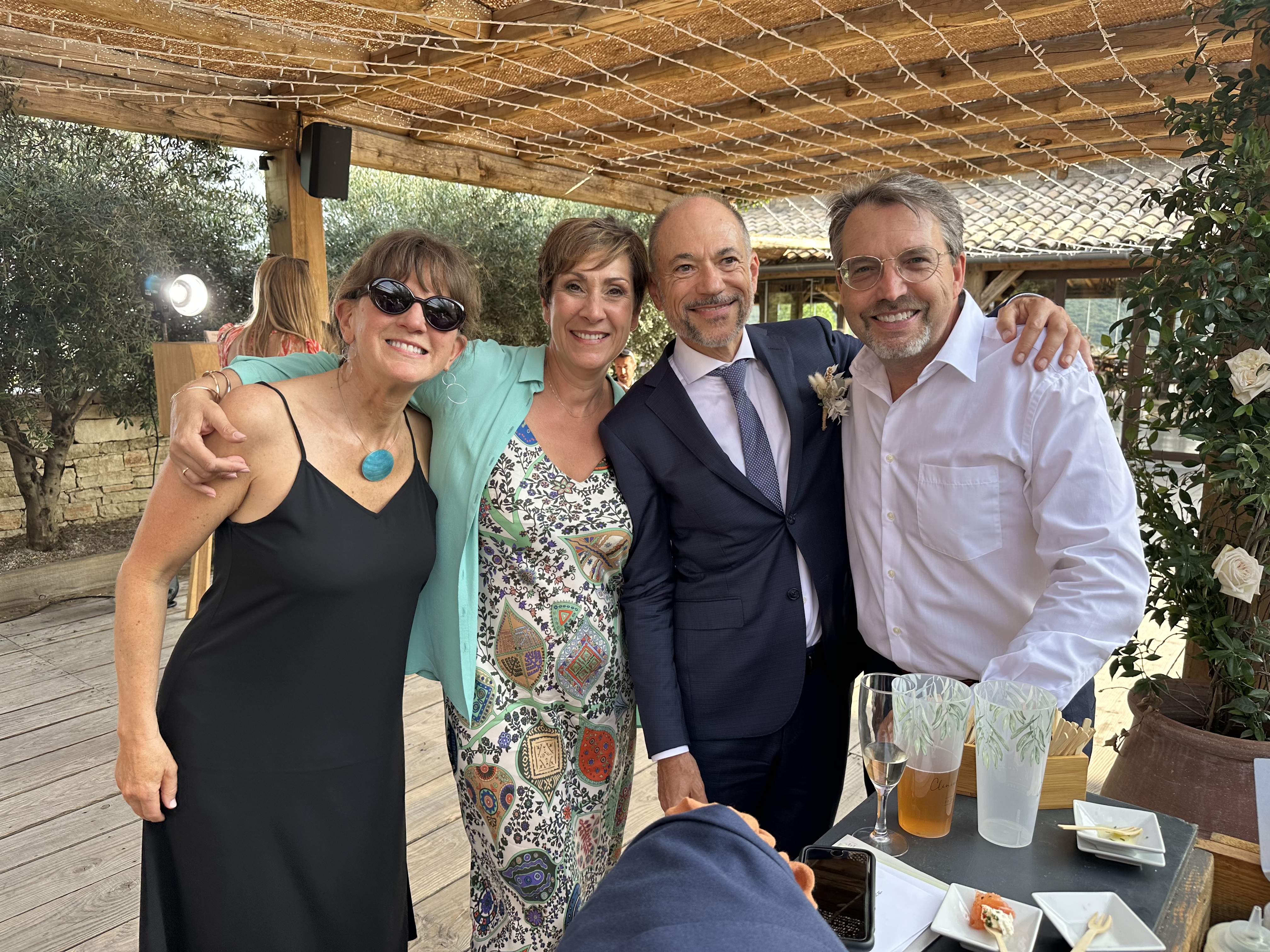
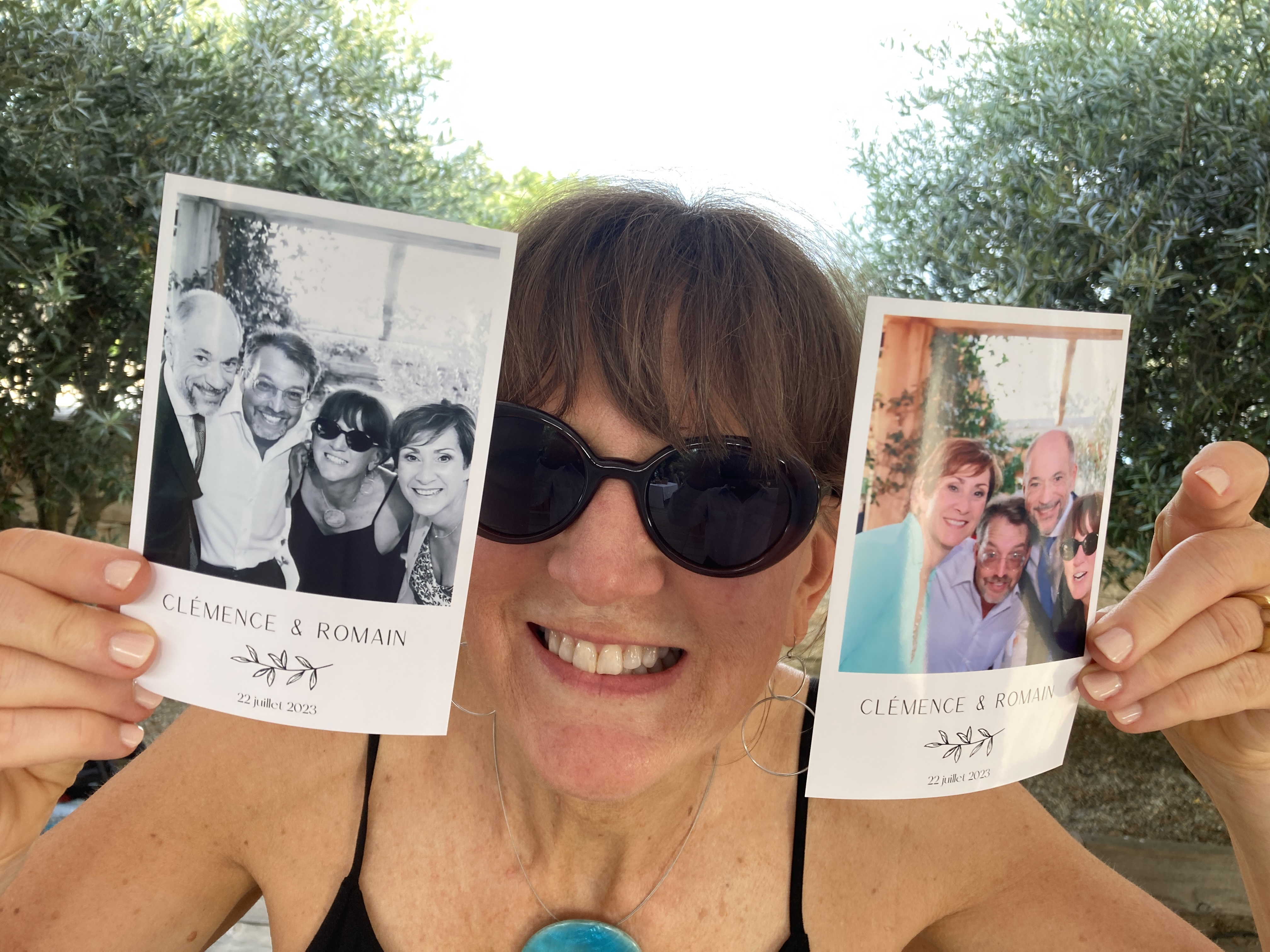
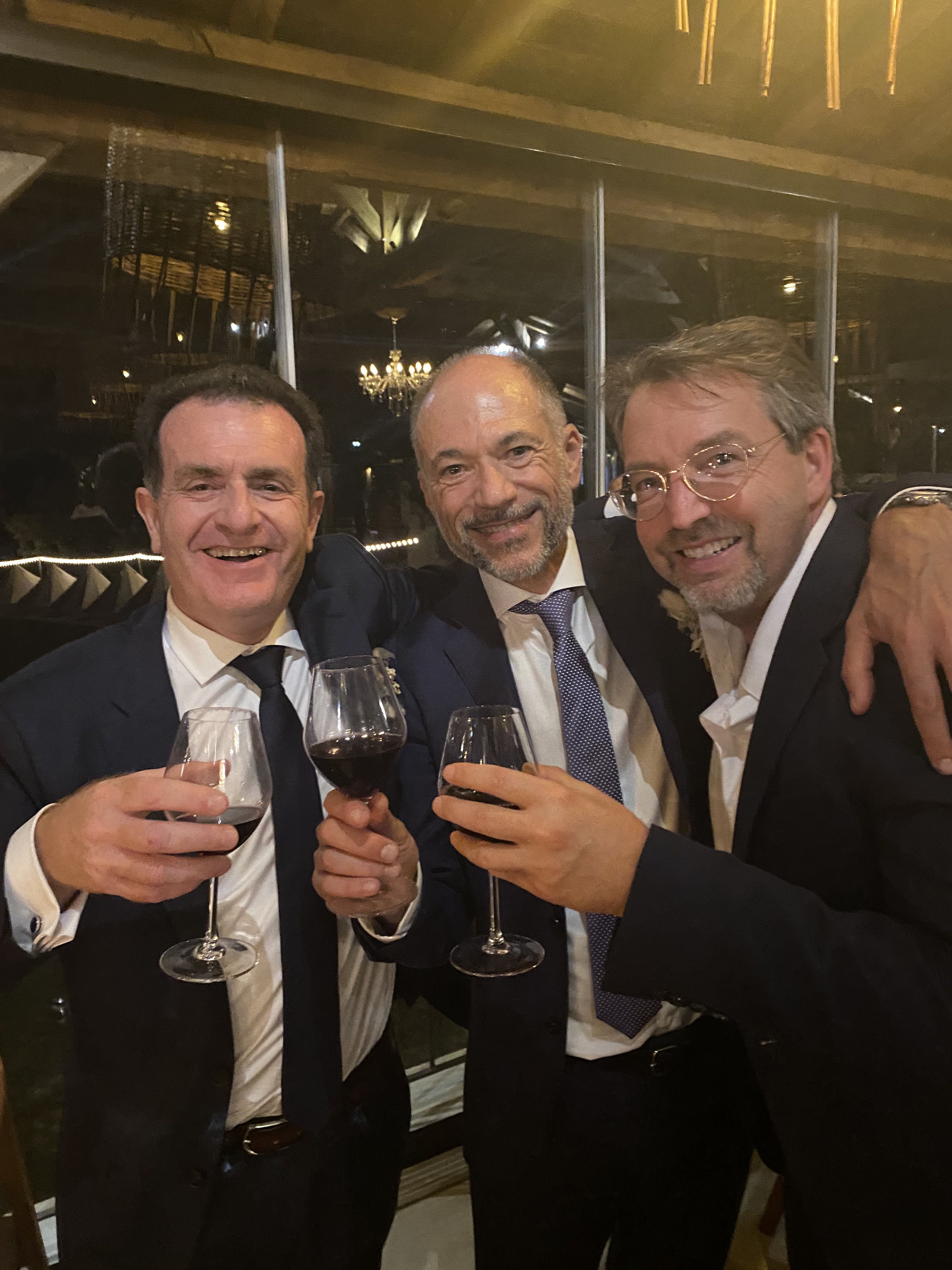
Exiting the church to the cheers of the crowd!Their car for the 30 minute drive to the reception. Melinda & I were part of the procession that followed them along tiny, winding roads, honking horns, and waving at smiling passersby.With our dear friends, Frédérique & Laurent, parents of the groom, Romain.Having fun with the photo booth photos!The happy couple saying hello to Chloe, Alex & Remy.The father of the bride (left), and the father of the groom (center) wanted a special toast with me with the most incredible wine I’ve ever had, a local Châteauneuf-du-Pape.This picture was taken between dinner courses at approximately 11pm, about 90 minutes before the dancing began.Yeah, after a couple of hours of dancing, some jet lag, and a couple of glasses of Châteauneuf-du-Pape, this is what I look like.
So one of the big reasons for this year’s trip to France is to celebrate the marriage of Romain and Cléménce. Romain, you longtime blog readers will recall, is a member of the Boudeau Family, the family responsible for us choosing to live in Nantes back in 2010. We became fast friends with them during our year there, something that is a vast understatement.
Today was the first part of the wedding celebration, what is called a “white party.” In short, this means that people wear white clothing, I guess. I’m not sure if all parties of this sort take place in southern France but if they do, I highly encourage you to attend one. The venue was, perhaps, the most spectacular spot for a party I’ve ever seen (and I was born in Omaha, mind you). I don’t think any words I could use would do it justice. Let me just say that there were views, and some trees, and a big sky, and some buildings. It was about 90 degrees and there was a band and an open bar, and a pizza truck.
Oh, there were some really nice people there, too, most of them French (all of them, I think), and many of them our friends. People seemed genuinely pleased to see us and by us I mean Melinda AND me. Go figure.
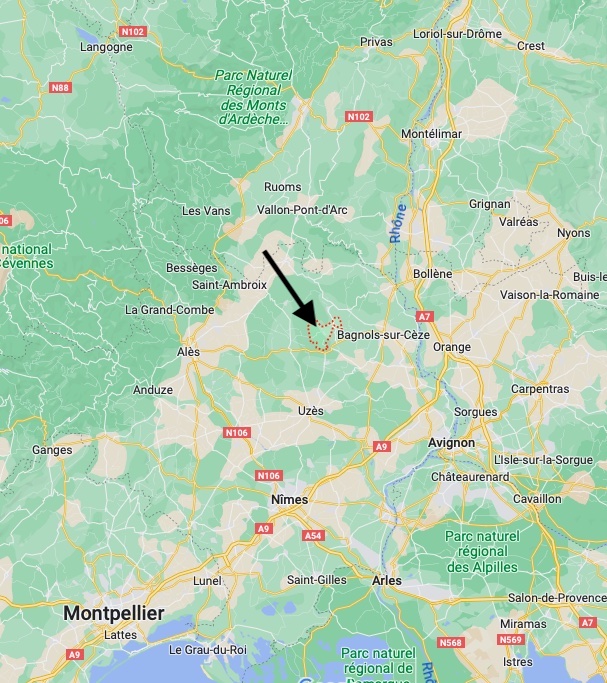
We were pretty tired, given we had flown 9 hours from Seattle to Paris, then another hour+ from Paris to Montpellier. In Montpellier we rented a car and drove 90 minutes into the center of French bliss (see attached map and the black arrow, that’s us).
About where we’re staying this weekend, I encourage you to visit this website. That’s where we are; in fact, it’s where I am as I write this.
Now about the marriage, the wedding ceremony is taking place tomorrow at 3:30pm, followed by a reception that is supposed to last into the wee hours of the morning. And by “wee hours,” I think that means the party will extend into next year.
More on that in my next post. And about posts, here’s what Melinda & I were doing on this day in 2012.
That’s right, Melinda & I are back in France. After the sabbatical in 2010/11, we vowed to come back every year and, mostly, pulled that off until 2018, the year I left PSCS and we moved for a year to California. Soon after, well, there was this little thing called the pandemic. And while we did make it to France last year courtesy of Melinda’s mom as part of a Shaw holiday, I didn’t update the blog (which I’m kicking myself for not doing).
So we’re back and I’m back!
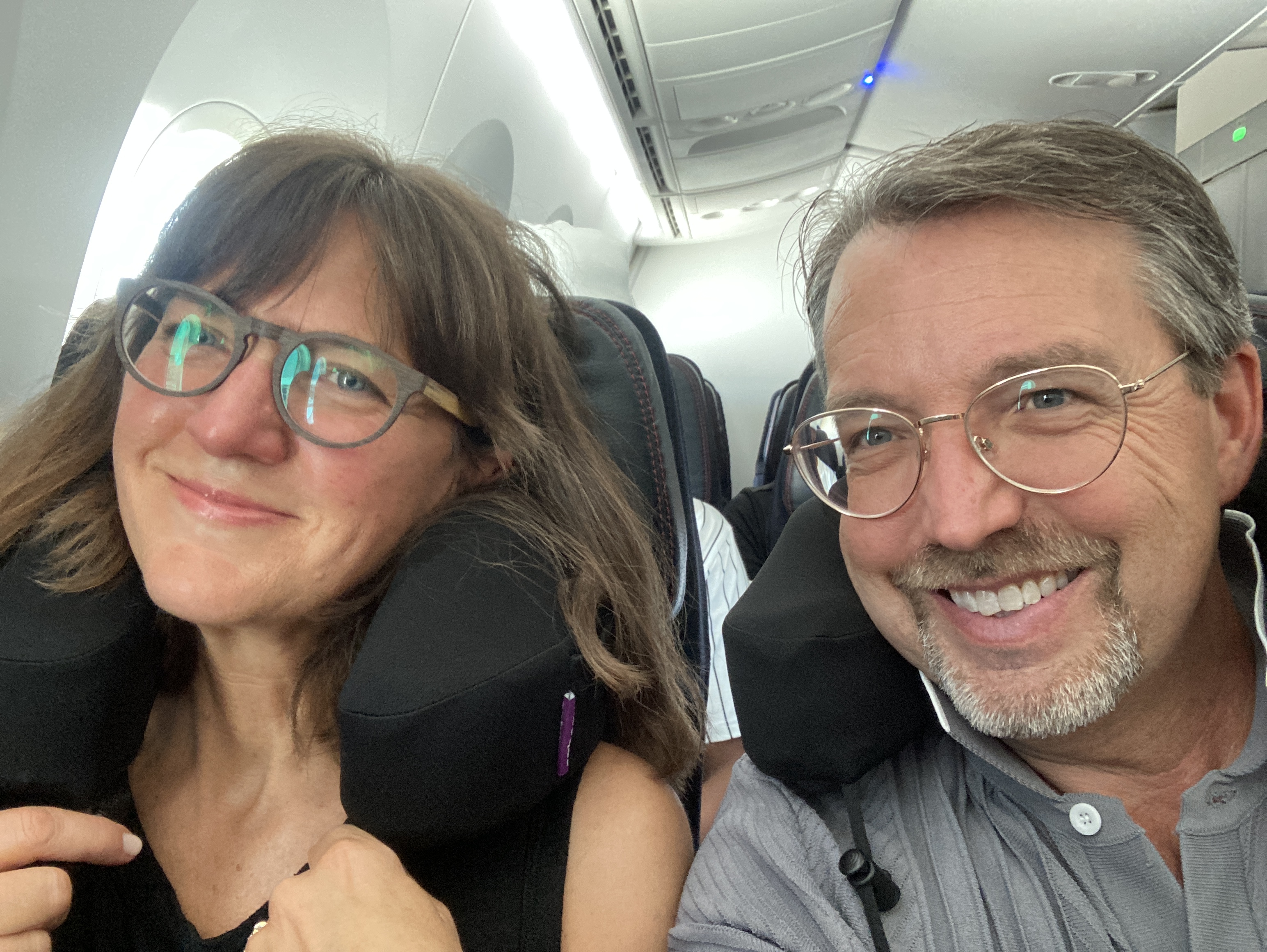
We left Seattle today on an Air France flight and with this nifty new neck pillow (seen in this photo). It attaches to the airplane seat and then connects under your chin, thus allowing you some comfort if you want to relax your head forward or to either side. It worked fairly well for me, but especially well for Melinda.
Speaking of Melinda, she was trying a new concept for the few days before we left, one in which she goes to bed an hour earlier each night and gets up an hour earlier each morning. Today she got up at something like 2am.
I think what worked for her was being sleep-deprived. She more or less passed out on the flight…
In other news, certainly significant news, it’s Carib’s 90th birthday today. 90 is a big number when it comes to age (it’s less significant when you think of dollars, that is unless you have those new-fangled dollars, what Jed Clampett referred to as mill-EE-on dollars).
My brother, Steve, who came up from California with his wife, Deb, to celebrate the occasion shared this photo with me.
Happy birthday, Carib! As a flashback, here is how we celebrated your birthday 13 years ago.
At the start of 2020 as part of my work with the Compassion Games and other similar projects, I was one of several people asked if I thought it would be possible to have peace on Earth by 2030. The question was being posed as a way to encourage reflection on what might need to happen in the present to support peace in the future. I thought about my answer for quite some time and then offered the following response:
I’d like to begin by suggesting there may be a clearer way to get to the point of this question, a way that acknowledges that to the rabbit who is hunted by the hawk there will never be peace on Earth. A way that understands that if we truly are interested in peace, we need to recognize that as humans we are connected to the rabbit AND to the hawk, AND to the fact that the hawk hunting the rabbit is part of a natural cycle of balance.
In other words, I don’t think peace on Earth will be defined as hawks laying down with rabbits.
As posed, I think the question also presupposes that world peace is an end result rather than the unfolding of a process. As as end, I think we are tempted to treat world peace as the solving of a problem, the lack of world peace. I think any time we reduce complex issues to that of problems needing to be solved, we are bound to think in absolute solutions: THIS is how we achieve peace on Earth.
I think this is how fundamentalists and dictators gain power. Ironically, this approach is the opposite of peace on Earth although it could lead to no more war. For instance, had Hitler’s “Final Solution” prevailed, one might have argued that peace on Earth had been achieved when in actuality all that would have happened was a global dictatorship.
So I think a clearer approach is to consider peace on Earth as a process to experience. In this way, the question to be asking may be more along the lines of, “Do I think the Earth will be a more peaceful place in 2030 than it is today?”
To that question, I can easily answer yes, provided I dedicate myself to being more peaceful in my interactions with others and with myself and others do the same. I understand that may appear to make the question too simple, that what the question requires is something more global than individualistic. But I’m of the mind that every time I choose a peaceful response over a violent one, even in my self-talk, I’m acting globally by setting off a chain of peace that impacts everything. So in me being more peaceful, I will help create a reality that makes it easier for others to be more peaceful. Others do that for me and for others, too, outside of anyone’s conscious awareness.
As such, it becomes a conspiracy, a word that really means breathing together, of peace. And even if all I take is one conscious breath of and for peace, even if that’s all you do, that’s fine, that’s a step forward. But we can do even more than that if we so choose. Just take the first step, take the first breath. Then take the second.
For instance, reflecting on having been asked the question contributes to the Earth being a more peaceful place. You’re thinking about peace and I’m thinking about peace, more than either of us would be if the question hadn’t been asked. Having peace elevated in my mind, I’ll be more likely to let the driver on the crowded highway merge in front of me during rush hour. She’ll be touched by the gesture and be more peaceful with her child once she gets home. The child, touched by his mother’s peacefulness, will be more peaceful with the dog.
Indeed, it’s the Butterfly Effect.
So as I see it, part of my role, today, tomorrow, to 2030 and beyond, is to not only cultivate and practice peace, it’s to promote peace. And my way of promoting peace is to help people recognize and celebrate what I call ordinary kindness or everyday thoughtfulness. These are the kinds (pun intended) of things that people do all the time every day:
hold open the elevator door
greet the grocery store clerk
smile at the bus driver
etc
What is needed is to elevate our individual and collective awareness of these acts. This is hard these days, what with so much division and partisanship. We are being tempted to choose sides all the times, which is an anti-peace movement. At the most simple level, your job and my job as promoters of peace is to look around and notice these ordinary things, contribute more, tell someone else about them. The more awareness we bring to these ordinary acts of kindness, the more of them happen.
The more that happen, the more that happen, you know?
Remember that great children’s song by Malvina Reynolds called “Magic Penny?” with the chorus, “Love is something if you give it away you end up having more”?
Practiced first individually, then within communities, then municipalities, then within countries, then globally, that’s peace on Earth.
Looking back on the spring and summer of 1988, it remains one of the highlight periods of my life and easily one of my favorites to that point. I turned 25 in May and earlier that spring had moved from Olympia, where I was attending The Evergreen State College, to Renton to be nearer to Longacres, a racetrack just south of Seattle.
That’s me on the far left with three of my high school friends. It’s 1980 and the dawn of our senior year. We’re cheering on our horses at Longacres.I had heard from colleagues at the Daily Racing Form that there was going to be an opening for the “call-taker” at Longacres that season. The “call-taker” is responsible for noting where the horses are at different points in a horse race using shorthand to write down the “calls” announced by a co-worker during the running of the race. Right after, the call-taker translates the shorthand into a chart that is typed up and made into the mass of data points in the Racing Form known as “past performances.” Having worked for the Racing Form prior to starting at Evergreen and after having spent my years at Evergreen working with and studying brain-injured children, as well as knowing I would soon be pursuing graduate work in education, the idea of having one last “fling” in the horse racing industry appealed to me tremendously. The job was mine if I wanted it. But I still had a number of credits to earn to meet the requirements of my undergraduate degree.
Back in 1985 when I started at Evergreen, like all first-year students I participated in a “core program,” a structure that introduces students to the school’s unique educational philosophy under a broad subject heading. I’ve sometimes referred to it as “2nd grade for college students” in that you work with the same students and teachers for the duration of the program. The core program I chose was called Human Development and was designed for students interested in future studies in education, medicine, psychology and other “helping” fields. Human Development enrolled 90 students who were supervised by four faculty members, three being part of the team all year and a fourth who changed each of the three academic terms. The head of the teaching team was a longtime Evergreen teacher named Sandra Simon.
This may be the one picture I have of me in my apartment in Olympia when I was attending Evergreen. Likely 1985 when this shot was taken.
Coincidentally, Sandra was involved in the horse racing industry as a horse owner so her name was familiar to me. Prior to Evergreen while working for the Racing Form, I had the responsibility of keeping owner records up to date. Not surprising, as my first year at Evergreen progressed, Sandra and I got to know each other pretty well, especially in the second quarter when she mentored me and approximately 20 other students directly. She was somewhat brusque in her manner but dedicated to helping her students discover our own deeper meanings. I enjoyed my conversations with her, which often started on something related to an assignment before venturing into horse racing. I clearly remember talking to her about Hester Prynne’s plight in “The Scarlet Letter” before the conversation pivoted to the ride her horse had gotten during a recent race down in California. I think I knew which topic we both preferred.
I had less contact with Sandra during the 1986-87 and 1987-88 school years owing to my off-campus work with an autistic teenager, a couple of brain-injured boys, and their parents. But with the call-taker job offer, I made an appointment to see her. Quite quickly, she got excited by the obvious “insider” status I would have at Longacres. The job involved me having a desk in the mornings near the barns, what in racetrack parlance is known as “the backstretch.” And during the races, I would be perched atop the grandstand near the stewards and the track announcer, as well as having access to the press box. In short, she recognized I would be hobnobbing with nearly every interesting personality at the track.
Sandra helped me conceptualize a study in which I would become, as she put it, a cultural anthropologist. The racetrack, she suggested, was a kind of closed culture. As an insider into this culture, she said, I could report on my observations while earning sociology and journalism credits. For spring quarter, she would assign me texts to read and reports to write. Two times per month, when racing wasn’t happening, I would travel the 60 miles from Renton to Olympia to meet with her in person to review my experience and efforts. For successful completion of the study, I would be awarded 16 credits, the maximum a student could earn for an academic term.
My dad, Al, at Longacres in the 1980’sI was completely smitten by the idea. Spending a season at Longacres with press credentials, free copies of the Daily Racing Form and other publications, as well as having access to trainers, jockeys, and race officials would be like a graduation gift to myself. An extra special bonus would be additional time with my dad, just the two of us. He was working two jobs then, one of which was as a correspondent for various horse race industry publications so he was at the track nearly every race day. With Sandra’s guidance, I wrote up what Evergreen called an “Independent Study Contract” and she signed it. I took the call-taker job and moved from Olympia to Renton.
As hoped for, my job at the track put me in contact with the inside workings of the racetrack. I would arrive at the track in the morning with a special parking pass that allowed me to drive my car into the barn area to a reserved parking spot near the race office. It was there that trainers entered their horses for races that would take place a few days later. I was given the entry information and organized it in a way that would make it easy to access each horse’s past performances for publication. In the case of a first-time starter, I would retrieve and copy the horse’s “papers,” what is in essence the horse’s birth certificate, to get breeding and other relevant information.
My desk was at the far end of the race office, just outside of where the stewards worked in the morning. The stewards at a racetrack, of which there are typically three, are like the referees in other sports. During the races, they watch for interference and can disqualify horses who negatively impact the ability of other horses from achieving their best performance. The stewards determine whether or not a violation has taken place and who is at fault, most commonly a jockey. In the morning, one of the stewards is present to meet with jockeys who have been responsible for such a violation. I could often overhear these conversations which resemble a seemingly repentant teenager listening to an authoritative parent chew them out. “Yes, sir. No, sir. Thank you, sir.”
On race days, of which there were five each week, my parking pass whisked me passed the general admission and preferred parkers to a special lot for members of the press and race officials a few feet from an employee’s entrance. I picked up a set of programs, passed through the press box, and then up to the “roof” to my desk in a special office for Racing Form employees. About an hour before the first race, I enjoyed a free meal offered to members of the press in the dining room. Before the first race and between races, I either hung out with the track announcer, the photo finisher camera operator, or with my dad in his favorite seat under the press box. During a race I was out on the catwalk with my call pad and pencil, having prepared my shorthand to identify each horse during the race. Next to me was the caller. A few feet from him was the videotape analyst and then the three stewards.
I was immediately drawn to the videotape analyst because he was my favorite jockey when I was a kid. His name was Steve Austin (yes, the same name given to the fictional Six Million Dollar man of the hit ABC TV show in the 70’s). Steve had to give up riding due to injuries but he had caught on in this role due to his good communication skills. His job was to watch the races from the perspective of a jockey and help the stewards understand what a jockey may have been been considering during a race. He would also coach and counsel jockeys to make better decisions. They listened to him because he had been in their position many times.
Steve was such a talker that it was easy to get to know him. I told him that he was my favorite jockey as a kid, regaling him with a story of how my grandmother and I liked to pick horses that he rode in a day’s final race if their running style was that of a closer, a horse that started slow and then came running past others toward the end of the race. Early in the season, I reminded him of a horse named Steelenson that he rode regularly and on whom my grandmother had cashed many $2 show tickets. I remember him laughing, his mustache smiling. He asked, “Do you remember Grandy Dandy?”
I remembered the name but not much more. Between races over a couple of days, Steve told me the Grandy Dandy story. I listened intently and when I got home each night, I wrote down what I remembered. I knew I had found a gold nugget for Sandra and my independent study requirements. What Steve told me of Grandy Dandy overlapped with when I became a huge horse racing fan. It was like pieces of a puzzle coming together in a wonderful way. I wrote an initial draft of the story and shared it with Sandra at one of our bi-weekly meetings. She enjoyed it but asked me to tighten it, focus a little bit more on the overlap and try to make the ending more profound. I drove to the office of the Racing Form to find charts of some of the races Steve recounted, worked on a final draft, and shared it with Sandra. It became one of the stand-out results of my 16-credit spring term and the one piece of writing I completed then that has survived the ensuing 35 years.
I present it here as I wrote it 35 years ago.
GRANDY DANDY
I was twelve-years-old in 1975 when Steve Austin was at the peak of his riding career. I was enjoying a leisurely summer, typical twelve-year-old fare, while Steve was earning a living guiding thoroughbred racehorses into the winner’s circle at Longacres racetrack near Seattle. Occasionally our paths came close to crossing as I was fast becoming a horserace fan and could think of nothing more entertaining than to spend an afternoon at the track with my father. He would teach me some of the finer subtleties of racehorse handicapping and over the course of the day’s ten races put up two dollars and allow me to put it on whatever horse I chose. If the ticket I bought was a winner, he’d get back his two bucks, leaving me with the profit.Steve Austin entering the paddock at Longacres, late 70’s or early 80’s.
One of the handicapping tools I found particularly useful was relating a jockey’s riding style to the running style of a horse. For instance, it became clear to me that Steve Austin was quite adept at bringing in horses from off the pace. And I always enjoyed watching a horse begin a race slowly, as if he were a rubber band slowly tightening, only to be released as the field turned for home. With a burst of speed on the outside he would catch the front-runners at the wire. I began looking for horses with this running style on which to invest my two dollars. And it was a plus if Steve Austin happened to be the rider.
That summer Steve picked up the mount on a three-year-old named Grandy Dandy. Actually, Steve had ridden the horse once before, guiding the gelding to an easy win over an average group of allowance runners in Portland. Recently, however, veteran reinsman Larry Pierce had been handling the assignment. But Grandy’s performance early in the Longacres season was below expectation and a rider change was suggested. Grandy and Steve were a perfect fit; Grandy was a loper, laying far off the early pace and Steve had the riding patience to allow for this. But when Steve asked him to run, Grandy would take off, circling the field and running them down. On June 29th, their first time together over the Longacres course, Grandy rallied from last in a stakes field of ten, catching the leaders late and paying 15 to 1!
Despite the fact that racehorse aren’t at their physical peak until about age five, their three-year-old season receives the most attention. The Kentucky Derby, the object of every thoroughbred horse owner’s dreams, is restricted to three-year-olds, as are many of the nation’s most famous races. When dreams get smaller and closer to reality, owners often turn their hopes to their state’s variation of the Derby. In Washington state that would be the Longacres Derby, run toward the end of August. Following his upset victory, Grandy’s owners were having these modest dreams. It appeared that they had a legitimate shot at capturing Washington’s biggest prize for three-year-olds but soon learned they would face one major obstacle, Dusty County.
Dusty County had been facing the top three-year-olds in northern California and had come away the kingpin. Going into the $100,000-added California Derby, he was undefeated and it took a record-breaking performance from an invader named Diablo to beat him. Still, Dusty moved on to face the best the west had to offer. In three starts at Hollywood Park, he had a second and a third, missing part of the purse only once and this due to a rough trip out of the gate. Hailing from Washington, it was expected he would be brought north to compete in his home state with the Longacres Derby as the ultimate goal. And with all variables considered, it would take a herculean effort to upset this overwhelming favorite.
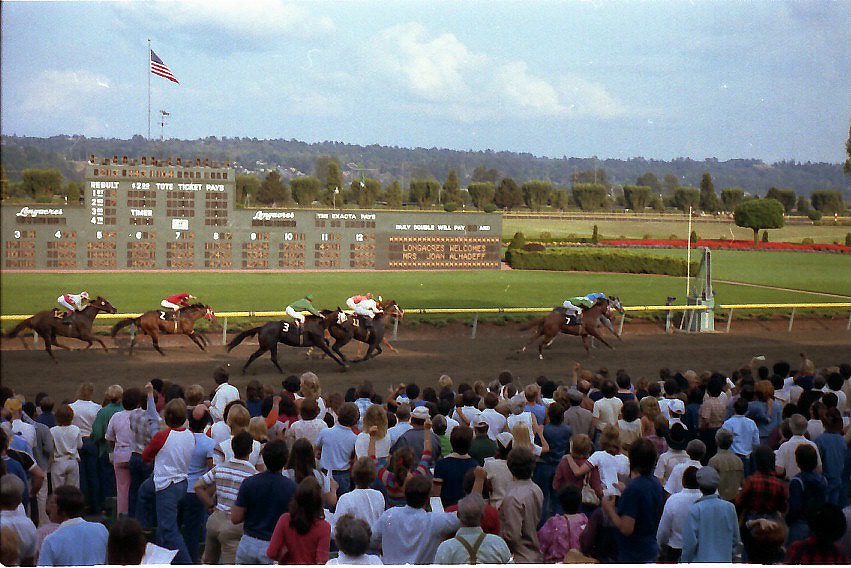
Longacres was a picturesque racetrack.
But Grandy’s connections were not going to sit idly by and watch their star get beaten. They took Grandy north to Exhibition Park in Vancouver for the Richmond Handicap on July 5th. Contested over the Longacres Derby distance of nine furlongs, it would be the perfect indicator of Grandy’s ability to handle the distance. Steve Austin ventured north to accept the mount and the tandem was bet down to 2 to 1 favoritism. Negotiating Exhibition Park’s tight bullring turns to perfection, Steve asked Grandy to move sooner than usual. Grandy responded and together they drew off to win by a commanding eight lengths.
The traditional final prep at Longacres for the Derby is the Spokane Handicap. Run the first Sunday in August and contested over 1 1/16th miles, it is the perfect tightener for the three-year-olds against stakes-caliber competition before the Derby. In the thirty-eight runnings prior to 1975’s renewal, no fewer than ten winners of the Spokane went on to capture the Longacres Derby. And it was here that Grandy Dandy and Dusty County would first meet.
The morning of the race Steve had completed his usual activities of exercising horses and was lingering a bit longer than usual in the backstretch café. He was absorbed in the Racing Form, looking over the past performances of both his horse and those of his chief competitor. A friend approached and sat down, ultimately asking Steve about the big race. Steve explained he was looking for a way to beat Dusty County.
“Can’t be done,” his friend exclaimed.
“Well look here,” Steve said. “Here’s a race where Dusty got beat. Diablo beat him and Pincay was riding. All I’ve got to do is pretend I’m Pincay.”
A beautiful summer afternoon of sunshine greeted the Northwest race fans. By the time of the ninth race they were well settled in, anxious to catch a glimpse of the superstar they had heard so much about. They bet down Dusty County to sixty cents on the dollar and weren’t disappointed when leading rider Gary Baze took the favorite right to the front. Steve allowed Grandy to assume his usual early battle position toward the end of the pack, conserving his energy for his strong late kick. As the field pounded around the clubhouse turn, Grandy was in ninth, some eleven lengths off the pace. Dusty County was running easily on the front end as Grandy started picking up some of the pack. With a half mile to run, Grandy was fifth and closing. At the top of the stretch, Baze asked Dusty County for all he had. On this day, however, it was not enough; Grandy and Steve caught them inside the 16th pole and registered an electrifying 3/4 length win. As Steve weighed in after the race his friend called out, “Nice ride, Pincay.”
The scene was now set, all that was left was to wait the two weeks for the Derby. Grandy’s dramatic victory had endeared him to the hearts of the race fans and much of the pre-race chatter was of his chances. The more seasoned handicappers were looking for Dusty County to bounce back, improving after having had a trip over the local course. But there were other horses to consider as well. Cash Your Ticket was coming south from Vancouver following a big win and was expected to push Dusty on the lead. And the game runner Auguste was expected to venture north from California where he had just won and figured to be a factor late in the race if the speed backed up. The race promised to be an exciting one.
12,902 race fans were on hand to witness the 40th running of Longacres’ premier event for three-year-olds. Each and every one was treated to a spectacular show. Dusty County broke alertly and, as expected, Gary Baze again took him right to the front. They settled in comfortably, despite early pressure from Cash Your Ticket and longshot Majestic Major, completing the first half mile in a relaxed forty-seven seconds. Grandy had settled back and was also running easily. Steve gauged the pace from atop his mount, a little concerned at its leisurely clip but reassured by the pressure Dusty was getting. Next to Grandy, just inside him, was Auguste. Larry Pierce, who had been riding Auguste in California, was also content to allow his horse to relax, saving speed for the important stretch run.
As the field rounded the far turn, Baze asked Dusty for some run and he quickly opened up a three length lead, finishing Cash Your Ticket and Majestic Major. Both Steve and Pierce knew they had better move now or the race would be over; Dusty County was running too well. Then Pierce got a break. The rail opened up and he guided Auguste through. Steve and Grandy were caught on the outside, losing precious ground as the field turned for home. Dusty was still out by three but both Auguste and Grandy were closing. At the eighth pole Steve felt Grandy shudder but the horse responded and he kept riding hard. They were four lengths back and Auguste and Dusty County had locked horns.
Studying the Racing Form at Longacres before a race, 1981.Dusty County and Auguste hit the wire together, a photo finish. Grandy was six lengths back in third, unable to threaten the top two. As the riders brought their horses back to be unsaddled, the winner was announced. Dusty County had held off Auguste’s challenge and had won by a nose. The race was all a fan could want. Two fierce competitors had waged battle in a classic confrontation and one had emerged victorious. Steve gave Grandy an affectionate pat on the shoulder and took his saddle to weigh in. Grandy was then led back to his stall as Dusty’s delirious contingent celebrated in the winner’s circle.
Later, it was learned that Grandy had blown the suspensories in a leg during the running of the race. Obviously to Steve, the injury had occurred as Grandy was making his patented stretch move. His inability to sustain this move was due to the injury and it was a testimonial to Grandy’s tremendous heart that he had continued to dig in and give it his all after having been hurt. Grandy was turned out for the rest of the season with the hope of returning him to action the following spring.
Hope springs eternal, especially at the beginning of any horse race meet. In early May of 1976, Grandy Dandy was back in training, being pointed for the inaugural running of the Lewis & Clark Handicap at Longacres. The five furlong sprint may have been a bit short for a closer such as Grandy but at least the race would be a good indicator of how well Grandy had recovered from his injury. With regular rider Steve Austin up, Grandy spotted the front-runners twelve lengths early, a huge amount in so short of a sprint. He closed well, making up over six lengths in the stretch and was only beaten by two and a half, an encouraging effort from a horse who hadn’t raced in nearly nine months. Unfortunately, Grandy came out of the race sore and was turned out again.
His second comeback began in June of 1977. Despite his having been sidelined for thirteen months, Grandy’s connections were optimistic of finding racing life in his now five-year-old form. He finished sixth in each of his first two tries, both against allowance company. Steve Austin rode him the first time but wasn’t available the second. In his third start, also without Steve, Grandy finished a fast-closing third and it was thought he could compete in the stakes ranks again. Grandy and Steve were reunited for 1977’s renewal of the Governor’s Handicap at Longacres. Grandy never got untracked and it was plain to Steve that the horse was hurting. He never asked him to run and Grandy limped home a well-beaten tenth.
At this point, the plan was to retire Grandy Dandy permanently. He had given everyone involved with him some exciting times and plenty of joy. Being a gelding, Grandy’s value was in racing, but his racing days were over. He now belonged in a picturesque pasture where he could live out his days in luxury, choosing to run when he himself wanted to.
Perhaps Grandy was one of those horses you hear about who want nothing to do with retirement. The kind who, understandably, feel useless without having a job to report to every day. For whatever the reason, in 1979 Grandy came back to the track. He came back in the claiming ranks this time, making his first start in a measly $1600 claiming affair at Playfair in Spokane. He still had his penchant for late moves and dramatic finishes, getting up at the wire to win by a nose. He was claimed out of that first start and ran eight more times in Spokane for his new owners, never finishing worse than fourth and winning twice before the Playfair summer meeting ended.
Down the stretch at Yakima Meadows, 1979.
In the fall of 1979, I was a junior in high school. My earlier enthusiasm for horse racing had escalated into a full-time hobby and my father’s two dollar investments had changed into portions of paychecks I earned while working as a clerk in a bookstore. I had a few friends who were equally smitten and on a sunny Saturday following the close of Longacres’ 1979 campaign, three of us decided to embark upon the three hour drive to Yakima and try our luck at Yakima Meadows. Our luck, mine especially, was poor as the day passed and we found ourselves with only two races left. In the first of those final two I selected Satus Springs, an even-the day’s-ledger choice at 9 to 1. When he went wire-to-wire, putting me a few dollars ahead, I decided to sit on my wallet and enjoy the afternoon’s final race, a non-descript cheap claimer for older horses going six furlongs.
Though nary a dollar escaped my wallet before the running of that all-too-ordinary race, I lost. In some great scheme of things, we all lost. For on the far turn, while making his typical move, a seven-year-old gelding named Grandy Dandy, the race favorite, broke down.
Steve Austin was there. He had ridden in the seventh race and, despite being without a later mount and having endured strong requests from his wife to head on home, had stuck around. He wanted to see Grandy one more time.
Since we had taken two trips to France in 2014, one during the summer and one in December to celebrate Ella’s 18th birthday, we didn’t make a trip in 2015. In London, 2016.So Melinda’s and my next return to see our friends in Nantes was in 2016. This time, to do something different, we flew in and out of London, staying for a few days both times. It was my first ever time in England and I thought it was fabulous. Even though we weren’t in France, I tagged the days we were in London with the “France 2016” moniker so they will appear when you click the link below.
While in Nantes, we rented a house in the neighborhood in which we lived during the sabbatical year, just a couple of blocks from the Bertail’s. Part of what I loved about this decision is that it put us on the same tram line (Ligne 2) that I fell in love with when we were there initially in 2010-11. It also put me in close proximity of the Nantes racetrack (the hippodrome) which is where I began running in 2011. Each morning, I’d get up and go for a jog from our house over to and around the track, plus anywhere else that suited my fancy.
Also, this was another one of those trips that consisted of just Melinda and me. While we missed having the girls with us, there was something liberating about traveling “sans enfants.”
To easily see the posts from 2016, click this link.















 Andy Smallman