A Boy, a Ballplayer, and a Ballad

When I was a little boy, the youngest of three sons, my family lived in Omaha, Nebraska. That’s where I was born so 100% of my life’s experience was developed in Omaha; that is, until my father was transferred to the Seattle area a couple of months before I turned 11.

I was raised a sports fan, most specifically baseball and hockey. While my brothers and I played sports, it was more the garden variety neighborhood pick-up games than with organized teams, albeit with some exceptions. My oldest brother, Scott, played a year of Little League baseball and I played a year of organized ice hockey. Steve, the middle brother, and I played softball through Cub Scouts and we all bowled somewhat competitively.

Perhaps more than playing sports, my family enjoyed attending sporting events. Omaha wasn’t big enough for the major leagues, but we did have some really good minor league teams during the time we lived there, the 1960’s and early 1970’s. The Omaha Knights hockey team was affiliated with the New York Rangers and we saw some pretty good players and coaches begin their professional careers inside Ak-Sar-Ben Coliseum. Most notably, defenseman André Dupont and coach Fred Shero helped guide the Knights to a Central Hockey League championship before winning a couple of Stanley Cups with the Philadelphia Flyers “Broad Street Bullies” teams in the mid 1970’s.

The top farm team for major league baseball’s Kansas City Royals was in Omaha. Also called the Royals, we saw some excellent baseball players pass through on the way to the “Show,” as the big leagues is called, including future Hall-of-Famer George Brett. Outfielder Amos Otis, pitcher Paul Splittorff, and second baseman Frank White all played in Omaha before making it big as members of some solid Kansas City teams in the 1970’s and beyond. And manager Jack McKeon ended up winning over 1000 games as a big league manager after his stint in Omaha.

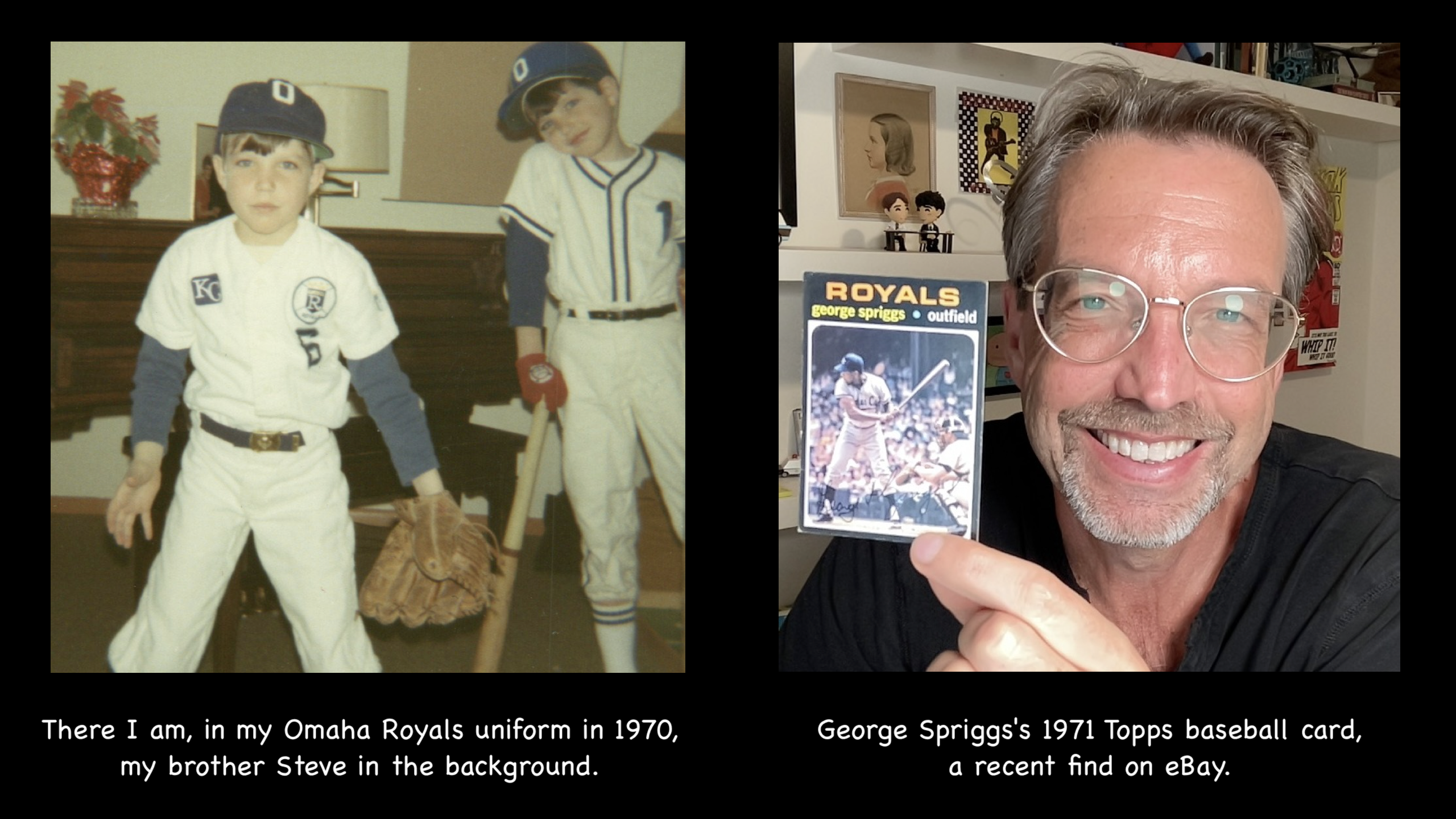
My favorite baseball player was one of the older members of the team in both 1969 and 1970, an outfielder by the name of George Spriggs. I’m not really sure why Spriggs caught my attention more than the younger guys on their way up. But if I was to make a guess, I’m pretty sure it was the way he carried himself. He just looked like a baseball player to me. He wore his socks up, making his baseball pants look baggy, which I tried to emulate when I put on my replica Omaha Royals uniform. His most notable characteristic, at least to me, was how he carried his baseball glove when jogging out to take his position in centerfield. With his hand in his glove, he somehow tucked the glove into the spot between his arm and chest, the top resting inside his armpit. Of course, that’s how I carried my glove when jogging from whatever we used as a dugout to my position in the field.

Spriggs came to the Kansas City organization from the Pittsburgh Pirates where he’d been languishing in the minor leagues. I suppose the Royals, being a new team at the time, thought he might make a good utility outfielder for them. For whatever reason, though, they sent him down to Omaha where he tore up the league in 1970. I remember him being super fast and stealing a lot of bases. He helped guide Omaha to the American Association championship that year and won the league’s Most Valuable Player award. My family was there at Rosenblatt Stadium to see a lot of those games.

We’d sit on the 3rd base side of the field and arrive early to watch the players warm-up. Looking back on it, I suppose arriving early extended my parents’ entertainment dollar, which I learned later wasn’t large. What I remember at the time was loving it, going down to the rail and calling the players’ names, hoping they’d come over to autograph our programs, gloves, or anything else we might have for them to sign. For some of the more veteran players on both the Royals and whatever team was visiting, players demoted from the majors, we’d bring their baseball cards. It was always a big achievement to get a baseball card signed.

About George Spriggs, as an adult I learned that he had played in what was the remnants of the Negro Leagues in the 1960’s. It’s well-known now that there was a time in which black players were banned from playing in the “major leagues” (I put that in quotes because the so-called Negro League teams were at least as good as the so-called Major League teams of the time). Jackie Robinson broke the “color barrier” in 1947 but due to racism and other reasons, aspects of the Negro Leagues continued on until the mid 1960’s. That’s when Spriggs played.

By the way, a well-written and heartfelt tribute to George Spriggs’s baseball career can be found here. I highly recommend it.

I don’t recall what made me think of George Spriggs recently but I think it had to do with reminiscing about my life in Omaha. As I often do, I was playing some songs from that time period and decided to try to create some “70’s soul ballads” on Suno, the artificial intelligence song generator that has captured my fancy for the better part of the last two years. I’ve been taking song lyrics and poems I’ve written at various points in my life and making them into songs, something that I’ve found both energizing and fulfilling.

Writing with a specific genre in mind provides me with an interesting challenge. I think I’ve been most successful with country songs, for whatever reason. But I’m such a nostalgia sap and I have a lot of warm feelings about music from the early 1970’s that I wanted to give that era a go, specifically some of the soul ballads of the time. “Midnight Train to Georgia,” “Me and Mrs Jones,” “You Make Me Feel Brand New,” and “Could it Be I’m Falling in Love” work like a time machine for me, bringing back feelings and memories from over 50 years ago. And because a couple of those years were really tough for me, punctuated by night terrors and a week-long hospitalization to try to get to the bottom of it, I think I have a need to make sense of the time.

Using Suno to create songs from different genres prompted a desire in me to come up with band names for the various styles. My country songs are “performed” by a fictional band I call Executive Estates, the name of the apartment complex in Seattle in which I lived when I started writing sappy break-up songs, perfect for country music. Two other of my “bands” are named in honor of tram stops on Line 2 in Nantes, France where my wife, daughters, and I lived for a year in 2010-11. Recteur Schmitt has an Eastern European / gypsy-punk vibe, and Motte Rouge has an alternative pop-folk feel with a female lead singer. You can find all three bands on Spotify or download some songs on Bandcamp.

Perhaps you see where this essay is going. What to name the fictional band of my new 70’s soul ballad songs, right? I got a little giddy when the idea of naming it for George Spriggs occurred to me. And given many of the songs include background singers, I decided I needed both a singer and the band in the name, you know like Gladys Knight and the Pips. So I’m pleased to announce the debut single of George Spriggs and the Omaha Royals, complete with the music video below.

END-NOTE:
I know a lot of people are understandably disturbed by AI-generated music. I’m not trying to promote it or defend it beyond saying that it brings me tremendous pleasure to create these songs. I write the lyrics and the prompts, then spend time adjusting the sound until I get what I want. The end result feels like some kind of magic to me.

The Summer of the Ladysmith Station, July 2007

All families have stories they regularly retell, the ones you have no idea will have long-lasting significance when they happen. This was certainly the case with an experience from 18 years ago this summer, when my wife’s parents, Dwight and Michele, dropped off my family – Melinda, my wife, and our daughters, Chloe and Ella – in Ladysmith, British Columbia after spending a week with them on their sailboat.

Spending a week on Dwight and Michele’s boat for the Commodore’s Cruise was a semi-annual event for us. This Seattle Yacht Club (SYC) event was always a highlight of our summer when it took place, and it fit Melinda’s and my meager summer holiday budget. As administrators of a nonprofit school, money was always tight.

We’d drive from Seattle to Anacortes and park our car, then take the ferry from Anacortes to Friday Harbor in the San Juan Islands. From there, we’d make our way to Roche Harbor where Dwight and Michele would meet us on their boat. From Roche Harbor, we’d travel by boat to Henry Island where SYC has an outstation. They’d tie up the sailboat there, and we’d have the run of the outstation for the rest of the day.

The next day would be the beginning of the Commodore’s Cruise, a social event that includes both casual cruising and a friendly competition among a large number of boaters, including point-to-point races for sailboats. It starts in the waters of the Salish Sea before crossing into British Columbia, with stops at various SYC outstations and other marinas for planned dinners, parties, and social activities.

Dwight & Michele at the helm!

In 2007, Dwight and Michele were going to continue north on their boat following the conclusion of the cruise in order to circumnavigate Vancouver Island. Because of our work responsibilities, Melinda and I didn’t have that much time so we needed to return to Seattle. Checking train schedules based on our planned location at the end of the cruise, Melinda determined that we could catch a train in Ladysmith, a tiny town on Vancouver Island, that would take us to Sidney. From Sidney, we’d catch a ferry to Anacortes, reunite with our car, and head back to Seattle.

Simple.

Traveling by boat is different than traveling by car. You have to take into account things like tides and water depth. And the morning we were being dropped in Ladysmith created a tight window for Dwight and Michele to have the depth of water they’d need to get through a narrow passage later that day. In other words, dropping us off would need to be both efficient and quick – no long goodbyes or dilly-dallying.

Also, Dwight’s and Michele’s sailboat, while comfortable and tremendously fun, was not really built for six people to live for an extended time. Quarters were tight and this needed to be considered when packing for the week-long cruise. Most of our clothes and essentials were packed in a single large duffle bag that could be easily stowed. The four of us each had a small backpack for personal belongings plus this larger duffle, which was understandably a tad heavy.

It was overcast as we approached the Government Dock in Ladysmith, our drop-off spot. Dwight expertly navigated the sailboat to the dock and Melinda, Chloe, Ella, and I jumped off, along with our backpacks and overstuffed duffle. I recall that Dwight didn’t even have us tie up to the dock to make the transition from sea to land easier. We pretty much jumped onto the dock before he quickly powered away, Michele waving and blowing kisses.

The Government Dock, Ladysmith.

So there we were, Melinda, Chloe, Ella, and me, on this very industrial-looking dock in Ladysmith with four small bags and one overstuffed large duffle. This was before smartphones with GPS. We really weren’t sure where the train station was. To our advantage, we had a few hours before the train was due to arrive. We set off on foot, me, with Melinda’s help, hoisting the duffle bag onto my back and latching it around my waist.

The first part of the walk was straightforward. There was only one way to go and that was away from the water. But we quickly discovered that this involved climbing an incline. In short order, Melinda, certain she’d found a shortcut, suggested we leave the paved road and walk on a trail of some kind. I was wearing flip-flops (it was summer vacation). I had a heavy bag on my back. But arguing with Melinda in moments like this is a losing proposition. Up the trail we went.

The trail got a bit steeper and one of my flip-flops started to fall off. I stood up to adjust it. With the weight of the bag on my back and the steepness of the incline, I started to fall backwards. I’m not quite sure how I caught myself but the look must have been entertaining to the rest of my family. They seemed to think it was worthy of laughter. Me, I pictured myself flat on back, my feet above my head, stuck on the trail and flailing like an overturned beetle.

I guess it was kinda funny.

We trudged on and found, get this, train tracks! Melinda’s next brilliant idea?! To walk along the train tracks as they certainly would lead us to the train station. I agreed, that’s true. But what about being run over by a train that happened to come by before we managed to arrive at said station? Being the one to have booked our train tickets, Melinda was pretty sure our train, the one still a couple hours away from arriving, was the only train scheduled. We walked along the tracks.

Before continuing with this story, let me just say that we all had it in our minds that a train station would be a place we could rest and wait for the train. I mean, what do you picture when you think of a train station? People, right? Workers, correct? Maybe a place to grab a drink and a bite to eat?

The Ladysmith Train Station was nothing like that. It consisted of a lot of overgrown brush and trees and a single, obviously abandoned, outbuilding. Littered around it was drug paraphernalia and evidence of past romantic trysts (aka syringes and condom wrappers). Most entertaining, though, was the graphic “F*!@ You” spray-painted on the building. No one else was there.

I’m pretty sure this is when Chloe’s internal warning system, heightened by being a fairly sheltered 14-year-old, went off. “Is this where we’re spending the next three hours waiting for the train? Where is the town? I bet the train isn’t even going to stop for us!”

I think it’s fair to say her foot came down strong on the side of the “I’m not staying here.”

Melinda’s parenting instincts had already kicked in. I knew her well enough to recognize that she was feeling pretty much like Chloe, but knew she also had the perspective that our options were limited. The sign here did say Ladysmith and by all accounts, we would be catching the train from this spot in a couple of hours. I could see her mental wheels turning and pretty much knew I didn’t need to say or do anything. She was going to, and in short order, say how we were going to make the best of this situation and help two kids pass the time with a halfway decent attitude.

A photoshoot.

It wasn’t a question. It was a statement.

A photoshoot!

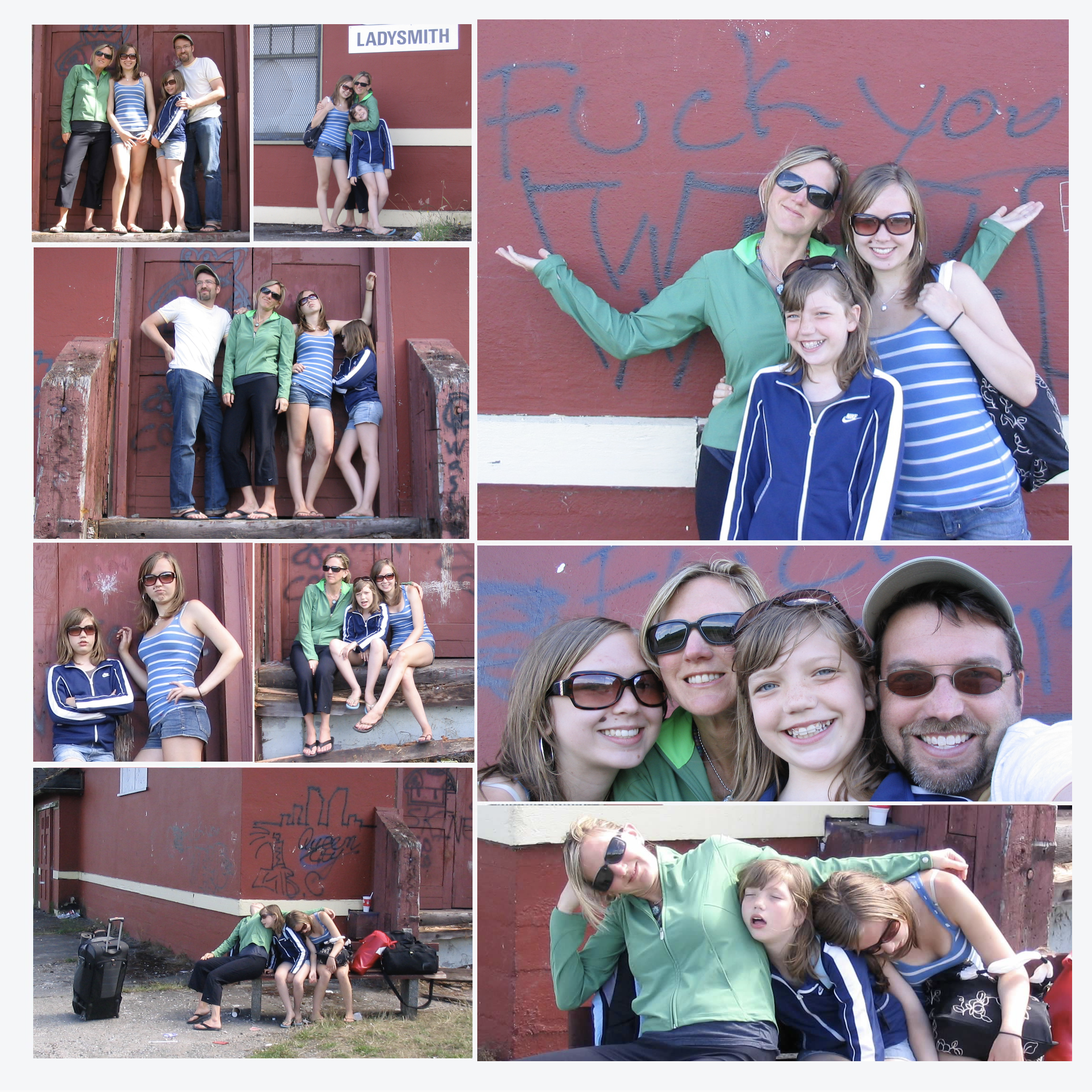
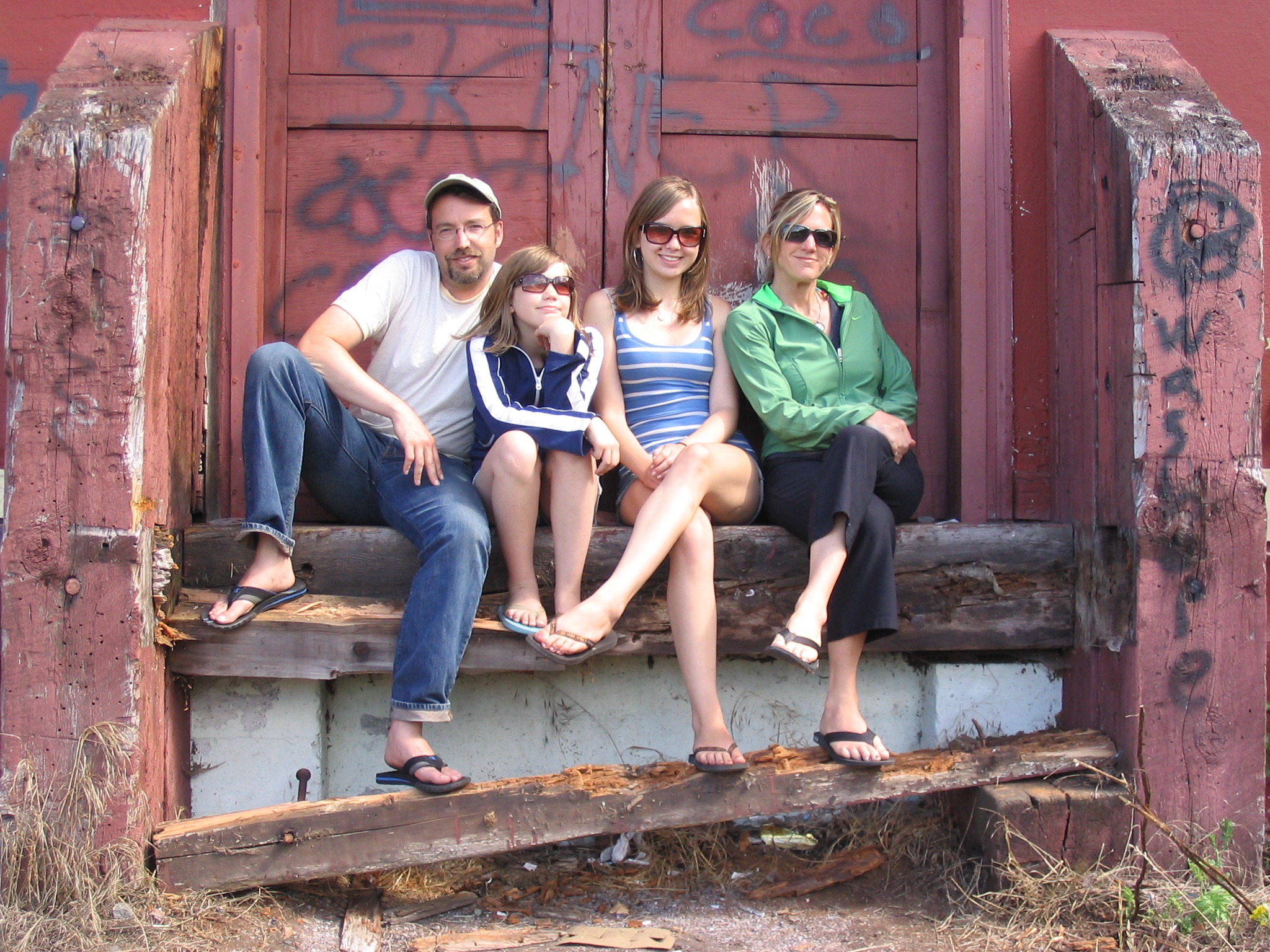
We had our camera (again, before smartphones) and, I had to admit, the overall look of the place would inspire the most creative of set-designers. Following Melinda’s directions, I carefully set down the duffle bag and we placed our smaller bags around it. Then we proceeded to line ourselves up in front of the abandoned station to take arm-distance group selfies before selfies were a thing. We were a little too scrunched together to get all of us in a really good shot so I took a few pictures of the three together. Melinda acted as photoshoot director, working to infuse energy and silliness into the moment. In the initial pictures, Chloe is looking pretty skeptical but ultimately came around. Ella, at age 10, was pretty game from the beginning.

Melinda pointed out that our camera had a delay feature, meaning we could try to get some posed group shots at a distance using the timer. We walked around to the end of the building and found a spot that we thought we could all sit down, backed by the peeling paint and graffiti-tagged exterior. I stepped on a lower plank to get to where we would sit, and my flip-flopped foot broke right through the rotten wood. A reminder to be careful.

By then, Melinda had set up the camera at the proper distance to capture the four of us and the building. Suggesting this could be the cover for our “record album,” she set the timer and rushed back to join us on the shady platform. By then, the sun had come out. Perfect! The resulting picture is one of my all-time favorites of my family.

One of my favorite family photos.

Maybe 20 minutes had passed and the photoshoot started to lose its luster. It was still more than two hours before the train was due to arrive. But we did notice a road at the far end, opposite of the way we had arrived. We walked up it and found the edge of Ladysmith, including a place to get a drink and a bite to eat. We relaxed, realizing that we weren’t the only people on earth, and laughed at our experience so far.

Close to the appointed time, we returned to the “train station,” and pretty much right on time our train appeared. About the train, it really didn’t come to a full stop for us. It slowed down, mind you, and a conductor did appear, clearly aware that some people were scheduled to be picked up in Ladysmith that day (that probably didn’t happen too often). He helped Chloe and Ella onboard, then Melinda jumped on. She reached back and helped get that crazy duffle bag onboard. Then I jumped on. The train picked up speed.

We had a lovely train ride to Sidney. I highly recommend it.

END NOTES:
– What prompted me to write this story was having recently come across an article in the Nanaimo News. Dated May 26, 2025, the headline is “$1M awarded for restoration of historic Ladysmith train station.” This pleases me no end. When the renovations are done, here’s hoping Melinda, Chloe, Ella and I can return for an updated photoshoot.
– Perhaps of interest, Pamela Anderson of Baywatch fame is from Ladysmith and lives there again now. Her TV show “Pamela’s Garden of Eden” shows how she has renovated her childhood home.
– In 2011, my efforts to promote ordinary acts of kindness were featured in a publication called Gulf News. The editors asked for a photo of me to include with the article and I sent them one from our Ladysmith photoshoot. Find the photo and the article here.

Planned Renovation

Moving Toward – The Spirit of Commencement

I’m the principal of a small school in Seattle called Spring Academy. Spring Academy serves students who, for a wide variety of reasons, have needs and/or circumstances that made things more challenging for them within a mainstream school. At Spring, we focus on building a compassionate school setting and providing the students personalized attention, thus allowing them to succeed in high school.

This past week we held our graduation ceremony and, as principal, it was my job to both facilitate the ceremony, which involved introducing the staff and addressing the graduates and their families. After personalizing the staff introductions, I addressed the graduates, of which there were five, as follows:

Here we are. You’ve done it. High school is complete. You’re finished with classes – well, you are welcome to come tomorrow, it is the last day of school, you know. Show of hands, who’s coming? No one?

Okay, you’re done. You’re about to get your high school diplomas! Whoo-hoo, right?! It feels like an ending, doesn’t it? A wrap-up. Your birthday and all the presents have been opened. Finished. You’re done.

But look at the name of this ceremony. Have you ever thought about it, the actual name of a graduation ceremony? It’s not called an ending or a termination. It’s called a commencement. Just what does that mean?

A commencement means a beginning.

This isn’t just a difference in words; it’s a powerful difference in perspective. It invites us to think about how we move through life – are we primarily moving away from something, or are we moving toward something?

Really, think about it. Moving away from something is often driven by fear, by the need to retreat. Sometimes, this is necessary – getting out of a dangerous situation, for example. But as a constant way of being, moving away can feel uncertain, heavy, and draining.

It’s an energy of retreat.

In contrast, moving toward something – a goal, a dream, a curiosity, a passion – is an act of active engagement. It brings energy, hope, excitement, and purpose. It’s like moving with a light guiding you. Moving toward something you believe in, something that inspires you, is an act of bringing positive energy into the world.

You might even call it a form of love.

Today is not just about moving away from the structure of high school. It is fundamentally about what you will choose to move toward next.

As you step out from here, into whatever comes next, I encourage you to find something to move toward. It doesn’t have to be a perfectly clear, lifelong plan. It can be a subject you want to learn more about, a skill you want to develop, a cause you believe in, a place you want to explore, or simply becoming the best version of yourself.

By actively seeking and moving toward something positive, you do two important things:

– You truly honor the spirit of a commencement ceremony, recognizing it as a beginning.
– And, more importantly, you contribute positively to the world around you.

So, Spring Academy Class of 2025, as you leave this chapter behind, go find your “toward.” Move with hope, move with energy, move with purpose. If you do, you will undoubtedly make all of us proud. And most of all, you will be proud of yourself.

Congratulations on your commencement!

The Tao of Kindness – 81 Songs Now Available

A few years back, a quiet weekly reflection became something bigger than I expected. From 2018-2020, I translated each Tao Te Ching chapter into kindness-focused poems, sharing them on Facebook and on my Kind Living website as a personal anchor and maybe a little support for others who value kindness.

Last year, I discovered an AI music generator called Suno and started turning those poems into modern pop songs. I wrote the words and prompts. Suno made the music. The result? “The Tao of Kindness,” a five-volume music series inspired by all 81 Tao verses, seen through a lens of kindness.

I’m pleased to announce that the fifth and final volume of The Tao of Kindness is now completed! This wraps up the full cycle—81 kindness poems, 81 kindness songs. You can stream the songs for free and even download all 81 tracks for free on Bandcamp.

“The Tao of Kindness” has been a real passion project, exploring old wisdom in a fresh way. I hope it resonates with some of you. Here’s a sample song:

France 2017 (From the Archives)

I often use this blog as a memory jog and one of my favorite “jogs” is to review Melinda’s and my trips to France. Melinda left PSCS in June of 2017 and that summer we took what we intended to be our annual trip to France

The idea of an annual trip to France got blown up in 2018, the year I left PSCS. Instead, we moved to the Bay Area and stayed there until 2019. We came back to Seattle and bought a little fixer-upper house. But we really hadn’t made any money over those 12 months. And living on savings and then buying a house that needed a LOT of work, well, annual trips to France were out. Besides, in 2020 there was a little thing called a global pandemic…

Still, all was quite innocent during the summer of 2017 and Melinda & I made our annual trip to France. This trip included some extended time in Amsterdam with Christine & Bérnard, celebrating Bérnard’s parents’ 60th anniversary in Normandy, and lots of fun times with Laurent & Frédérique. One downside was that my beloved tram line in Nantes, Line 2, was closed in our old neighborhood. To help me cope, Bérnard took me dumpster diving to find some Line 2 souvenirs to bring home.

To easily see all the posts from 2017 in reverse order, click this link.

THE Finish Line at Emerald Downs (my dad’s final resting spot)

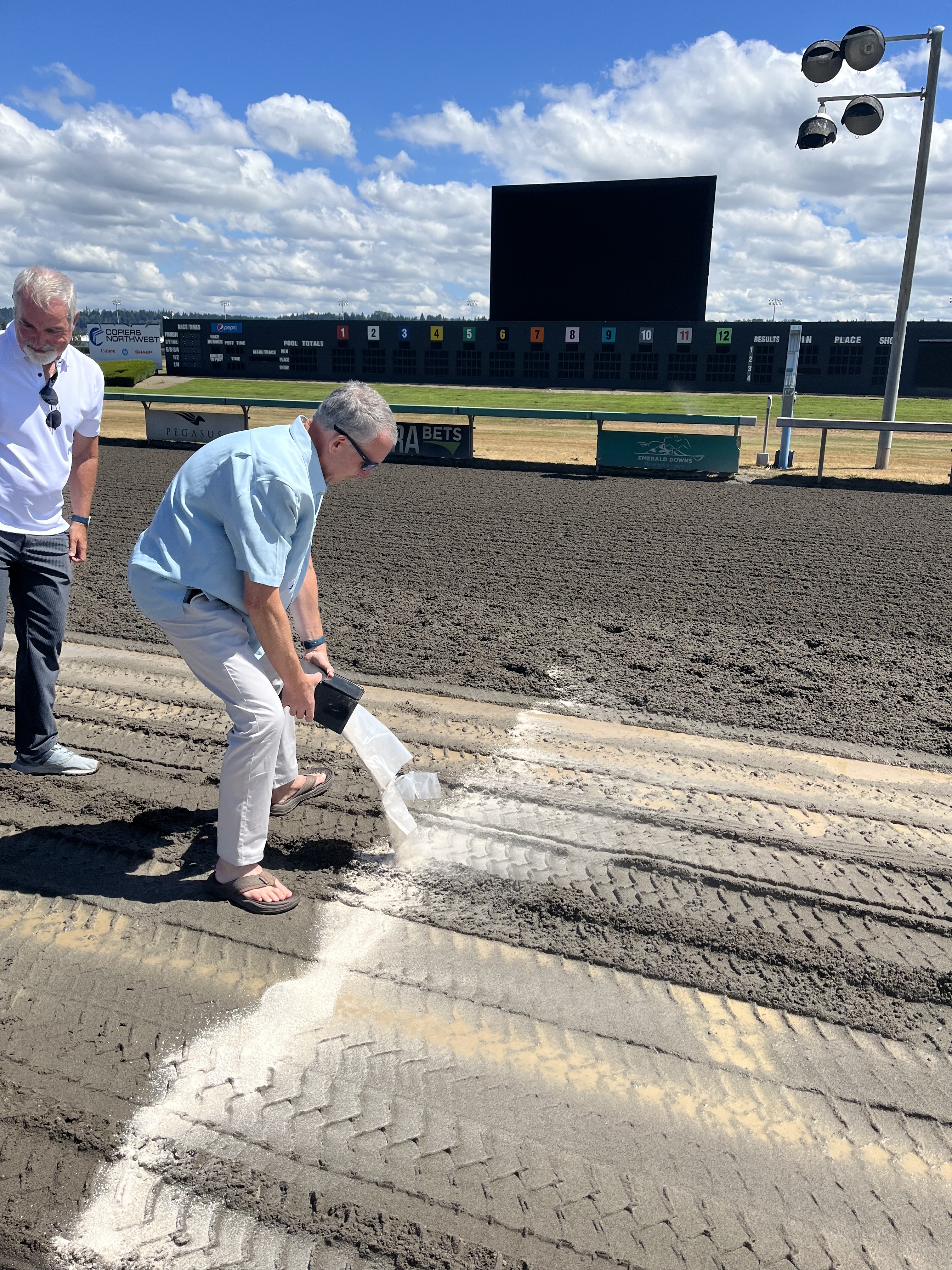
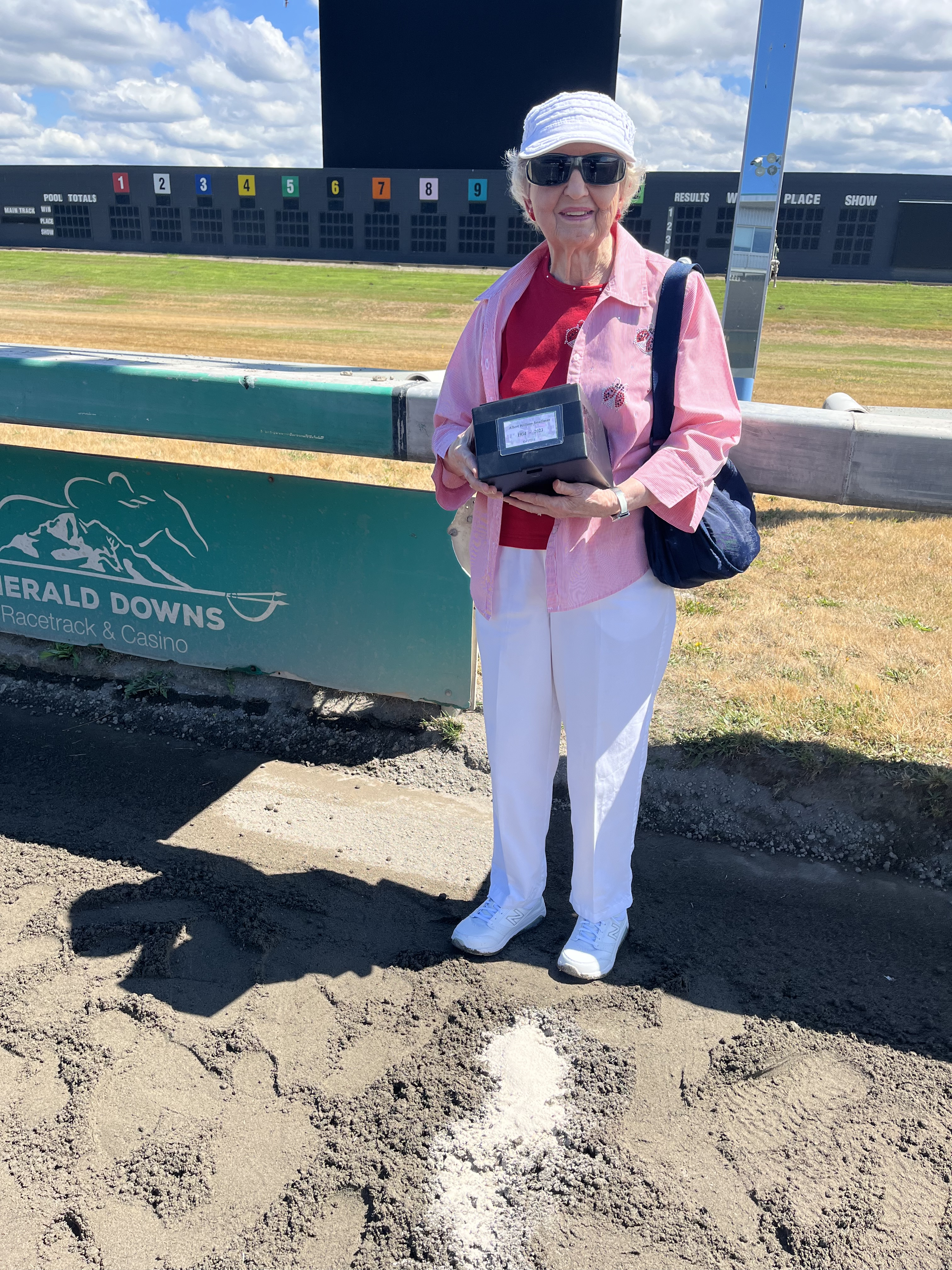
You may recall that my dad died last year, almost exactly a year ago. Yesterday, my mother, my brothers, and I, along with three of my dad’s racetrack colleagues, honored his life by spreading his ashes on the racetrack at Emerald Downs. But not just anywhere on the racetrack, like in a tiny corner where the horses don’t run, but at the finish line.

In fact, we made my father’s final resting spot to be THE FINISH LINE. How poetic is that, especially for my dad, to become a visible line across a racetrack at the point where every race ends?

The photos below, I hope, put this in even better perspective than my short description here. As my mom said soon after we walked through the Winner’s Circle on our way out of the racetrack, “This was perfect.”

Indeed.

Spreading my dad’s ashes across the racetrack at Emerald Downs, we made a new finish line.
My mom, with a little help from me, gets THE finish line started.
Steve adds to the line.
Scott’s turn.
I moved over to the inside rail and connected the line to the center of the track.
My mom standing with her back to inside rail, the ashes remains of her husband now a line across the racetrack.
Soon after we had finished spreading the ashes at the finish line, the tractors came and my dad’s remains were more thoroughly merged into the racetrack.
Before opening up the box containing my father’s ashes, we posed for a picture in the Winner’s Circle, an apt place for my brothers, my mother, and me to pose with my father.

Before spreading the ashes, we stood in the Winner’s Circle and listened to legendary track announcer Robert Geller’s “race call” of my dad’s life, an obituary in the form of a track announcer’s call of a horse race:

“Don’t Turn Your Head,” a Song About “Goodbye Moments” At the End of a Date

I’m fairly convinced that my family and friends think I’ve gone off the deep end with the amount of time I’m spending on Suno, the AI-music generator. I know I keep saying it but it’s so true. Doing this really brings me a lot of joy.

I’m spending the most time adapting my Tao of Kindness poems into pop songs. As a refresher, over 81 consecutive weeks beginning in 2018, I adapted the 81 verses of the Tao Te Ching into kindness-themed poems. After discovering Suno in March, I had the idea to take those 81 kindness poems and make them into pop songs. So far, I’ve completed 48 of them, all of which you can find on Bandcamp.

Here I am, 1985, age 22.
But I’m just as enamored with taking song lyrics I’ve written over the years and using Suno to make them into full-blown songs. About the lyrics, I wrote most of them in the 1980’s, long before getting married, having kids, and starting a school. And most of those songs are about my romantic plights at the time. It’s kind of remarkable that through all of the moves and changes of the last 40 years I held onto the lyric sheets. But I’m a sappy archivist at heart and these songs serve as a kind of diary or journal, much like this blog has been serving as a memory jog for me over the last 14 years.

With that long introduction, I offer a song that I first wrote in June of 1985. I’m 22 years-old and know I’m heading off to Olympia and The Evergreen State College in a couple of months. My job as a statistician at The Daily Racing Form had been automated, meaning I had been laid off (truthfully, I was offered the opportunity to continue with the DRF but had to move to Los Angeles to do it, which didn’t really interest me). In short, I had a lot of time on my hands.

My apartment in NE Seattle, called Executive Estates, had an outdoor swimming pool. I spent a lot of time that summer out by the pool (well, in the pool, too). I also spent time with Matt, my “little brother,” part of the Big Brothers program. And I had a couple of women friends that I hung out with that summer, too. One, Janet, would come over to the pool quite regularly. We went to the Puyallup Fair in September to see Three Dog Night. She was a security guard at the time and we drove to Puyallup in her patrol car that had lights on top, like a police car. Driving down Highway 167 to Puyallup, it was fun seeing the drivers ahead of us slow way down when they caught a glimpse of Janet’s car in their rear view mirrors.

My other female friend was Cynthia who I’d known since my family moved to Washington State in 1974. She was in the combined 4th/5th classroom I was placed in upon our arrival in March. We went onto the same junior high school, Tillicum, grades 7th-9th. I remember being in the same English class in 9th grade, the year she was a cheerleader. We became more casual friends in high school although by the time we were seniors I had a pretty serious crush on her. Late in the school year, I asked her to the senior prom although we both had said we didn’t plan to go. She turned me down, perhaps because of that earlier pledge. I don’t know.

My feelings for Cynthia remained fairly dormant over the next couple years, during which I had the first adult romantic relationship of my life (Suno has helped me develop a whole album of songs dedicated to that relationship – stay tuned). But it had long ended and by early 1985 my feelings for Cynthia had rekindled. We hung out fairly often and my desire to be more than friends increased significantly.

After doing something together (what, I don’t remember – maybe a movie, a walk in the park, whatever), we’d say goodbye. And it was in these awkward moments of saying goodbye that I’d get flustered. I wanted the friendship to blossom into a romance so in each of these “goodbye moments” I’d imagine that we’d have a romantic kiss. Clearly, though, she wasn’t interested. So we’d say goodbye and she’d turn her head, offering me her cheek to kiss. Very European, a French bissou.

After one of these goodbyes I went home and wrote this song in which I imagined a time in which she wouldn’t turn her head, that instead of her cheek I’d be offered her lips.

Original lyric sheet from 1985 (click to enlarge)
Maybe it’s kind of sappy, maybe it’s kind of sweet. Over the years, I still remember the feelings of it.

Finding the lyric sheet in a notebook after discovering Suno in March, I tried a number of different genres and AI prompts, more than any other of my old songs. In the end, the one that I like best is as a country song. I rephrased a couple of the lines and got this final result.

If you like this one, I created an entire album of similar songs, all country-sounding and using my original lyrics, and posted it on Bandcamp. One of those, “Off Course, Of Course,” was also inspired by me wanting to date Cynthia.

“To Be a Blessing” by Recteur Schmitt (a get well card for David Spangler)

I put the embedded song together as a “Get Well Card” of sorts to my friend David Spangler, he of the Lorian Association. David has been a major source of personal & professional inspiration and support for more than half my life. He and the entire Spangler family helped Melinda and me start PSCS back in 1994. Since then, David and I have had regular lunches, email back & forths, and many other ways to stay connected.

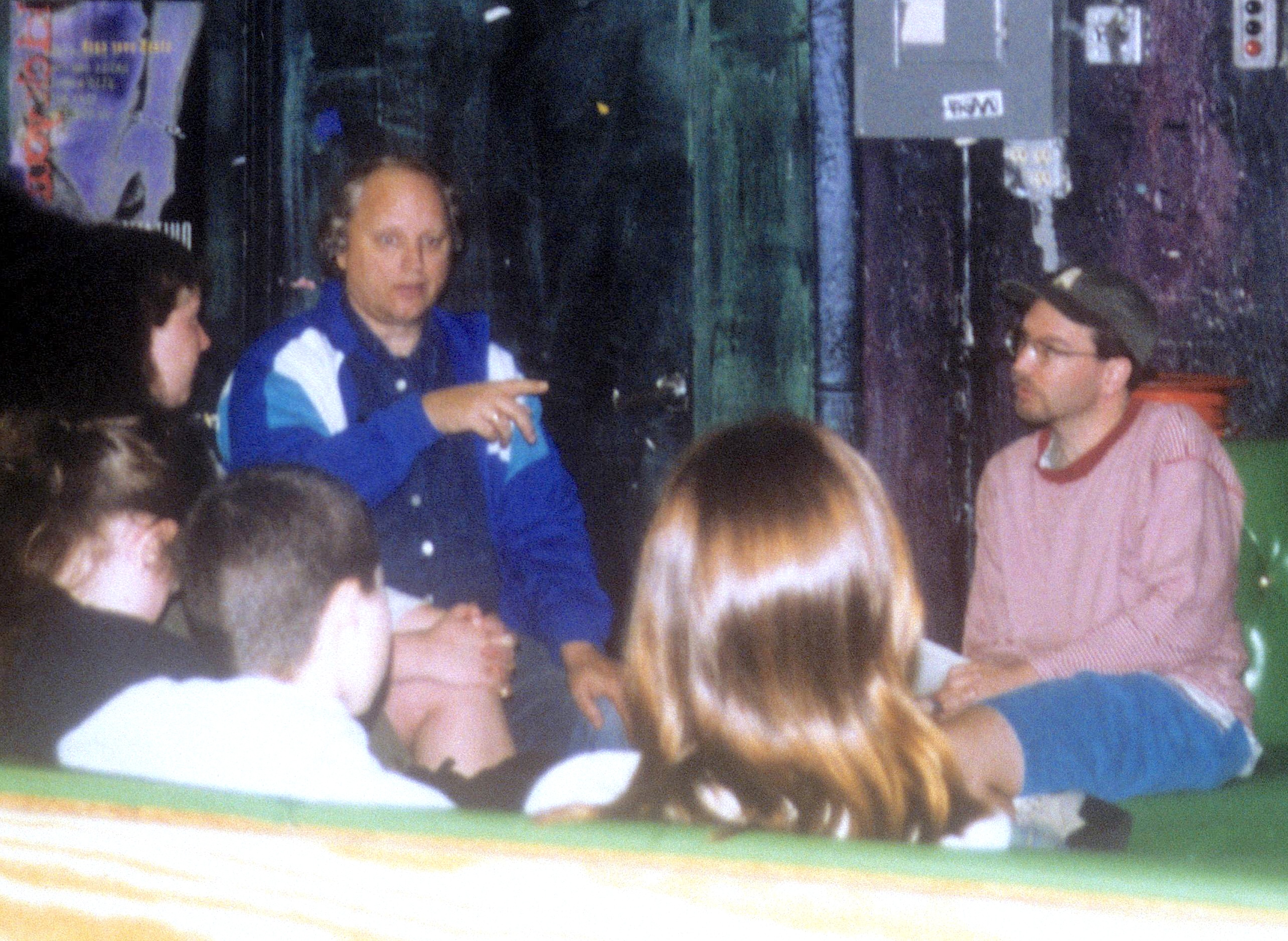
David facilitating a PSCS class in the 1990’s. Yes, that’s me in the striped shirt.
The central part of David’s work is about what he calls “Incarnational Spirituality,” which revolves around the idea that being human, with our unique physical bodies, is a sacred experience. It emphasizes the importance of appreciating our physical selves and our connection to the Earth. Instead of simply aiming for oneness with everything, this approach sees our individuality as a strength that allows us to express love and make the world a better place through acts of service and kindness towards others.

I’ve long been a subscriber to David’s newsletter and a few years back he shared how a number of people associated with Lorian individually described incarnational spirituality. I was taken by their descriptions and as an exercise designed to increase my understanding, I worked to make each individual’s description into a haiku. If you’re interested in them, I’ve pasted them below.

Earlier this year, I discovered Suno, an AI music generator that allow you to quite easily create songs. Having enjoyed poetry- and lyric-writing for all of my adult life, I started playing around with Suno, learning how to best use prompts, extend songs, etc, and have really enjoyed the results. Knowing David hasn’t been feeling great and remembering my haikus, I thought I’d work on adapting them into a pop song. Today, I made the accompanying music video that allows the listener/viewer to follow along with my lyrics.

If you’re interested, here’s the music genre prompt I entered into Suno to get it to create this sound: Eastern European, gypsy punk ballad, accordion, trumpet, male vocal

I actually created an album’s worth of songs with a similar sound, many of them adapted from other things I’ve written over the years — poems, essays, memoirs. The album is called “Rediscover Play” and the band is called “Recteur Schmitt,” a tribute to Nantes, France, where my family lived for a year in 2010-11, specifically Line 2 of the tramway there (Recteur Schmitt is the name of a tram stop). Listen to the album (and/or pay $1 to download it) on Bandcamp.

Get well, David! I hope you get a kick out of this, my “get well card.”

THE HAIKUS THAT INSPIRED THIS SONG:

Souls walking on ground
enable a partnership.
To be a blessing.

We are each sacred.
An intimate universe.
Pre and post mortem.

Live a human life.
An inherent act of love.
Ourselves being here.

To work as partners.
Physical and spirit worlds.
In joy, love, and will.

The unfolding spark
is linked through relationships.
Unique and vital.

Metaphysical.
Practical simplicity.
Heart-wise renewal.

Go inwards with heart.
Unexpected hope rising.
Life, weaving its way.

Physical, subtle.
Interconnected wholeness
of co-creation.

The Tao of Kindness Pop Songs – “Slow Down”

First, it’s my birthday today (61 – wow!) and I’m using the occasion to announce a new Kind Living project based on one of my all-time favorites.

Over 81 consecutive weeks, beginning in 2018 and ending in 2020, I adapted the 81 chapters of the Tao Te Ching into kindness verses, one each week, as part of a personal meditation practice. The idea of this project was to consider the ancient wisdom of the Tao through the lens of 21st-century kindness. Find the verses archived here.

In 2024, I discovered Suno, the AI music generator that allows people to make their own music using prompts, including putting their own lyrics to music. I’ve found this to be a tremendously satisfying thing to do and I’m joyfully adapting all 81 of my verses into pop songs.

The one embedded above, “Slow Down (At One With the Divine),” was inspired by Verse 13 of the Tao Te Ching. It’s included in the first of five albums I’ll be making available over the next several months, ultimately having all 81 verses adapted in readily-available pop songs. You’ll be able to find them on pretty much all the usual music streaming services and as free downloads on Bandcamp (links below).

I’ve named the “band” Motte Rouge as a tribute to the city of Nantes, France, where my family lived in 2010-11. This is a specific tribute to Line 2 of the city’s tramway, Motte Rouge being one of the tram stops. Learn more via this blog post I wrote on October 15, 2010.

STREAM:
Apple Music || Amazon Music || Spotify

DOWNLOAD FOR FREE:
Bandcamp

SUPPORT KIND LIVING:
Buy Me a Coffee || Patreon || PayPal