48 Card Pick-up (No Kings)

This morning, I got a funny text message from a friend of mine:

“I was watching a clip from Fox News (yes, really) where they accidentally unmuted their report of an ICE protest in Portland and an awesome AI generated disco themed song about the Epstein files is playing!”

Typical of me, I quickly offered a silly response:

“Ha! That sounds like the plot from a dream! Are you sure you’re awake?”

As I hit send on my message, I got this follow-up:

“And I thought: we need a song like that to play at our No Kings protest here, maybe Andy would write one for us!”

Challenge accepted!
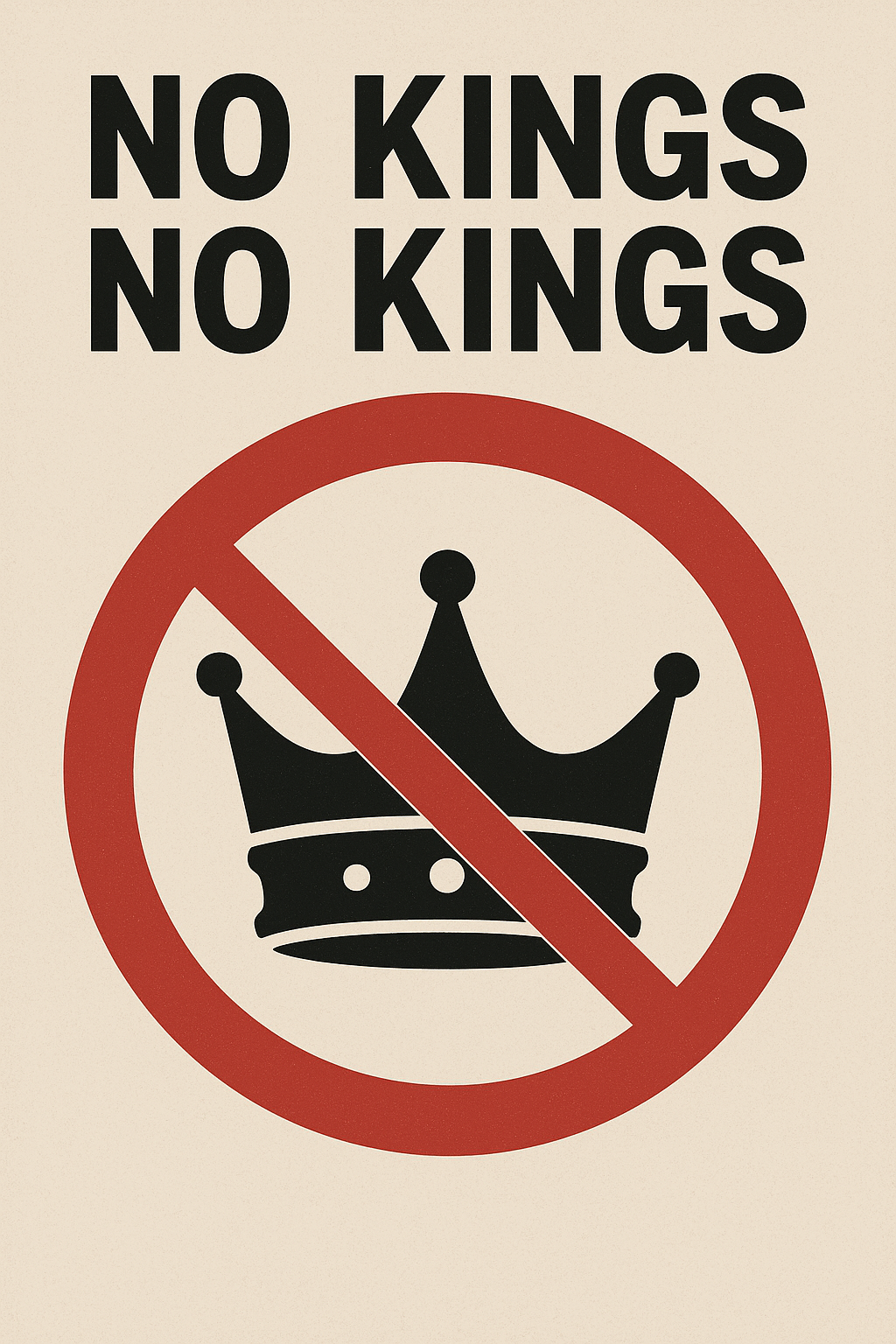
I stepped into the kitchen to fix breakfast for Senator Lloyd Bentsen From Texas (that’s the full name of Melinda’s and my maltipoo) and started thinking about what I might write. The “No Kings” concept had already planted in my head the idea of removing the four kings from a deck of cards, suggesting, perhaps, that the country wasn’t playing with a full deck. But that isn’t quite right. It’s not so much that the country isn’t playing with a full deck but, depending on one’s politics, half of the country and a number of politicians aren’t playing with a full deck.

At this point, I was breaking up Bentsen’s kibble into tiny pieces to get them ready to soak in beef broth. You see, he had dental surgery on Tuesday – 18 teeth removed – so we’re having to soften his food. He doesn’t have a lot of patience for this, especially when I’m distracted by a songwriting idea.

So distracted, I took Bentsen out to the parking strip to make room for his soon-to-be moist breakfast, if you know what I mean, and the idea of a song called “48 Card Pick-up” (52 cards minus the 4 kings) came to me. In standard 52 card pick-up, at least how I remember playing the game, you basically pinch a deck of cards so they go flying off in every direction. Once scattered, you pick them up. My idea for 48 card pick-up is you pick up, or reorganize, all the cards except the kings, getting everything in order again while leaving the kings where they’ve fallen

My creativity took off as Bentsen and I returned to the kitchen and I gave him his breakfast, along with his crushed pain pill and antibiotic. He gulped down the meal with the body language of a dog – who needs teeth, anyway, if you’re just going to swallow everything whole?

I sat down at my desk and started jotting down a few of these ideas, keeping any eye on the clock. I had a 9am meeting with 13-year-old client in California, followed by a scheduled conversation with his parents, so I wanted to capture these things before shifting my focus to the mentoring work I do on Saturday mornings. Today’s lesson with my client was on Honesty & Truthfulness, something for which I created slideshow during the pandemic. I wanted to make sure I had that all cued up so I put 48 Card Pick-up on hold.

Both my meeting with my client and the follow-up chat with his parents with his parents went long so it was about 10:30 when I got back to the song. By then, my friend who had texted me, along with her partner, had sent me several more texts, one of which was a suggestion to include something about the Epstein Files in the song.

At that point, I started to imagine how Pete Seeger might take on this assignment and typed his name into Google. I glanced through his Wikipedia page and some of the songs he helped make famous, one of which is “We Shall Overcome.” I opened a tab with the lyrics and typed “5 string banjo” at the top of my text file that at that point had nothing but my working title, “48 Card Pick-up (No Kings)” across the top.

Next, I opened a tab to NotebookLM, that’s part of Google’s AI suite and a tool I find extraordinarily helpful at condensing ideas. Notebook LM allows you to input sources – websites, random thoughts, pdfs, YouTube videos, etc. Then you enter a prompt and the AI will sort through the sources and respond to your prompt. I entered Wikipedia links to Pete Seeger and 52 Card Pickup, as well as two articles about Jeffrey Epstein, and the website to the No Kings rally. I also created a text source of my initial song ideas as I’ve summarized them above. I then prompted Notebook LM to organize the sources into an outline, highlighting overlaps between them. From the outline I got the lines “shuffle the deck” and “let the people decide” that I ultimately used in the song’s chorus.

Perhaps of interest, when writing a song lyric this way I find it helpful to start hearing some words being sung. I edited the NotebookLM outline and then uploaded it “as-is” to Suno, and used my first genre prompts:

“A protest song, children’s singalong, bouncy bluegrass, five-string banjo, upright bass”

The result was an absolute mess except for one thing. In editing the outline I had tried to create a simple chorus so my first input of words to Suno included this:

[CHORUS]
Oh, pick ’em up, pick ’em up, forty-eight cards!
We don’t need the Kings, they just stand in the yards.
Shuffle the deck, let the people decide,
A democracy built where the Kings cannot hide.

The prompts and the chorus yielded the catchy melody that you hear in the final version. And having a catchy melody allowed me to get a flowing rhythm for writing the verses and then ultimately editing the chorus.

Years ago, back in 1984 when I first started writing song lyrics, I found that the words came more easily if I could come up with a rudimentary melody. Suno provides me a more sophisticated melody and then musical accompaniment than I could ever hope to create on my own, one that helps me hear what needs to happen lyrically. And that’s what happened today.

When this happens, it’s like entering a zone or even like I’m channeling an idea from somewhere out in space. I’ve heard other people describe something similar when they’re creating something. It’s like it comes through you rather than from you. One piece of inspiration was to actually include a quote from “We Shall Overcome” in my lyric (can you find it?).

Just after noon, I had a version that I felt really good about and sent it to my friend. You can listen to that first version here. At that point, I could have been done. But once I send out a song link to someone, I click on the link and try to imagine how it might be to sit with them while they listen. And when I did that, I realized the chorus needed to be rewritten.

I had already rewritten what I had first written (remember, as inspired by the NotebookLM outline) to this:

[CHORUS]
Oh, pick ’em up, pick ’em up, forty-eight cards!
We don’t need the kings, put ’em in the discards.
Shuffle the deck, let the people decide.
No kings, no kings – that was already tried.

The “cards” and “discards” rhyme bothered me. And the 48 Card Pick-up idea, what had initially inspired the whole song while I was feeding Bentsen, really wasn’t part of this final version. But I had come up with something while writing the song’s bridge, how I could make a play on words with “The Art of the Deal” concept of the president and how I was using a deck of cards for imagery purposes. I needed a good rhyme for deal in order to have the art of the deal serve as a punchline.

I often use a lyrical bridge to enhance a point or to offer a new perspective or play on words. To get a rhyme for “deal,” I played with the “Stop the Steal” phrase that became ubiquitous with the 2020 election. I thought of “Start the Steal” as an opposite but that would give validity to the idea that the 2020 election was stolen and I didn’t want to do that. Keeping “steal” for the rhyme, I shifted focus to consider other playing card references and the concept of how in poker some cards are often announced as “wild cards” and that the king is a “face card” came to me. I knew I had the final chorus:

[CHORUS]
Shuffle the deck, let the people decide.
No kings, no kings – that was already tried.
His face card is wild, just out to steal.
No kings, no kings, that’s the art of this deal.

Having now used the best part of the bridge to complete a much improved chorus, I decided to forego writing a new bridge and set about taking what I now felt was a really good final lyric and putting it through Suno’s prompts and editing.

I had found that my original song was way too heavy on banjo (sorry, Pete Seeger) so I started using Suno’s cover feature to focus on other instruments. This takes a lot of time and tweaking, and uses a lot of the credits I pay to be able to fully use Suno. Some tweaks improved the song, some were neutral, and some didn’t work at all. What I finally liked was this set of genre prompts, covering a scaled down version of the song:

“Folk, musical hooks, male singer, alternative folk, catchy”

I recently upgraded my Suno subscription to allow me to use what they call the Suno Studio. With Studio, you basically have a recording studio at your fingertips, something that takes me back to my days at The Recording Workshop in Chillicothe, Ohio in 1983 when I learned how to record bands and mix songs on a 24 track analog console. I took my favorite version of my song and extracted the “stems,” stems being the individual instrument tracks. Then I exported a version that was just the vocal and acoustic guitar, what is kind of like a demo version.

With that version, I used Suno’s Cover feature with these genre prompts:

“children’s singalong, sparse acoustic instruments, twangy male vocal”

That’s the version I’m now promoting; in fact, I even made a simple music video of it:

A Boy, a Ballplayer, and a Ballad

When I was a little boy, the youngest of three sons, my family lived in Omaha, Nebraska. That’s where I was born so 100% of my life’s experience was developed in Omaha; that is, until my father was transferred to the Seattle area a couple of months before I turned 11.

I was raised a sports fan, most specifically baseball and hockey. While my brothers and I played sports, it was more the garden variety neighborhood pick-up games than with organized teams, albeit with some exceptions. My oldest brother, Scott, played a year of Little League baseball and I played a year of organized ice hockey. Steve, the middle brother, and I played softball through Cub Scouts and we all bowled somewhat competitively.

Perhaps more than playing sports, my family enjoyed attending sporting events. Omaha wasn’t big enough for the major leagues, but we did have some really good minor league teams during the time we lived there, the 1960’s and early 1970’s. The Omaha Knights hockey team was affiliated with the New York Rangers and we saw some pretty good players and coaches begin their professional careers inside Ak-Sar-Ben Coliseum. Most notably, defenseman André Dupont and coach Fred Shero helped guide the Knights to a Central Hockey League championship before winning a couple of Stanley Cups with the Philadelphia Flyers “Broad Street Bullies” teams in the mid 1970’s.

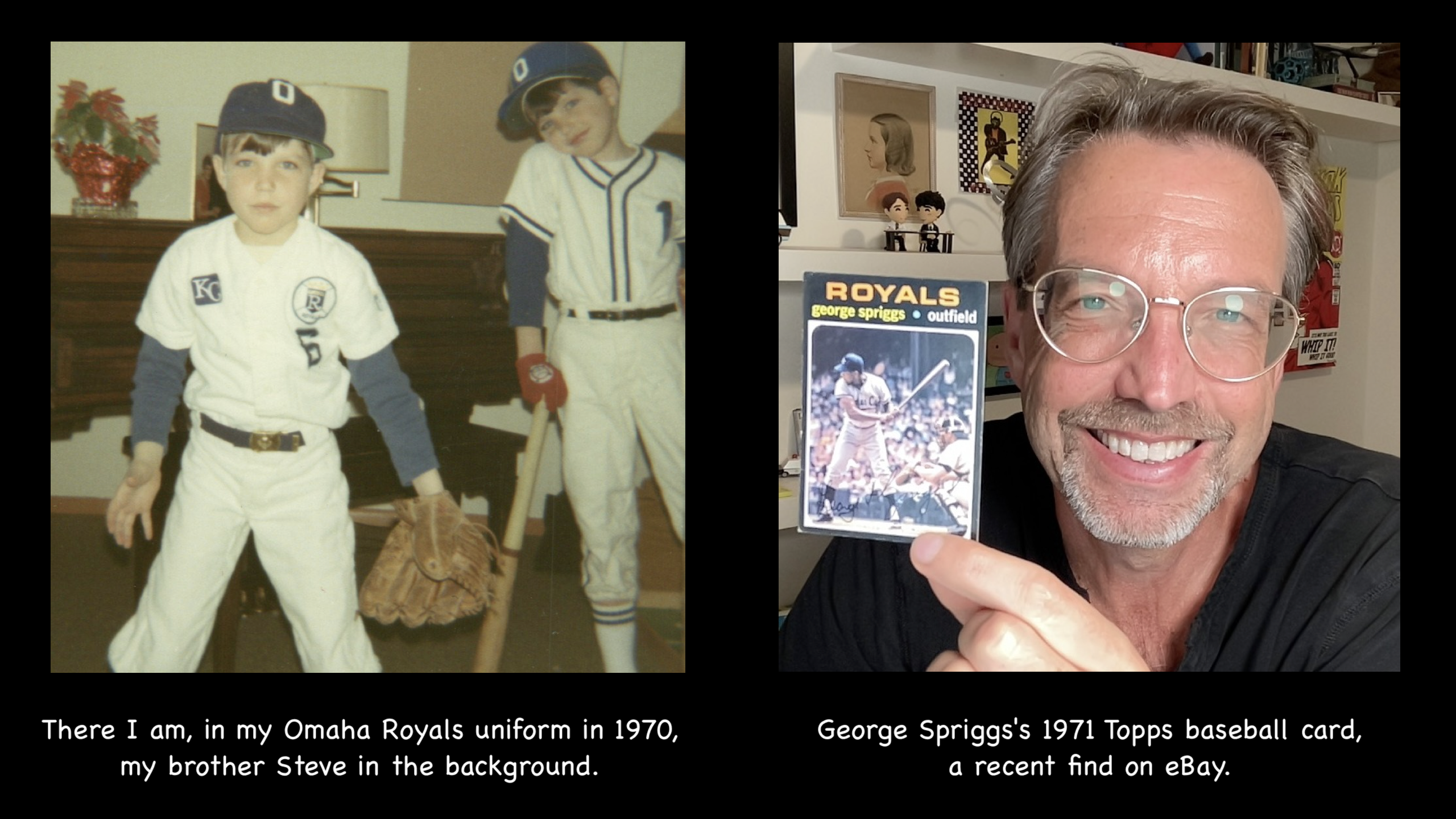
The top farm team for major league baseball’s Kansas City Royals was in Omaha. Also called the Royals, we saw some excellent baseball players pass through on the way to the “Show,” as the big leagues is called, including future Hall-of-Famer George Brett. Outfielder Amos Otis, pitcher Paul Splittorff, and second baseman Frank White all played in Omaha before making it big as members of some solid Kansas City teams in the 1970’s and beyond. And manager Jack McKeon ended up winning over 1000 games as a big league manager after his stint in Omaha.

My favorite baseball player was one of the older members of the team in both 1969 and 1970, an outfielder by the name of George Spriggs. I’m not really sure why Spriggs caught my attention more than the younger guys on their way up. But if I was to make a guess, I’m pretty sure it was the way he carried himself. He just looked like a baseball player to me. He wore his socks up, making his baseball pants look baggy, which I tried to emulate when I put on my replica Omaha Royals uniform. His most notable characteristic, at least to me, was how he carried his baseball glove when jogging out to take his position in centerfield. With his hand in his glove, he somehow tucked the glove into the spot between his arm and chest, the top resting inside his armpit. Of course, that’s how I carried my glove when jogging from whatever we used as a dugout to my position in the field.

Spriggs came to the Kansas City organization from the Pittsburgh Pirates where he’d been languishing in the minor leagues. I suppose the Royals, being a new team at the time, thought he might make a good utility outfielder for them. For whatever reason, though, they sent him down to Omaha where he tore up the league in 1970. I remember him being super fast and stealing a lot of bases. He helped guide Omaha to the American Association championship that year and won the league’s Most Valuable Player award. My family was there at Rosenblatt Stadium to see a lot of those games.

We’d sit on the 3rd base side of the field and arrive early to watch the players warm-up. Looking back on it, I suppose arriving early extended my parents’ entertainment dollar, which I learned later wasn’t large. What I remember at the time was loving it, going down to the rail and calling the players’ names, hoping they’d come over to autograph our programs, gloves, or anything else we might have for them to sign. For some of the more veteran players on both the Royals and whatever team was visiting, players demoted from the majors, we’d bring their baseball cards. It was always a big achievement to get a baseball card signed.

About George Spriggs, as an adult I learned that he had played in what was the remnants of the Negro Leagues in the 1960’s. It’s well-known now that there was a time in which black players were banned from playing in the “major leagues” (I put that in quotes because the so-called Negro League teams were at least as good as the so-called Major League teams of the time). Jackie Robinson broke the “color barrier” in 1947 but due to racism and other reasons, aspects of the Negro Leagues continued on until the mid 1960’s. That’s when Spriggs played.

By the way, a well-written and heartfelt tribute to George Spriggs’s baseball career can be found here. I highly recommend it.

I don’t recall what made me think of George Spriggs recently but I think it had to do with reminiscing about my life in Omaha. As I often do, I was playing some songs from that time period and decided to try to create some “70’s soul ballads” on Suno, the artificial intelligence song generator that has captured my fancy for the better part of the last two years. I’ve been taking song lyrics and poems I’ve written at various points in my life and making them into songs, something that I’ve found both energizing and fulfilling.

Writing with a specific genre in mind provides me with an interesting challenge. I think I’ve been most successful with country songs, for whatever reason. But I’m such a nostalgia sap and I have a lot of warm feelings about music from the early 1970’s that I wanted to give that era a go, specifically some of the soul ballads of the time. “Midnight Train to Georgia,” “Me and Mrs Jones,” “You Make Me Feel Brand New,” and “Could it Be I’m Falling in Love” work like a time machine for me, bringing back feelings and memories from over 50 years ago. And because a couple of those years were really tough for me, punctuated by night terrors and a week-long hospitalization to try to get to the bottom of it, I think I have a need to make sense of the time.

Using Suno to create songs from different genres prompted a desire in me to come up with band names for the various styles. My country songs are “performed” by a fictional band I call Executive Estates, the name of the apartment complex in Seattle in which I lived when I started writing sappy break-up songs, perfect for country music. Two other of my “bands” are named in honor of tram stops on Line 2 in Nantes, France where my wife, daughters, and I lived for a year in 2010-11. Recteur Schmitt has an Eastern European / gypsy-punk vibe, and Motte Rouge has an alternative pop-folk feel with a female lead singer. You can find all three bands on Spotify or download some songs on Bandcamp.

Perhaps you see where this essay is going. What to name the fictional band of my new 70’s soul ballad songs, right? I got a little giddy when the idea of naming it for George Spriggs occurred to me. And given many of the songs include background singers, I decided I needed both a singer and the band in the name, you know like Gladys Knight and the Pips. So I’m pleased to announce the debut single of George Spriggs and the Omaha Royals, complete with the music video below.

END-NOTE:
I know a lot of people are understandably disturbed by AI-generated music. I’m not trying to promote it or defend it beyond saying that it brings me tremendous pleasure to create these songs. I write the lyrics and the prompts, then spend time adjusting the sound until I get what I want. The end result feels like some kind of magic to me.

The Tao of Kindness – 81 Songs Now Available

A few years back, a quiet weekly reflection became something bigger than I expected. From 2018-2020, I translated each Tao Te Ching chapter into kindness-focused poems, sharing them on Facebook and on my Kind Living website as a personal anchor and maybe a little support for others who value kindness.
Last year, I discovered an AI music generator called Suno and started turning those poems into modern pop songs. I wrote the words and prompts. Suno made the music. The result? “The Tao of Kindness,” a five-volume music series inspired by all 81 Tao verses, seen through a lens of kindness.

I’m pleased to announce that the fifth and final volume of The Tao of Kindness is now completed! This wraps up the full cycle—81 kindness poems, 81 kindness songs. You can stream the songs for free and even download all 81 tracks for free on Bandcamp.

“The Tao of Kindness” has been a real passion project, exploring old wisdom in a fresh way. I hope it resonates with some of you. Here’s a sample song:

“To Be a Blessing” by Recteur Schmitt (a get well card for David Spangler)

I put the embedded song together as a “Get Well Card” of sorts to my friend David Spangler, he of the Lorian Association. David has been a major source of personal & professional inspiration and support for more than half my life. He and the entire Spangler family helped Melinda and me start PSCS back in 1994. Since then, David and I have had regular lunches, email back & forths, and many other ways to stay connected.

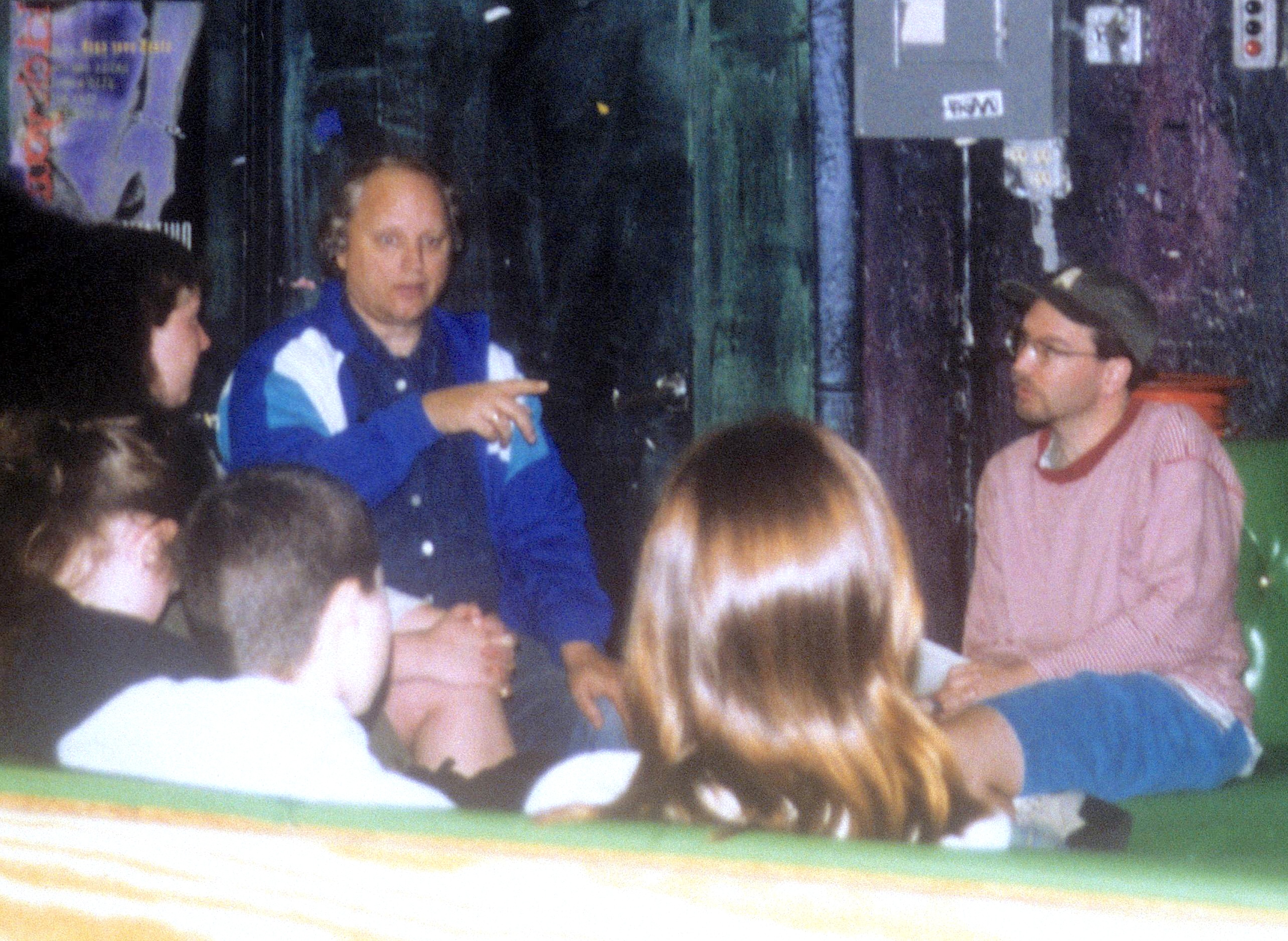
David facilitating a PSCS class in the 1990’s. Yes, that’s me in the striped shirt.
The central part of David’s work is about what he calls “Incarnational Spirituality,” which revolves around the idea that being human, with our unique physical bodies, is a sacred experience. It emphasizes the importance of appreciating our physical selves and our connection to the Earth. Instead of simply aiming for oneness with everything, this approach sees our individuality as a strength that allows us to express love and make the world a better place through acts of service and kindness towards others.

I’ve long been a subscriber to David’s newsletter and a few years back he shared how a number of people associated with Lorian individually described incarnational spirituality. I was taken by their descriptions and as an exercise designed to increase my understanding, I worked to make each individual’s description into a haiku. If you’re interested in them, I’ve pasted them below.

Earlier this year, I discovered Suno, an AI music generator that allow you to quite easily create songs. Having enjoyed poetry- and lyric-writing for all of my adult life, I started playing around with Suno, learning how to best use prompts, extend songs, etc, and have really enjoyed the results. Knowing David hasn’t been feeling great and remembering my haikus, I thought I’d work on adapting them into a pop song. Today, I made the accompanying music video that allows the listener/viewer to follow along with my lyrics.

If you’re interested, here’s the music genre prompt I entered into Suno to get it to create this sound: Eastern European, gypsy punk ballad, accordion, trumpet, male vocal

I actually created an album’s worth of songs with a similar sound, many of them adapted from other things I’ve written over the years — poems, essays, memoirs. The album is called “Rediscover Play” and the band is called “Recteur Schmitt,” a tribute to Nantes, France, where my family lived for a year in 2010-11, specifically Line 2 of the tramway there (Recteur Schmitt is the name of a tram stop). Listen to the album (and/or pay $1 to download it) on Bandcamp.

Get well, David! I hope you get a kick out of this, my “get well card.”

THE HAIKUS THAT INSPIRED THIS SONG:

Souls walking on ground
enable a partnership.
To be a blessing.

We are each sacred.
An intimate universe.
Pre and post mortem.

Live a human life.
An inherent act of love.
Ourselves being here.

To work as partners.
Physical and spirit worlds.
In joy, love, and will.

The unfolding spark
is linked through relationships.
Unique and vital.

Metaphysical.
Practical simplicity.
Heart-wise renewal.

Go inwards with heart.
Unexpected hope rising.
Life, weaving its way.

Physical, subtle.
Interconnected wholeness
of co-creation.

The Tao of Kindness Pop Songs – “Slow Down”

First, it’s my birthday today (61 – wow!) and I’m using the occasion to announce a new Kind Living project based on one of my all-time favorites.

Over 81 consecutive weeks, beginning in 2018 and ending in 2020, I adapted the 81 chapters of the Tao Te Ching into kindness verses, one each week, as part of a personal meditation practice. The idea of this project was to consider the ancient wisdom of the Tao through the lens of 21st-century kindness. Find the verses archived here.

In 2024, I discovered Suno, the AI music generator that allows people to make their own music using prompts, including putting their own lyrics to music. I’ve found this to be a tremendously satisfying thing to do and I’m joyfully adapting all 81 of my verses into pop songs.

The one embedded above, “Slow Down (At One With the Divine),” was inspired by Verse 13 of the Tao Te Ching. It’s included in the first of five albums I’ll be making available over the next several months, ultimately having all 81 verses adapted in readily-available pop songs. You’ll be able to find them on pretty much all the usual music streaming services and as free downloads on Bandcamp (links below).

I’ve named the “band” Motte Rouge as a tribute to the city of Nantes, France, where my family lived in 2010-11. This is a specific tribute to Line 2 of the city’s tramway, Motte Rouge being one of the tram stops. Learn more via this blog post I wrote on October 15, 2010.

STREAM:
Apple Music || Amazon Music || Spotify

DOWNLOAD FOR FREE:
Bandcamp

SUPPORT KIND LIVING:
Buy Me a Coffee || Patreon || PayPal

“Does Time Tell Us?” by Recteur Schmitt

Back in the late summer of 1996, my older daughter, Chloe, age three, and I were home, just the two of us on a Saturday night. My wife and Chloe’s mom, Melinda (who was pregnant with our younger daughter, Ella, at the time), had gone out with some friends. Together, Chloe and I made ourselves a casual dinner and now, the dishes cleaned up, it was nearing her bedtime.

At Chloe’s request, I had gotten out the art supplies and she was busy coloring, cutting paper, painting, and whatever else struck her artistic fancy at three-years-old. I was taken by the seriousness with which she was engaged, although it also struck me that part of her seriousness was to keep herself busy so maybe she would get to stay up past her bedtime. Watching her, all of these things kind of converged in my mind and this idea of who controls time came to me.

We use the expression “learn to tell time” to refer to being able to read a clock. But I had the inspiration that there was another meaning for that expression, that if we tried, we might want “to tell time” to ease up on us. I mean it’s Saturday night, your lovely little three-year-old is engaged in an art project. Do you really need to put her to bed because the clock says it’s 8pm? Who’s telling who what to do?

Do we tell time or does time tell us?

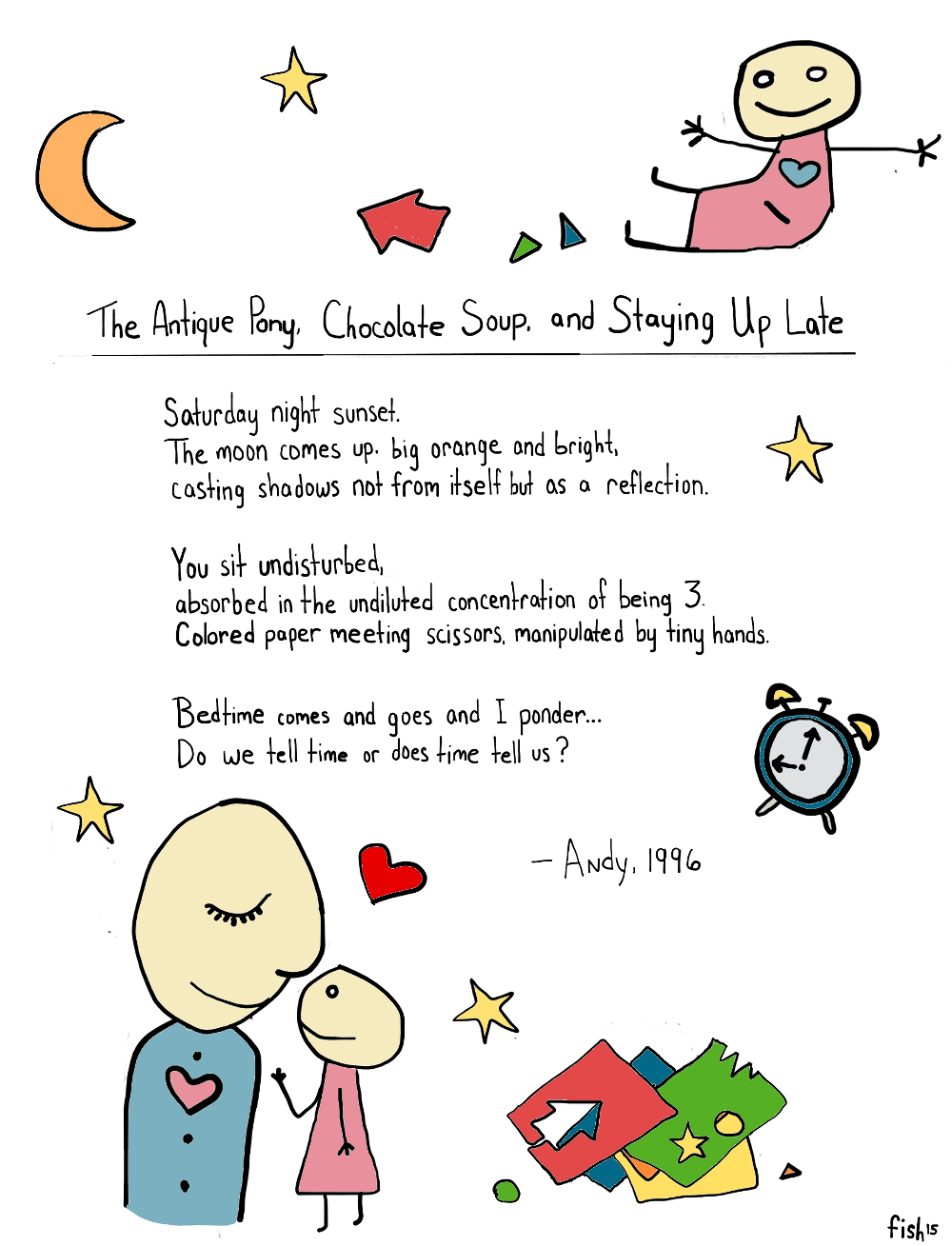
I made note of that expression and let Chloe stay up past her bedtime. After finally putting her to bed, I wrote a poem that ended with that line and referenced the evening we had had together. Over the next nearly 20 years, the poem was stashed in a binder where I kept things like it, songs, poems, ideas. Soon before Chloe graduated from college in 2015, I came across it while sifting through the binder in one of my frequent forays down memory lane. I asked an artist friend (Fish Astronaut) to illustrate the poem, and I presented the hand-printed illustrated version to her as a graduation gift (click on the image above, that’s it, to see it enlarged and read the original poem).

In the ensuing nine years, the poem would find its way back into my mind. Or, more accurately, the idea of being the master of my time or time being the master of me would find its way back into my mind. The concept of mindfulness, Eckhart Tolle’s book “The Power of Now,” and even expressions like “there’s no time like the present” would rattle around.

One night not loo long ago, I decided to see if I could make the poem into a song lyric, a song that would make the point about being the master of our time rather than the other way around with an added implication that maybe we could all learn something from little kids. The rewrite came fairly easily. Then this month, April of 2024, after I discovered the Suno AI music generator, I inputted my song lyric and the prompt “An eastern European gypsy punk ballad with accordion and power chords, sung fast.” The song here is the result. For the music video, I added pictures of Chloe from in and around the time she was three.

Postscript – I’ve named the “band” performing this song “Recteur Schmitt” for reasons I will explain at a different time. For now, understand that Recteur Schmitt is the name of one of the stops on Line 2 of the tramway in Nantes, France. Find an entire album of Recteur Schmitt songs on the usual platforms – Spotify, Amazon Music & Apple Music. If you want to buy a copy of the album for $1.00, go to Bandcamp and know you will have made my day.

DOES TIME TELL US?

Saturday night sunset, the moon comes up – big, orange and bright.
Too late for being on time, too early for saying goodnight.
You sit undisturbed, absorbed in the concentration of being three.
Your bedtime comes and goes, now what becomes of me?

What do we know, what is the fuss?
Do we tell time or does time tell us?
What do we know, what is the fuss?
Do we tell time or does time tell us?

I buried a wish in the sandbox when I was eight.
And lost more than my friends when they could not relate.
Now I hold your tiny hand and I’m back in the right place,
I thank the clock each time I see your face.

What do we know, what is the fuss?
Do we tell time or does time tell us?
What do we know, what is the fuss?
Do we tell time or does time tell us?

They mismanage the time they save for themselves,
while little kids listen for fire trucks, fairies, and elves.
You and me, we are the secret no one understands,
colored paper meeting scissors, manipulated by little hands.

Hour glasses to measure time, alarm clocks to wake us up.
Too much sand is passing through while morning is too abrupt.
Saturday night sunset, the moon comes up – big, orange and bright.
Too late for being on time, too early for saying goodnight.

What do we know, what is the fuss?
Do we tell time or does time tell us?
What do we know, what is the fuss?
Do we tell time or does time tell us?

“The Trick of Your Trade” – Songwriting, Spring Break, & A.I.

It’s spring break for me at Spring Academy where I’m the principal (yeah, a lot has happened since I last posted). I don’t want to talk about that right now, I want to talk about songwriting and AI.

I recently learned of Suno, an Artificial Intelligence music generator. To make use of it is pretty simple. Once you log in, you give it a few simple instructions and it will create a song for you. Want to write a country-tinged love song for your garbage collector, Suno’s got you covered.

For me, as much as I appreciate (love may be too strong) the people who collect our garbage, I’m not really interested in writing them songs of any kind. I am interested in taking many of the dozens of song lyrics I’ve written over the last 40 years and having them made into actual songs. I’ve had a couple of songwriting partners in the past but those fizzled out and the number of songs we created you could count on two hands. With Suno, I have a musical partner and a band wrapped into one. And after many weekend, evening, and now spring break hours of well-considered prompts and then some editing, Suno and I have collaborated on over 50 songs.

It’s a glorious feeling for me, tapping into a side of my history and creativity that doesn’t get a lot of attention these days. And with it being spring break, the timing is perfect.

[Click to Enlarge]
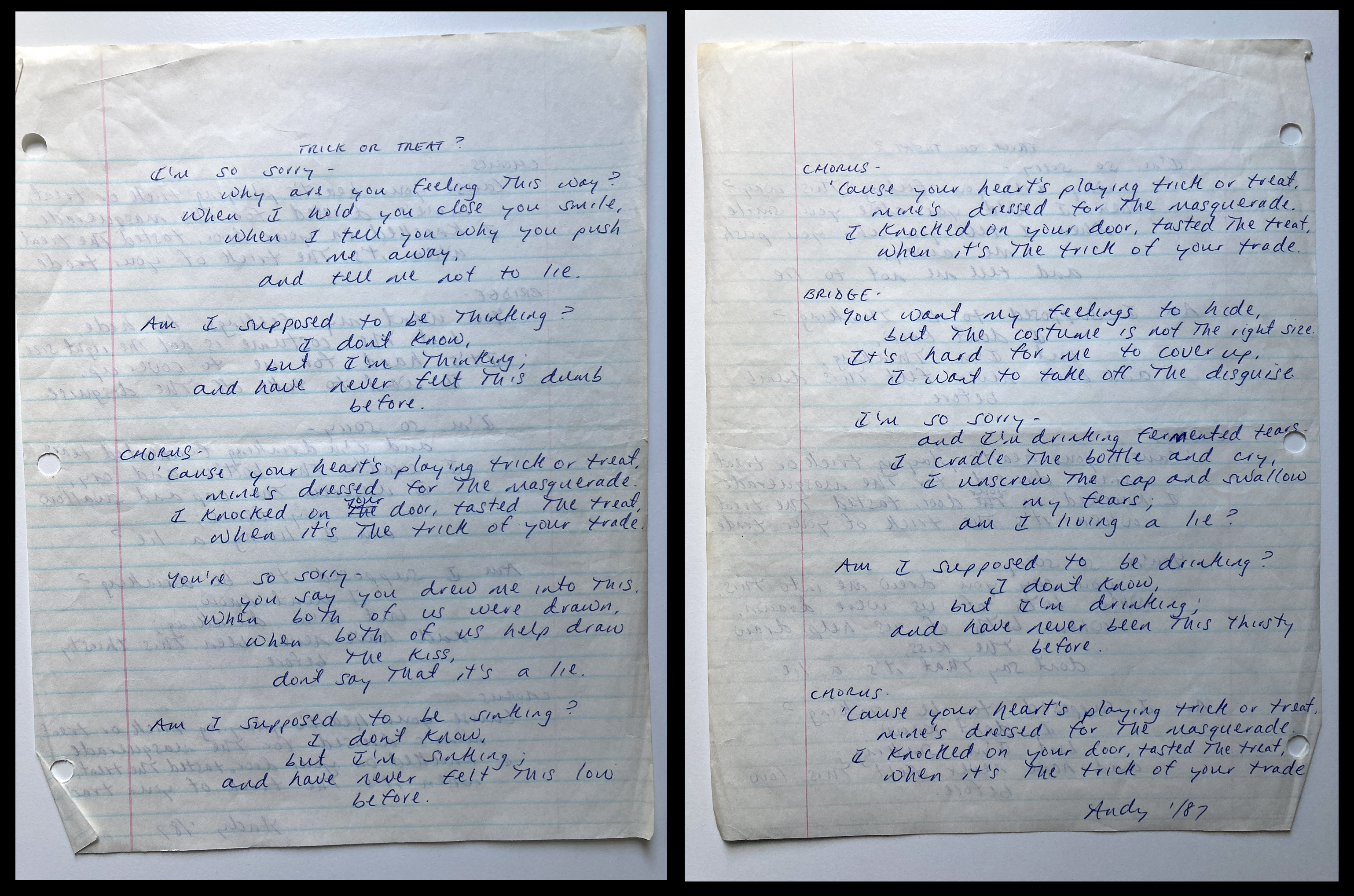
As an example, I present this song. I wrote the song lyric in late 1986 / early 1987 when I was a sappy 23-year-old undergraduate at The Evergreen State College. I was in what I wanted to be a serious romantic relationship but my girlfriend was interested in something less committed. Looking back, I can’t really blame her. It was college, after all.

Interestingly, this song was written in longhand on notebook paper, pages that I’ve kept all these years (click the photo above to have it enlarged). It started out as a poem so you might see some poetic structure to the verses. Once I added the chorus, it started to seem more like a song to me, although the rhyme structure of the verses (or lack thereof) is unusual for a pop song. My AI prompt was “Bouncy folky pop. Male singer. Brushed drums. Pedal steel guitar. Musical hooks.” There are a couple of errors with the output and the video generated by Suno misses the opening lyrics. But the falsetto-style chorus with the hook is genuinely beautiful to my listening ear, giving the song even more meaning for me than just the words on paper. Even 37 years later!

Oh, back in 1987 I called this “Trick or Treat” and even inputted it that way to Suno. But after listening to Suno’s output, “The Trick of Your Trade” sounded like a better title. Listen by clicking on the YouTube play button below and follow along with the lyrics, below that.

THE TRICK OF YOUR TRADE

(VERSE):
I’m so sorry, why are you feeling this way?
When I hold you close you smile.
When I tell you why you push me away and tell me not to lie.
Am I supposed to be thinking, I don’t know.
But I’m thinking and have never felt this dumb before.

(CHORUS):
’cause your heart’s playing trick or treat, it’s dressed for the masquerade.
I knocked on your door, tasted the treat, but it’s the trick of your trade.

(VERSE)
You say you’re sorry you drew me into this.
When both of us were drawn.
When both of us drew out that kiss, don’t say it was a lie.
Am I supposed to be sinking, I don’t know.
But I’m sinking and I’ve never felt this low before.

(CHORUS):
’cause your heart’s playing trick or treat, it’s dressed for the masquerade.
I knocked on your door, tasted the treat, but it’s the trick of your trade.

(BRIDGE):
You said you want my feelings to hide but this costume is not the right size.
It’s hard for me to cover up when I want to take off your disguise.

(VERSE):
I’m so sorry, I’m drinking fermented tears.
I cradle the bottle and cry.
I unscrew the cap, swallow my fears, am I living a lie?
Am I supposed to be drinking, I don’t know.
But I’m drinking and I’ve never been this thirsty before.

(CHORUS):
’cause your heart’s playing trick or treat, it’s dressed for the masquerade.
I knocked on your door, tasted the treat, but it’s the trick of your trade.