
This morning, I got a funny text message from a friend of mine:
“I was watching a clip from Fox News (yes, really) where they accidentally unmuted their report of an ICE protest in Portland and an awesome AI generated disco themed song about the Epstein files is playing!”
Typical of me, I quickly offered a silly response:
“Ha! That sounds like the plot from a dream! Are you sure you’re awake?”
As I hit send on my message, I got this follow-up:
“And I thought: we need a song like that to play at our No Kings protest here, maybe Andy would write one for us!”
Challenge accepted!
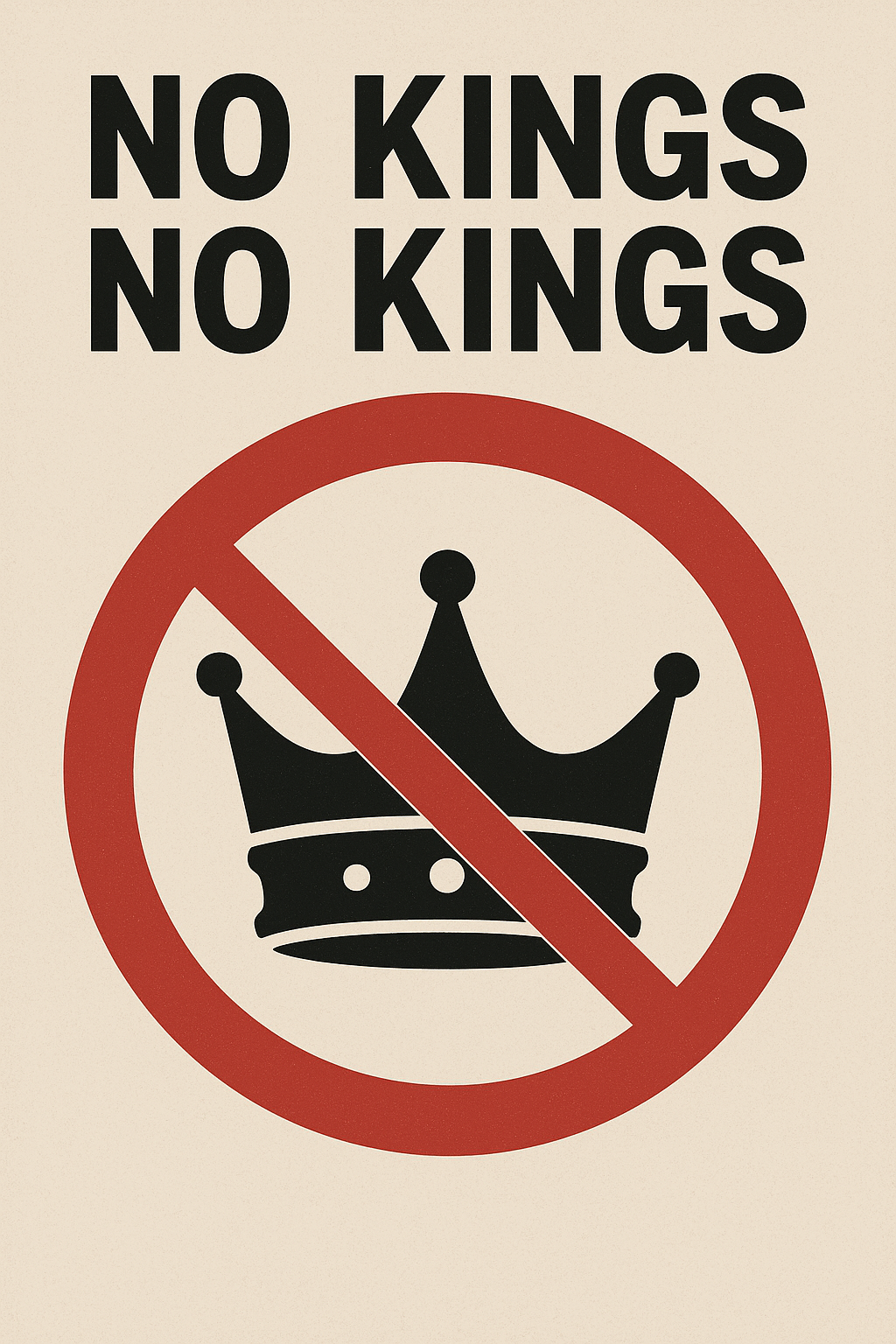 I stepped into the kitchen to fix breakfast for Senator Lloyd Bentsen From Texas (that’s the full name of Melinda’s and my maltipoo) and started thinking about what I might write. The “No Kings” concept had already planted in my head the idea of removing the four kings from a deck of cards, suggesting, perhaps, that the country wasn’t playing with a full deck. But that isn’t quite right. It’s not so much that the country isn’t playing with a full deck but, depending on one’s politics, half of the country and a number of politicians aren’t playing with a full deck.
At this point, I was breaking up Bentsen’s kibble into tiny pieces to get them ready to soak in beef broth. You see, he had dental surgery on Tuesday – 18 teeth removed – so we’re having to soften his food. He doesn’t have a lot of patience for this, especially when I’m distracted by a songwriting idea.
So distracted, I took Bentsen out to the parking strip to make room for his soon-to-be moist breakfast, if you know what I mean, and the idea of a song called “48 Card Pick-up” (52 cards minus the 4 kings) came to me. In standard 52 card pick-up, at least how I remember playing the game, you basically pinch a deck of cards so they go flying off in every direction. Once scattered, you pick them up. My idea for 48 card pick-up is you pick up, or reorganize, all the cards except the kings, getting everything in order again while leaving the kings where they’ve fallen
My creativity took off as Bentsen and I returned to the kitchen and I gave him his breakfast, along with his crushed pain pill and antibiotic. He gulped down the meal with the body language of a dog – who needs teeth, anyway, if you’re just going to swallow everything whole?
I sat down at my desk and started jotting down a few of these ideas, keeping any eye on the clock. I had a 9am meeting with 13-year-old client in California, followed by a scheduled conversation with his parents, so I wanted to capture these things before shifting my focus to the mentoring work I do on Saturday mornings. Today’s lesson with my client was on Honesty & Truthfulness, something for which I created slideshow during the pandemic. I wanted to make sure I had that all cued up so I put 48 Card Pick-up on hold.
Both my meeting with my client and the follow-up chat with his parents with his parents went long so it was about 10:30 when I got back to the song. By then, my friend who had texted me, along with her partner, had sent me several more texts, one of which was a suggestion to include something about the Epstein Files in the song.
At that point, I started to imagine how Pete Seeger might take on this assignment and typed his name into Google. I glanced through his Wikipedia page and some of the songs he helped make famous, one of which is “We Shall Overcome.” I opened a tab with the lyrics and typed “5 string banjo” at the top of my text file that at that point had nothing but my working title, “48 Card Pick-up (No Kings)” across the top.
Next, I opened a tab to NotebookLM, that’s part of Google’s AI suite and a tool I find extraordinarily helpful at condensing ideas. Notebook LM allows you to input sources – websites, random thoughts, pdfs, YouTube videos, etc. Then you enter a prompt and the AI will sort through the sources and respond to your prompt. I entered Wikipedia links to Pete Seeger and 52 Card Pickup, as well as two articles about Jeffrey Epstein, and the website to the No Kings rally. I also created a text source of my initial song ideas as I’ve summarized them above. I then prompted Notebook LM to organize the sources into an outline, highlighting overlaps between them. From the outline I got the lines “shuffle the deck” and “let the people decide” that I ultimately used in the song’s chorus.
Perhaps of interest, when writing a song lyric this way I find it helpful to start hearing some words being sung. I edited the NotebookLM outline and then uploaded it “as-is” to Suno, and used my first genre prompts:
“A protest song, children’s singalong, bouncy bluegrass, five-string banjo, upright bass”
The result was an absolute mess except for one thing. In editing the outline I had tried to create a simple chorus so my first input of words to Suno included this:
[CHORUS]
Oh, pick ’em up, pick ’em up, forty-eight cards!
We don’t need the Kings, they just stand in the yards.
Shuffle the deck, let the people decide,
A democracy built where the Kings cannot hide.
The prompts and the chorus yielded the catchy melody that you hear in the final version. And having a catchy melody allowed me to get a flowing rhythm for writing the verses and then ultimately editing the chorus.
Years ago, back in 1984 when I first started writing song lyrics, I found that the words came more easily if I could come up with a rudimentary melody. Suno provides me a more sophisticated melody and then musical accompaniment than I could ever hope to create on my own, one that helps me hear what needs to happen lyrically. And that’s what happened today.
When this happens, it’s like entering a zone or even like I’m channeling an idea from somewhere out in space. I’ve heard other people describe something similar when they’re creating something. It’s like it comes through you rather than from you. One piece of inspiration was to actually include a quote from “We Shall Overcome” in my lyric (can you find it?).
Just after noon, I had a version that I felt really good about and sent it to my friend. You can listen to that first version here. At that point, I could have been done. But once I send out a song link to someone, I click on the link and try to imagine how it might be to sit with them while they listen. And when I did that, I realized the chorus needed to be rewritten.
I had already rewritten what I had first written (remember, as inspired by the NotebookLM outline) to this:
[CHORUS]
Oh, pick ’em up, pick ’em up, forty-eight cards!
We don’t need the kings, put ’em in the discards.
Shuffle the deck, let the people decide.
No kings, no kings – that was already tried.
The “cards” and “discards” rhyme bothered me. And the 48 Card Pick-up idea, what had initially inspired the whole song while I was feeding Bentsen, really wasn’t part of this final version. But I had come up with something while writing the song’s bridge, how I could make a play on words with “The Art of the Deal” concept of the president and how I was using a deck of cards for imagery purposes. I needed a good rhyme for deal in order to have the art of the deal serve as a punchline.
I often use a lyrical bridge to enhance a point or to offer a new perspective or play on words. To get a rhyme for “deal,” I played with the “Stop the Steal” phrase that became ubiquitous with the 2020 election. I thought of “Start the Steal” as an opposite but that would give validity to the idea that the 2020 election was stolen and I didn’t want to do that. Keeping “steal” for the rhyme, I shifted focus to consider other playing card references and the concept of how in poker some cards are often announced as “wild cards” and that the king is a “face card” came to me. I knew I had the final chorus:
[CHORUS]
Shuffle the deck, let the people decide.
No kings, no kings – that was already tried.
His face card is wild, just out to steal.
No kings, no kings, that’s the art of this deal.
Having now used the best part of the bridge to complete a much improved chorus, I decided to forego writing a new bridge and set about taking what I now felt was a really good final lyric and putting it through Suno’s prompts and editing.
I had found that my original song was way too heavy on banjo (sorry, Pete Seeger) so I started using Suno’s cover feature to focus on other instruments. This takes a lot of time and tweaking, and uses a lot of the credits I pay to be able to fully use Suno. Some tweaks improved the song, some were neutral, and some didn’t work at all. What I finally liked was this set of genre prompts, covering a scaled down version of the song:
“Folk, musical hooks, male singer, alternative folk, catchy”
I recently upgraded my Suno subscription to allow me to use what they call the Suno Studio. With Studio, you basically have a recording studio at your fingertips, something that takes me back to my days at The Recording Workshop in Chillicothe, Ohio in 1983 when I learned how to record bands and mix songs on a 24 track analog console. I took my favorite version of my song and extracted the “stems,” stems being the individual instrument tracks. Then I exported a version that was just the vocal and acoustic guitar, what is kind of like a demo version.
With that version, I used Suno’s Cover feature with these genre prompts:
“children’s singalong, sparse acoustic instruments, twangy male vocal”
That’s the version I’m now promoting; in fact, I even made a simple music video of it:



 Andy Smallman