How Did You Get Your First Job?

(As a holiday gift in December 2022, Chloe, Ella & Alex provided me a gift subscription to something called Storyworth. Each week in 2023, I’m being provided a writing prompt designed to get me to reflect on some moment in my life. At the end of the year, my reflections will be printed in a bound book as a family keepsake. So nice! I have the option of editing or even selecting the prompts, as do Chloe, Ella & Alex. I chose this first one, “How Did You Get Your First Job?”)

Commonly, when telling people about my first job, what comes to mind is from 1979 when I started as a clerk at Hunter’s Books, a small bookstore in the Crossroads Shopping Center in Bellevue, WA. Hunter’s was a small chain with headquarters in California. There were two branches in Bellevue, a larger one in Bellevue Square and our quaint shop at Crossroads, not far from our house on the edge of Lake Hills.

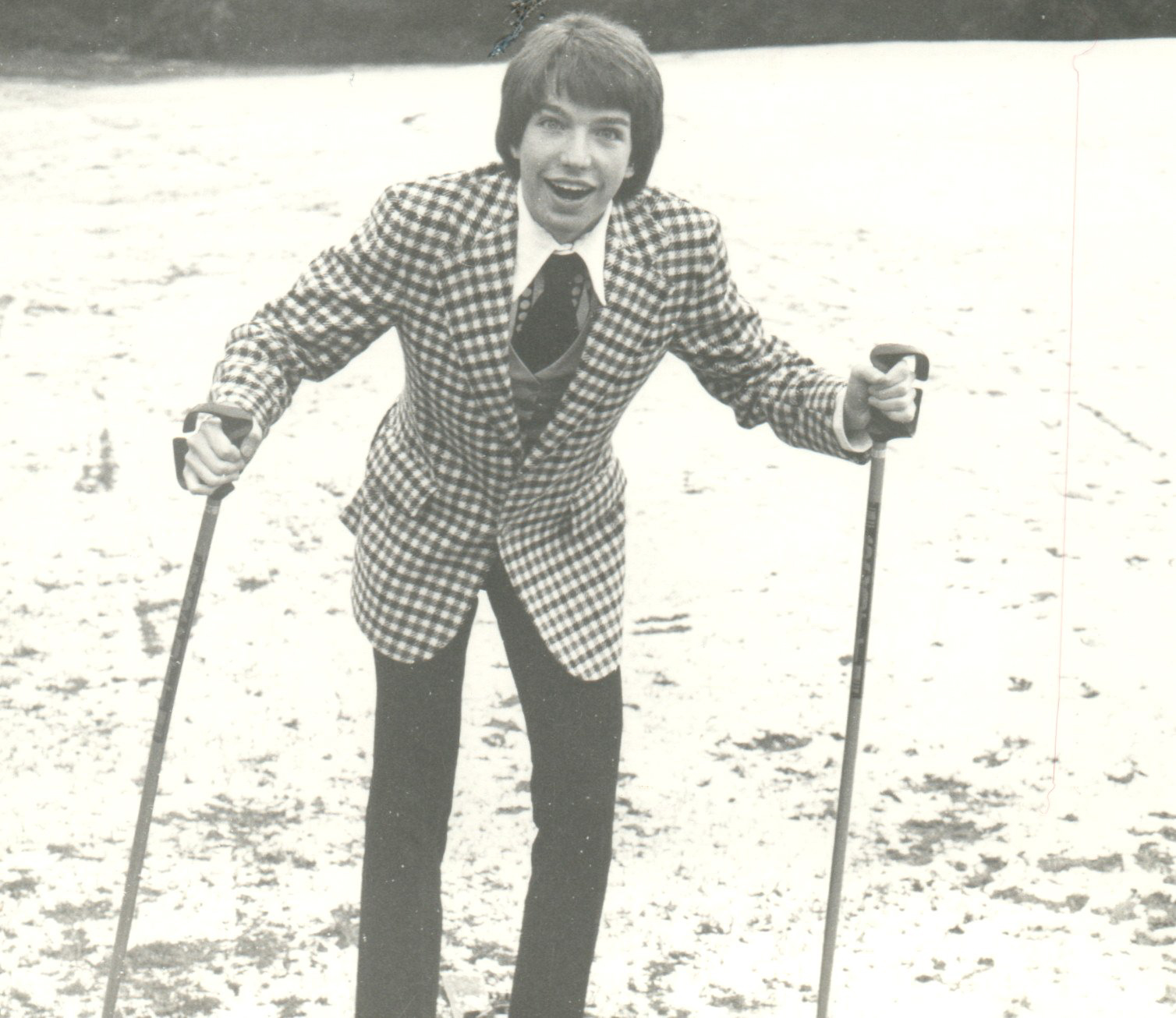
How I got the job is pretty straightforward but does require some explanation. The manager of the Crossroads store was the mother of one of Scott’s high school friends, Scott being my eldest brother. Since Scott turned 16 in August of 1975 and you had to be 16 to have a job, he probably got the job soon after that although it may have been in 1976 or even 1977.

Scott at Hunter’s Books, late 1970’s
Jobs for high schoolers back then were mostly restricted to restaurant work, bussing tables or washing dishes. And I have a recollection of Scott doing that. But at some point, he started working at Hunter’s. I assume the manager liked his work ethic so when an opening came up, Steve, my other brother, got a job at Hunter’s, likely around the time he turned 16 in 1978.

History repeated itself when a clerk left Hunter’s soon before my 16th birthday, which was in May of 1979, and I was hired. Steve and I sometimes worked together but mostly we worked opposite shifts. Weekday shifts would be after school, beginning around 3pm and ending at 9pm when the store closed. Weekend shifts would be all day on Saturdays, 9-5pm, and Sundays from 12-5pm, the hours the store was open. On the weekday shifts, we would work with the day crew, middle age women whose work seemed as much a social gathering as selling books, until they left at 5pm.

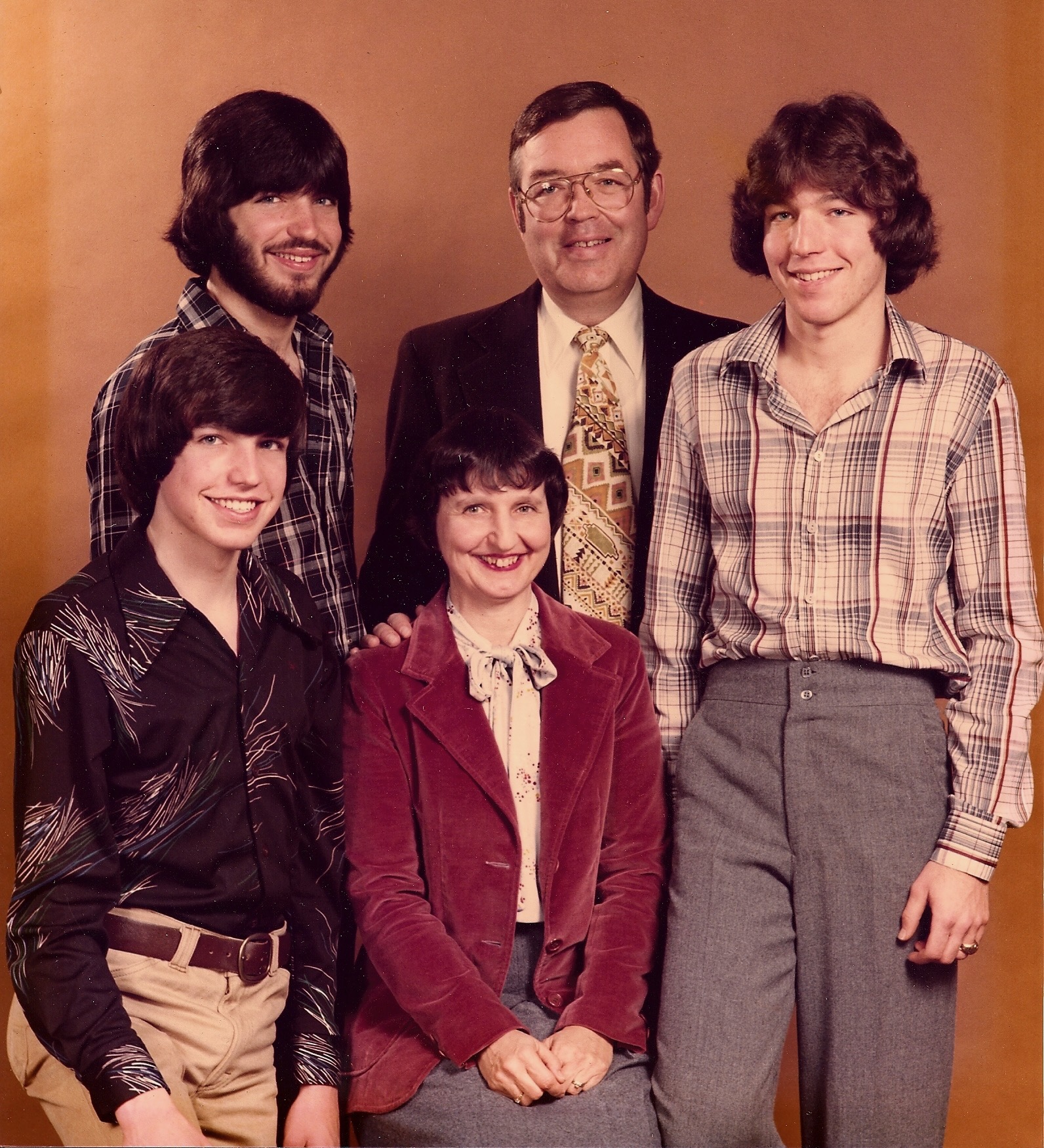
Smallman Family, 1980
From 5-9pm we worked by ourselves, which was a great thing. We’d change the radio station from the classical music preferred by the manager to the “new wave” station, KZAM, that had rocketed into our consciousness in 1979. Working by ourselves in the early evening also allowed us to get our homework done at the store. Other than a “movie rush” (there was a theater next door), it would be pretty quiet. To close up, we’d clear the cash register of the day’s receipts, enter them into a simple ledger, and make the night deposit at the bank around the corner.

Steve and I alternated working on Saturdays and Sundays. Saturdays, we had a co-worker, Magda, who was probably in her mid to late 20’s but seemed much older than that to me. All things considered, she was pleasant and reliable. I remember telling her about the police scanner I’d received for Christmas in 1979 and then the fancier one I saved up to buy a year later. She was interested so I brought it in and when it was quiet in the store we listened to local police and fire department calls behind the counter. On Sundays, Steve and I worked by ourselves, opening and closing the store on our own.

At the time, the amount of responsibility we were afforded didn’t really occur to me. But we had a key to the store, handled the cash, did the bookkeeping, and made bank deposits. By the time I was a senior in high school and Steve had left Hunter’s to attend the University of Washington, I was working a 40 hour week and had acquired the unofficial title of Night & Weekend Manager. I was able to craft my school schedule around my shifts at the bookstore. I don’t recall my exact hourly rate but it started at something like $2.10/hour. Not having other expenses, I saved up what I earned and sometime in 1980 used it to buy a component stereo system to the tune of around $1000. All in all, it was a great high school job.

Okay, so I began this essay by saying that I commonly refer to working at Hunter’s as my first job. Indeed, it was the first job I had in which I received an actual paycheck and had taxes withheld. But one of the most formative experiences I had as a young teen was the nine months I worked as paperboy when I was in 9th grade.

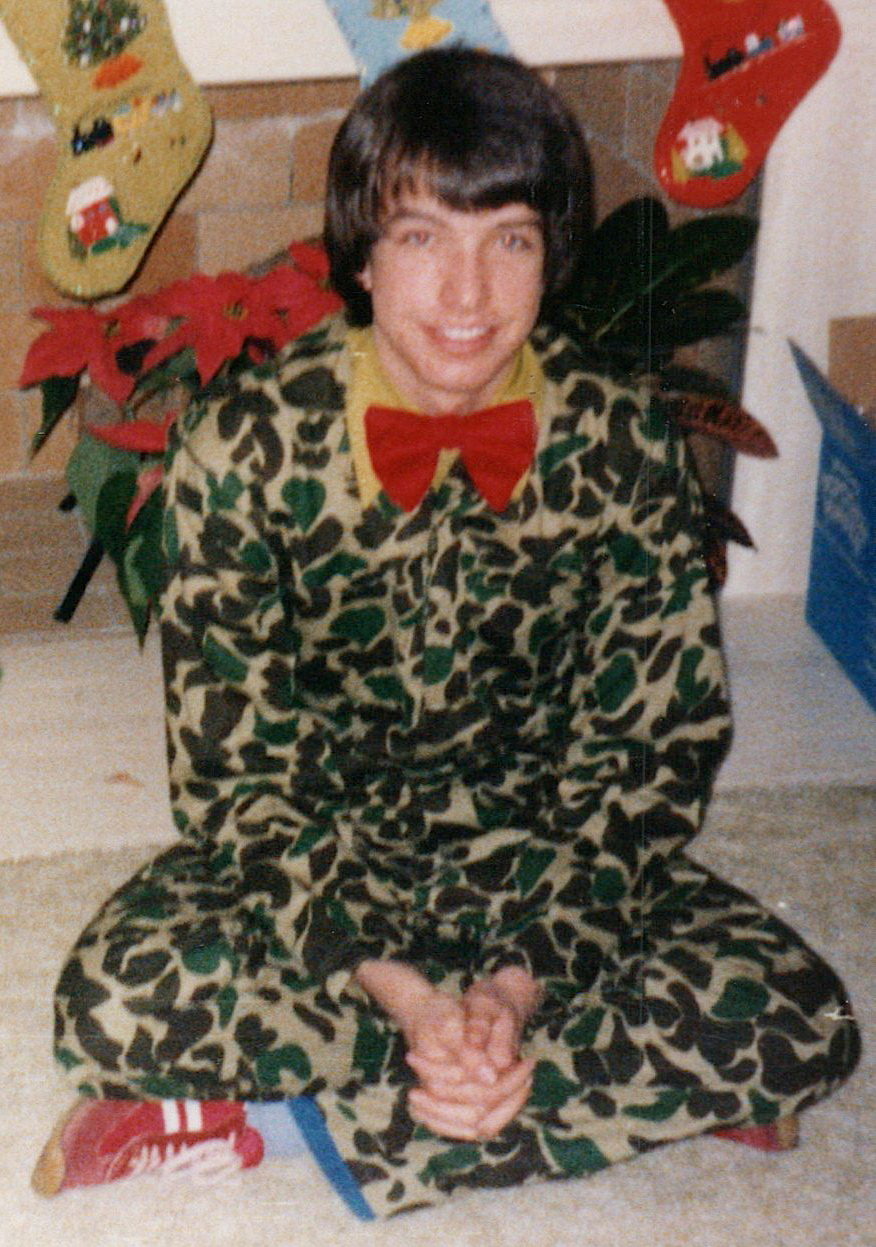
Andy, 9th grade
One of my best friends at the time, Pat Stull, was the “shack manager” in our neighborhood for The Seattle Times. A “shack manager” was a kid who received the daily papers at the shack, a tiny structure quickly constructed in neighborhoods throughout the region for The Seattle Times to drop off home delivery papers, and divided them into piles for the neighborhood paperboys to pick up based on the size of their routes. Pat told me that a route was opening up so I pursued it.

I took the offered job almost on a whim, not really realizing how much being a paperboy interfered with one’s daily routine. You worked every day, right after school on the weekdays so no hanging out with friends, and got up before the dawn on weekends (my alarm woke me up at 4:52am). You also had to collect the subscription fees directly from the customers on your route and then pay The Seattle Times for the papers you’d received that month. Whatever was left over, including if anyone was kind enough to tip you, you’d get to keep. When all was said and done, I made about $1/day so probably less than $300 for those nine months.

The experience was formative because once I picked up the papers and started walking to my route, it became almost meditative for me. The neighborhood had a serene feel on the weekdays, a time of day just before day workers were getting home. And while the darkness of the weekend mornings initially scared me, I came to enjoy the stillness of this time of day. The quiet, broken only by the sounds of my walking or, on Sundays, the sound of the paper cart (Sunday papers were too heavy to carry so paperboys pulled them in a cart), made it easy for me to imagine I was the only person alive. I made a point of putting every paper on the doorstep and on rainy days putting them inside the storm door if there was one. To this day, when I see a newspaper far from someone’s porch I get a little smile at the thoughtfulness of my 14-year-old self.

One other “job” I’d like to mention came when I was in the 3rd grade, I think. I don’t recall all of the details but the feelings are pretty clear. What I remember is sitting at our kitchen table with my family and talking about door-to-door salespeople. My paternal grandfather worked for a company called Mason Shoes and one way their shoes were sold was by salespeople going door-to-door. For some reason, this really appealed to me so I decided right then and there to become a door-to-door Mason Shoes salesperson!

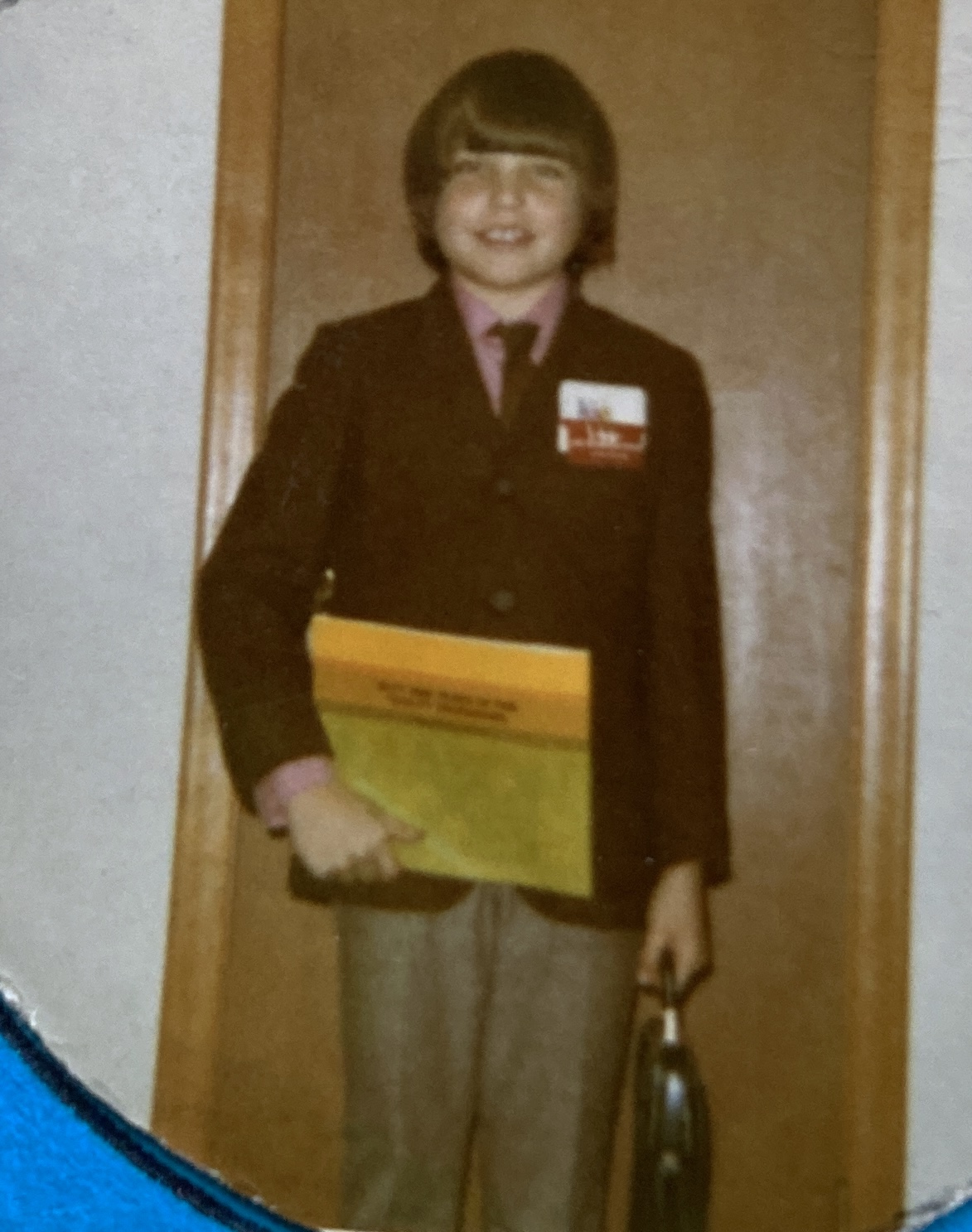
Andy the Shoe Salesman, early 1970’s
My family didn’t dissuade me, at least not by my recollection, so the next thing I remember is putting on a suit and tie, affixing a pocket protector in my suit jacket pocket and putting in some pens, grabbing a briefcase and a Mason Shoes catalogue, and getting ready to head out the door. While I don’t have pictures of me as a paperboy or at Hunter’s Books, my appearance must have been either humorous or adorable enough for my parents to have snapped the accompanying photo.

My final recollection of this experience is more of the feeling variety. I’m pretty sure I started out the door but got cold feet and never managed to knock on any doors or ring any doorbells despite what I now think was mock encouragement from my brothers. Who knows, maybe a nifty career as a shoe salesperson got thwarted that day.

So now here at the end of this essay, what do you think was my first job – bookstore clerk, newspaper boy, or shoe salesman?

Hearts Expand By Expressing Gratitude

Each interaction we have with people opens a metaphorical circle. Simple interactions, like those we have passing a stranger on the street, cause the circles to open and close quickly without much work on our parts. But those interactions we have with people in which something significant takes place create larger circles with larger openings. To close these requires more mindful awareness of our responsibilities in the relationship.

If we move through life learning to open and close our circles with mindful awareness we live happier, more fulfilled lives. Those of us with lots of unclosed circles experience a “cluttered” feeling in our interactions because we have so much unfinished business with others.

With this explanation, I introduced my kindness class to their new assignment – to do something kind for someone who at some point in their lives had helped them. At its core, the assignment was intended to help my students identify circles that were left open in their lives and to try to close one.

“If more people did this the world would be a better place.” So said Elizabeth at our next class session. She was actually quoting what was said to her by the wife of one of her college professors, the person she chose to be the recipient of her kind action.

Elizabeth explained, “In college, I was in my senior year and paying my own way. I got a notification that my bill was unpaid and I wasn’t going to graduate. My professor and his family suggested I stay with them to save on room and board. After all these years, I was able to thank him for his kindness. Without it, I don’t think I could have gone on in my schooling, met my fabulous spouse and got my wonderful job, also teaching. I think we will correspond for a long time, a kindness for both of us.”

People who have helped us, been generous toward us, or have served as a source of inspiration for us are our benefactors. These folks come into our lives to help light our way on our own unique paths.

And they often come into our lives in a way and at a time in which we may not fully appreciate them. This can be, perhaps, for reasons having to do with our youth, how hectic our lives are at the time, or for a number of other reasons. We often best recognize their influence in hindsight.

Other students shared their experiences, including:

  • “When I suddenly found myself alone with five small children and very little money, a friend offered help without unsolicited advice or criticism, including organizing a painting party for my dilapidated house. Today, ten years after her untimely death, I placed flowers on her grave. Her widower and (now) grown children were surprised and touched to find me there…”
  • “I called my cousin this evening to more fully express my gratitude and why I sent her the mum plant. We both had tears and laughter as we talked. A full 35 minutes of deep connecting and appreciating of each other. Yes, we’ve said it and we say it often, but decidedly acknowledging and honoring that gratitude more fully makes it come alive in my own being, and my heart expands from the activity of expressing this gratitude.”

This assignment required Elizabeth and the rest of the students to think about the past, to bring something positive from their lives into the present to both relive and more fully appreciate it. Bringing these stories into the present helped the students acknowledge their importance.

Expressing their gratitude for their benefactors then helped them close the “circle of the story” and feel a profound sense of satisfaction. In closing a circle left open, some of them also were excited to open a new one.

Also of importance, the kindness extended to the benefactors included a solid kindness for the students, too. The statement, “my heart expands from the activity of expressing this gratitude” summarizes this concept perfectly and poetically.

“Short Stay” – Personal Memoir From My Mom

(Here’s the next in a series of memoirs my 89-year-old mother is writing as she looks back on her life. She’s been taking a memoir writing class at my parents’ retirement community. If you want to encourage her, offer some positive feedback in the comments section below. To see the other memoirs I’ve posted so far, visit these quick links: Days at the Cottage || New House || My Big Train Trip –Andy)

Short Stay

by Carib Smallman

When I finished fifth grade at Lynnbrook Elementary School, Bethesda, Maryland, I took my big train trip to spend the summer with Gom and Pop. Dad was recovering from his surgery and learning what he was able to do and not do. His boss at the Geological Survey brought several pages of work to our house to determine whether Dad could return to the office. Dad realized that would not be an option, at least not at that point.

Gom & Pop’s house. Carib’s room is the one in the upper right.
My grandparents were terribly concerned and wanted to help. They convinced my parents that a move to Grand Rapids, Michigan, was a good solution. We could move into their three-bedroom house comfortably. Mother and Dad would have Dad’s room when he was in high school, I had the ‘guest bedroom’ that I considered mine and of course Gom and Pop had theirs. I was already there; Mother rented our Bethesda house and she and Dad joined us at the end of the summer.

In September I started sixth grade at Dickenson Elementary School, across the street from my grandparents’ house. The school was very different from what I was used to. Most of the students started in September, but others in the same classroom started mid-year. I felt unsettled. I wasn’t happy that I was made to change the way I learned to write cursive. Everyone in Grand Rapids used the Palmer Method. We spent an hour each day writing aaaaa or eeeee or ooooo across a lined sheet of paper. Boring! I had been learning Maryland history. Here history, naturally, was about Michigan. I found it difficult to change.

I was managing in Grand Rapids, but Mother was really unhappy. She didn’t have much to do since Gom had her routine and stuck to it. Pop was still working so was gone most weekdays. While I was out of the house schooldays and with other kids, Mother and Dad were stuck in the house, except for the walk they took daily.

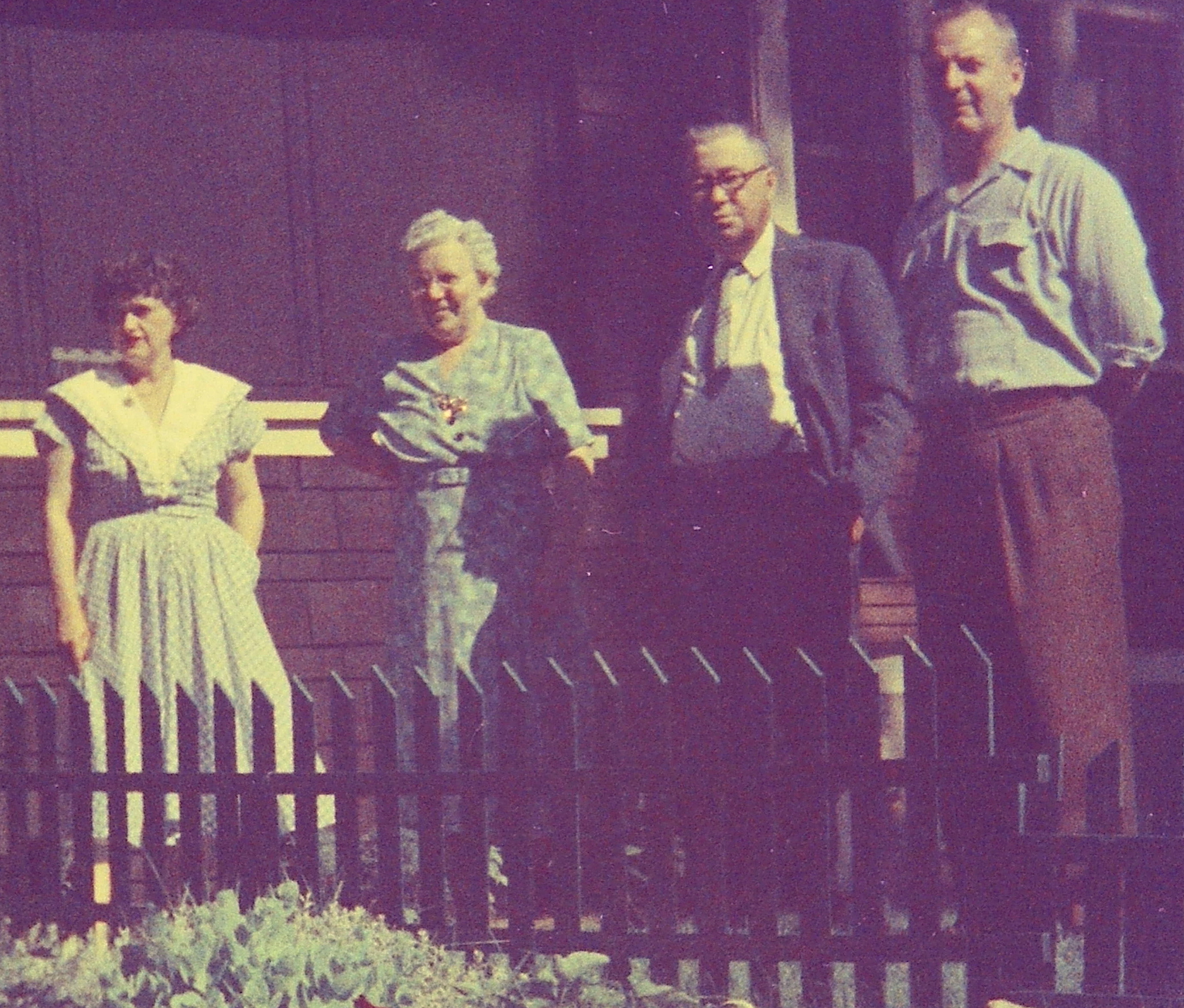
Carib’s family in Grand Rapids, Michigan – L-R: Mother, Gom, Pop, Dad
Mother had never admitted to Gom that she smoked. When my parents visited she never smoked in front of Gom and Pop. Pop probably would have been fine with it, but not Gom. Obviously, Mother had to ‘fess up. I’m sure that Gom was not happy to have Mother smoking in her house. I can remember walking to the nearby drug store and standing in line with Mother so she could buy a pack of cigarettes. She sometimes bought loose tobacco and paper. She had a strange gismo to roll the cigarettes. I thought it was fun when she let me do it.

Mother and Dad must have had long talks about the future. I am sure neither of them expected to live like this for long. Mother needed a paying job. As the semester was ending, I was told that we were returning to Bethesda. I was more than happy to return to my house, school and friends.

Dad’s friends and former fellow workers assured Mother that she could have a job with them. Not my independent mother! She would find her own job. Mother landed a position as an editor with the US Information Agency, the publishing branch of the Voice of America. She started as a GS-3, what I was years later when I worked summers for the government. After twenty plus years she retired as a GS-11. Quite an accomplishment!

Carib in the driveway next to Pop’s car.
Mother loved that job! She had always been a reader, whatever was available, from cereal boxes to the dictionary. Now she was reading and being paid to do it. She was assigned the Christian Science Monitor Newspaper and several magazines to read. From them she chose articles that put the USA in a good light. She edited the pieces, sent them to the translators after which they were distributed around the world as ‘propaganda’, during the war and thereafter.

As Dad learned to compensate for his lack of vision, he became chief cook and grocery shopper. He would walk the mile to Safeway and carry two full bags of necessities home. During the summer and holidays from school I often walked with him so we could purchase more rationed items. Our small family settled into a new routine that worked to the satisfaction of us all. I never felt that we were less well off than our neighbors and friends. I just loved us all being together again. Just us.

Appreciate Your Mundane Tasks

We all have repetitious tasks that may seem tedious, even boring to do, so much so that we might complete them on auto-pilot. But these are often the tasks that need to get to done to ensure the bigger projects get done.

If it helps, think about what happens to your teeth if you don’t brush them every day.

This also holds true in our relationships with others, be they personal or professional. In the relationship dynamic, we all have tedious jobs to complete in order for the relationship to work.

For a little exercise, get out a pen and piece of paper and write down at least five tedious tasks you do that enhance one of your personal relationships.

If you’ve chosen a home relationship and you live with others, your list might include grocery shopping, doing the laundry and/or the dishes, making the bed, cleaning the bathrooms, changing the toilet paper roll…

In all likelihood, your list quickly grew to more than five tasks.

Next, consider what kind of breakdown would occur if you didn’t do one of the tasks. For instance, if your list includes grocery shopping and you don’t do it, there won’t be food in the house. And if there isn’t food in the house, what would happen next?

People would be hungry?

You’d have to eat out, which might mean you wouldn’t be eating healthy food, and you might go over your budget, thus impacting your plans for an upcoming vacation?

Again, you can likely extend this pretty far and pretty quickly, including the lack of food having a negative impact on your relationships.

As I said earlier, the point here is that the little tasks getting done is what leads to the bigger projects happening. When you do the grocery shopping, for instance, you are saving toward the family’s summer vacation.

Now it’s all well and good to simply think about the little tasks that WE, ourselves, do. It’s a more challenging exercise to identify the little tasks others do and from which we derive benefit.

In other words, who else in your relationship dynamic is doing the little things in a way that helps ensure your family will get to go on its summer vacation?

On your paper, try to write down five tedious tasks that are done by someone else in a personal relationship with you. You’ll likely find this to be more difficult to do than creating your list of tasks, the reason being that we tend to take for granted the tasks completed by others.

We are even more likely to take them for granted when they are done consistently, for the simple reason that we don’t notice them being done. For instance, if doing the laundry isn’t on your list, the fact that you have clean underwear in your drawer is due to the efforts of someone else.

With these things in mind, consider the word “synergy,” which, at its root, means “working together.” In practice, the word has come to mean working together WELL.

When there is food in the house and underwear in the drawers, and hundreds of other things are completed and/or available, there is synergy at play. This synergy allows for smooth functioning in the home, which stabilizes the home lives of everyone.

So think again about those little tasks you do, but do so with this awareness of synergy. You are contributing to the smooth working of your home.

Further, we all have had times in which we are functioning so well with others that we feel we are part of a whole. It is at these times that we gain glimpses of the concept that we are part of something greater than ourselves. This form of synergy awareness is warming and provides us energy.

Here’s another way to think about the ideas of synergy and that we all are part of something bigger than ourselves:

Holographic images can be recorded on glass. Looking at them, they appear 3-D despite being in 2-D form, and seen from different angles give you the look of seeing the image from different perspectives. Further, if the glass that holds the image is broken, each piece contains the whole image. It’s not like pieces of a jigsaw puzzle that have to be reassembled to form a whole.

Each piece CONTAINS the whole (learn more here).

With that in mind, consider the value each member of a team plays in making the whole team function, like the five basketball players on the floor during a game, that have to work together well in order for any one of them to excel.

Next, consider that every person on a team is one piece of glass of a broken hologram, each piece containing the whole. Seen like this, our responsibility as individuals is to contribute positively to the whole, to do our part to make sure the team functions at its best.

Now apply this same concept to those with whom you share a home.

Are you familiar with the Dr. Seuss book “Did I Ever Tell You How Lucky You Are?” Many people see this book, intended for children, as a way to focus on how to feel better about their lives by comparing them to the lives of less fortunate, albeit silly, characters.

For instance, this quote comes from page 24:

And poor Mr. Potter,
T-crosser,
I-dotter.
He has to cross t’s
and he has to dot i’s
in and I-and-T factory
out in Van Nuys.
Yes, poor Mr. Potter.

These may seem like meaningless tasks he has to do, but if Mr. Potter doesn’t do them, an attention to detail is lost that will contribute to a significant problem down the line, just like what would happen if you didn’t do the grocery shopping or someone else didn’t doing the laundry.

As such, I encourage you to appreciate when you have to be Mr. Potter and to acknowledge when others are doing their “Mr. Potter” tasks. Extended to our places of businesses, to our cities, to our country, and to the world, it’s how everything keeps functioning.

Ultimately, we’ll come to appreciate that it’s completing the repetitious tasks in our lives that move us closer to peace on earth.

“My Big Train Trip” – Personal Memoir From My Mom

(My mom is continuing with her wonderful memoir writing, providing a gift of her memories in writing to the rest of the family. With this one, her third, about a train trip she took by herself when she was 10, we don’t have relevant photos. I’ve decided to include a couple from roughly that time period as I think the writing is enhanced with pictures. If you want to encourage her, offer some positive feedback in the comments section below. Find the first two memoirs via these quick links: Days at the Cottage || New House –Andy)

My Big Train Trip

by Carib Smallman

Each summer of my childhood, my parents and I drove to my father’s parents’ (Gom and Pop) home in Grand Rapids, Michigan. Mother and Dad would stay for a few days before they left for Nebraska, where Dad worked each summer. At the end of summer, when they returned to Michigan, we would drive back home to Washington, D.C.. The year after my father’s serious surgery, he was unable to work. My parents decided I should spend the summer with my grandparents, as usual. I was excited, remembering all the fun I always had at the cottage.

How to get me there was a problem. To arrive in Grand Rapids from Washington by train, it takes a change of trains. I would turn eleven years old in July, a bit young to handle changing trains by myself. After conferring with Gom and Pop, the decision was made. I would ride the train to the Jackson, Michigan station. Gom and Pop would drive to Jackson and be at the station to meet me. I was a bit hesitant at first; I would be all by myself. Mother and Dad assured me I could do it. They gave me the confidence to trust myself.

Carib’s paternal grandparents – Gom & Pop.
Soon after school dismissed for the summer, Mother and I packed a suitcase with my clothes. A carry-on bag had food, pajamas, and books. Mother explained I would board the train after lunch and arrive in Michigan after breakfast the next day. Gom and Pop would be there to meet me. My memory is of excitement . . . not worry or fear.

Friends drove Mother and me to the station, where Mother walked me to the Pullman car. “Take good care of her,” I heard Mother say to the porter as she handed him a tip and then walked toward the station’s exit. It makes my heart hurt when I think how she must have felt as she watched me disappear into the train. I felt the same way the first time each of our sons left on his own.

I learned a lot about trains on that trip. Passengers with upper berths, as I had, sat facing the end of the train, watching where they had been. The upper berth doors pulled down from above the seats making a berth. The two seats used during the day made up the lower berth. For privacy, on the aisle side, there were curtains that snapped closed. The porter prepared the beds while passengers were at dinner. Many years later, I remember traveling with Al, where we rode the train from Salt Lake City to Denver. It made me smile as I discovered much was the same as I had first experienced it.

Many of the passengers in my train car were traveling because of the war. A U.S. Army Major sat down across from me. I felt proud to know he was a major because my friend, a Lieutenant Colonel, had taught me that a silver maple leaf insignia was a Lt. Colonel and a golden maple leaf was a major. The major was very nice to me. I am sure that we talked, but the exciting happening was that he took me to the dining car for dinner. I noticed as we walked through several cars to reach the dining car that every seat was taken, many with soldiers. It surprised me to learn that as I walked between cars I was ‘outside.’ Below my feet, I was able to see the coupling holding the car to the rest of the train. I was finding many facts that I was anxious to share with Gom and Pop.

I have no idea what I ate, but I was impressed that the waiters wore white shirts and black bow ties. After dinner, the major walked me back to our car. The beds were ready. The major suggested I take my toothbrush to the bathroom at the end of the car and get ready for bed. The porter told me if I needed anything, to call him. Then he put a ladder up to my berth and up I went. It was like a hidey-hole, snug and comfy. I changed into my pajamas, got out my book, and read until I fell asleep.

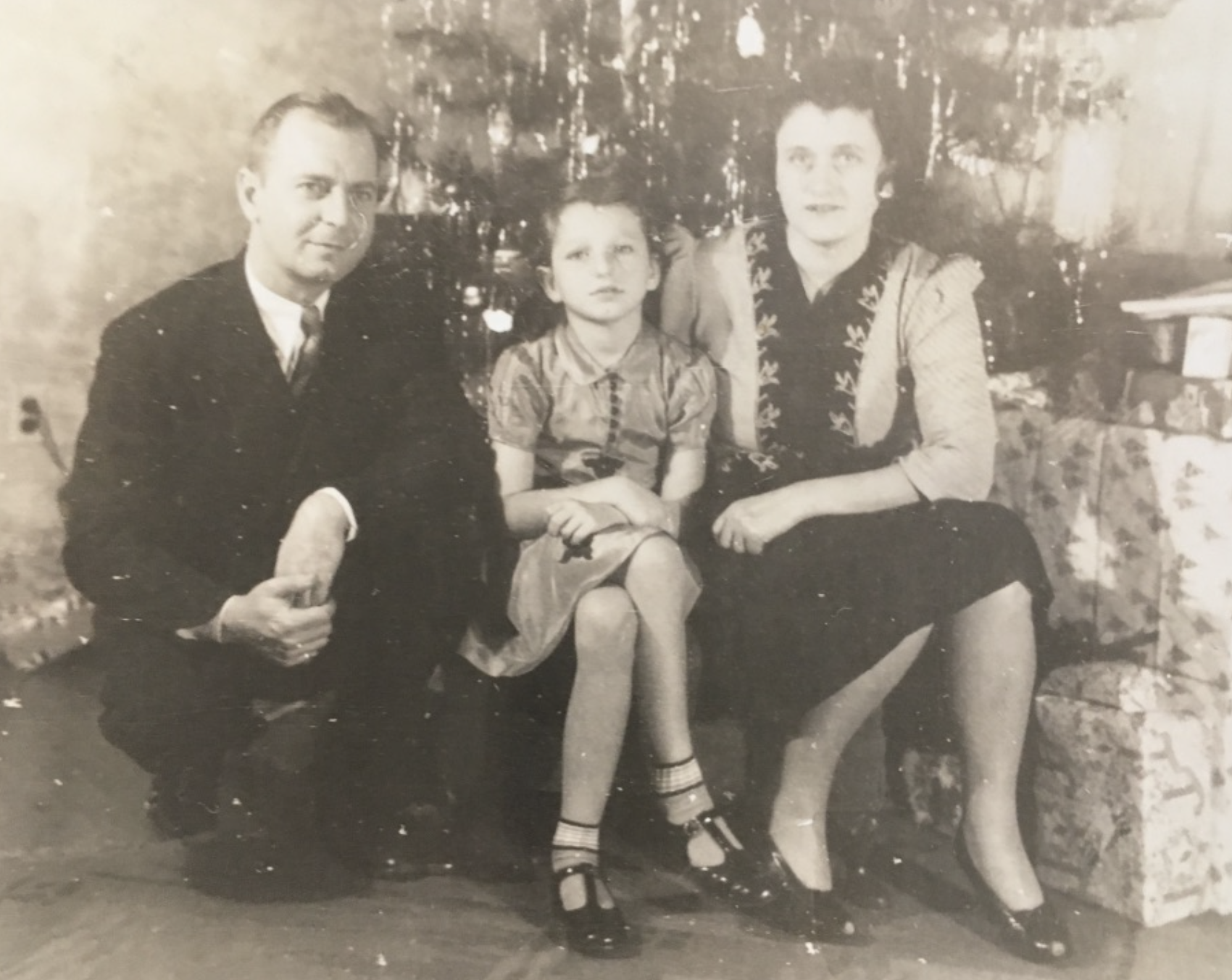
Carib & her parents, Christmas time.
Morning came. I quickly dressed and ate some of the snacks that Mother had packed for me. The porter showed me where to sit while he put the seats and upper berth back together. Shortly after returning to my seat, he explained that the next time the train stopped, we would be at my destination. The train slowed to a stop. The porter had my bags ready by the exit. How happy I was to see Gom and Pop waiting as I got off the train! I felt very proud of myself and pleased that I had acted very grown up and able to be alone.

It was a different world in wartime America. I recall the musketeer attitude: “All for one and one for all.” As I look back, I realize how much I benefitted from the kindness of strangers. Today, I wouldn’t feel comfortable allowing a ten year old to travel alone, anywhere, much less on an overnight train trip.

Focusing Our Attention on the Profound

(I’m reviewing articles I’ve written for my professional website, narrowing them down to some favorites. Here’s the first, which focuses on a life lesson I received from a respected teacher and try to pass along to some of my students who I think might appreciate it.)

I’ve often told my students an allegory that was told to me by one of my most important teachers when I was a young adult, the story of two people walking at dawn one morning, the rising sun at their backs. One paused and turned to look at the beautiful sunrise, awed by its beauty. Wanting to share it, he tapped the shoulder of his friend, who turned to look and was equally awed.

I invite my students to stop and consider this story, to contemplate it for its meaning or meanings. One comes from recognizing the important role we have to help those in our lives be aware of meaningful things.

Related to that, however, is the truth that try as we might, we can never MAKE another person be aware of something. We may WANT to share things with others, but they still have to turn, literally and/or metaphorically, to see them. THEY have to do the physical and mental work.

If my students get to that understanding, I’m pleased.

As I’ve gotten older, interestingly, I’ve found what has become an even bigger lesson for me from this story. It’s that we all are being tapped on our shoulders all the time. Every second of every day, we are being offered the opportunity to see meaningful things.

Many of us wonder who or what does what I’m calling this shoulder-tapping. Call it Source, or Light, or Intelligence, or God, or some other name. For my purposes, though, putting a name to what taps us is not the most important thing.

What’s important is to recognize that we are being tapped and to practice focusing our attention. In other words, I have the responsibility to do the physical and mental work, to turn and look, so to speak.
As I’ve gained experience doing this, I’ve learned that there is discipline involved in the practice. Undisciplined, my attention is drawn to all sorts of things — negative news stories, certain uses of social media, drama from the sports world — each of which distracts me from what is actually meaningful.

I sometimes even fool myself into believing the distracting things are important.

Disciplined, I learn to see the difference between the distracting and the divine, between the pointless and the profound. In time, I find that I’ve started to internally filter out the things that distract me, which better enables me to gently focus on the divine and the profound.

Like a sunrise.

“New House” – Personal Memoir From My Mom

(As I mentioned last month, my mom is taking a memoir writing class at her retirement community. I continue to encourage her to allow me to publish what she’s been writing so others have easy access to these lovely remembrances. Here’s the second one she’s agreed to release. And as I said last time, if you want to encourage her, offer some positive feedback in the comments section below. –Andy)

New House

by Carib Smallman

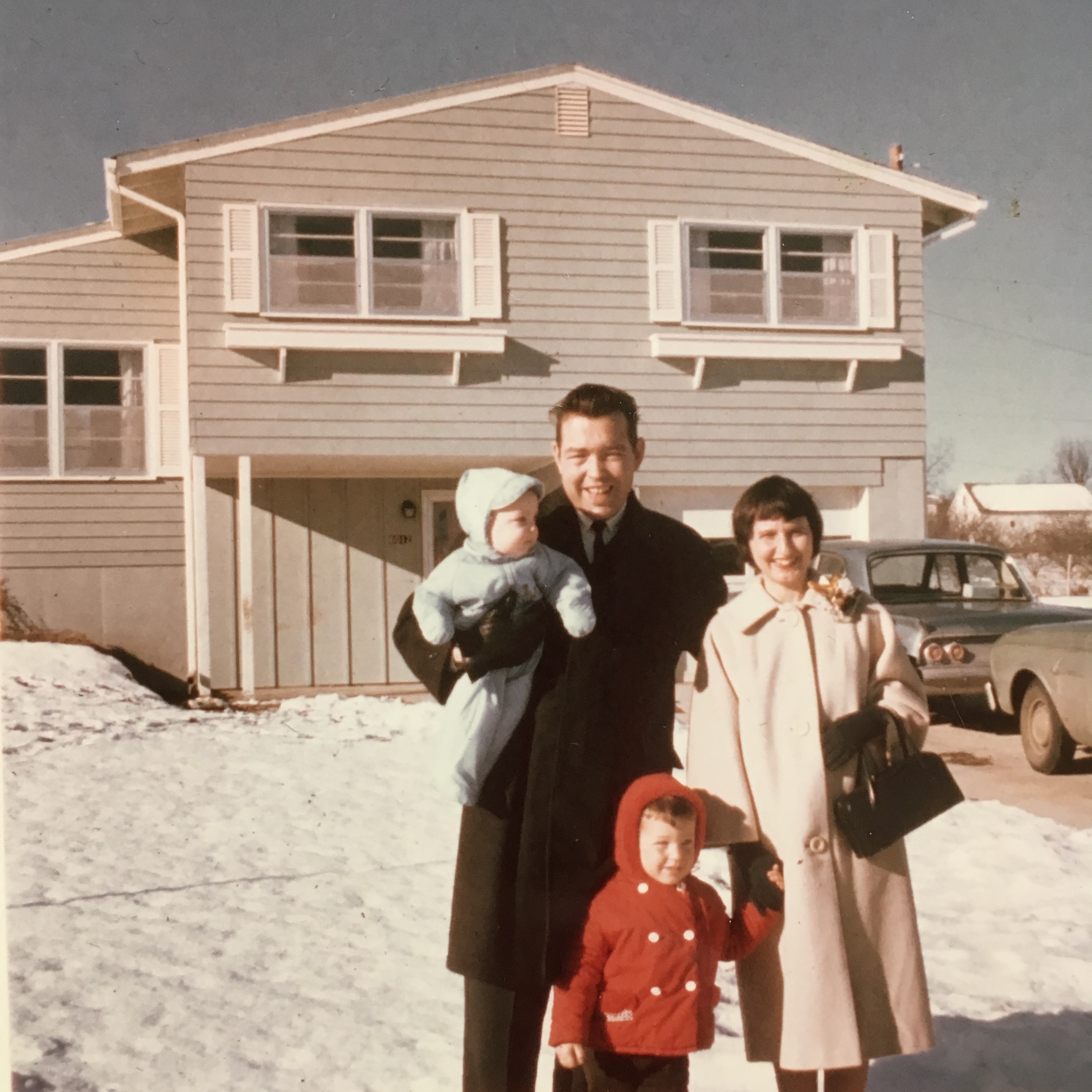
Our first family home in Omaha on 69th St – Al holding Steve. Scott in front, holding my hand. I’m pregnant with Andy.
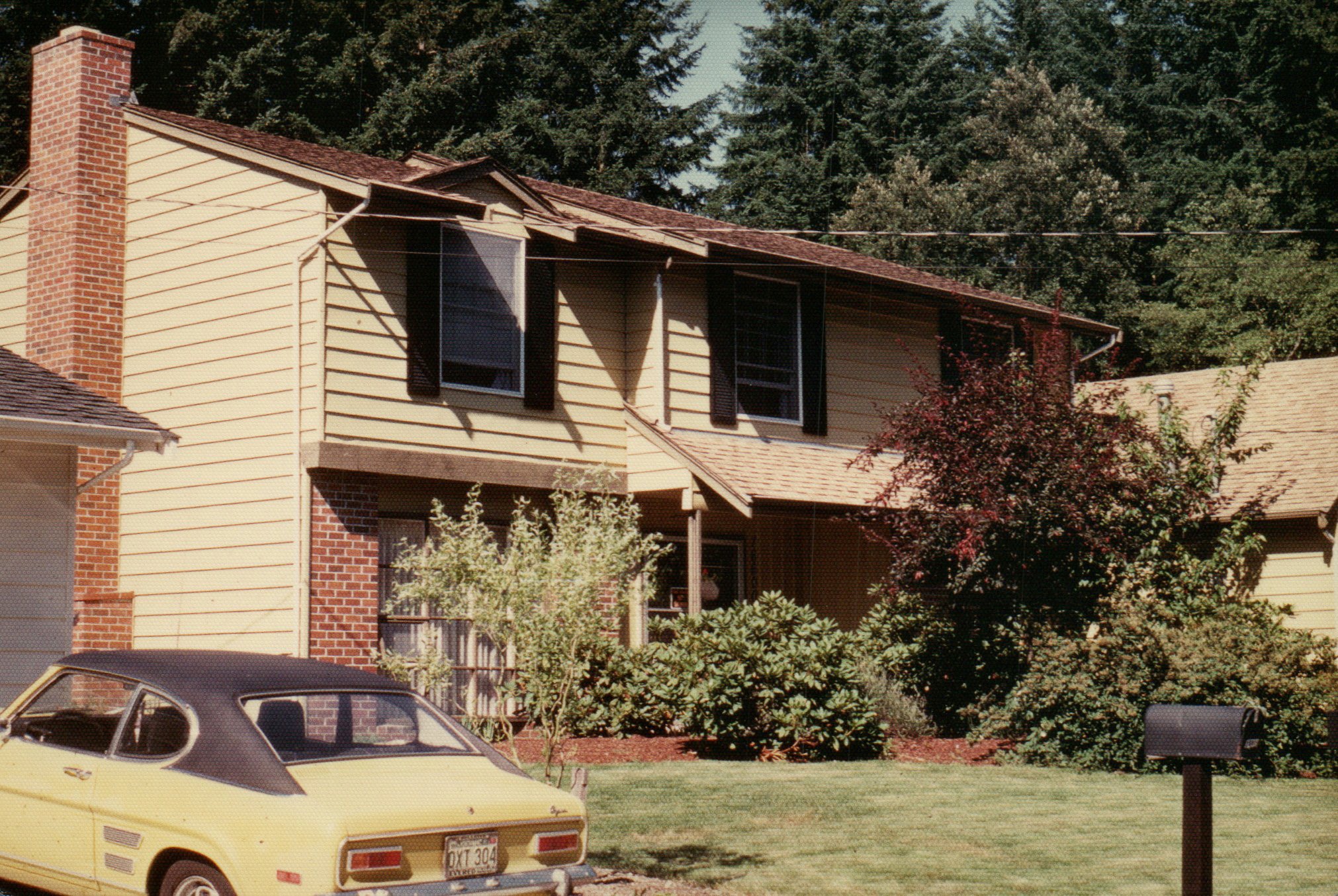
Having outgrown our three-bedroom home on 69th Street in Omaha, we purchased a four-bedroom house in Ralston, on the edge of Omaha. The outside was a vivid yellow, as were almost all the rooms inside. We were told the former owner worked for Sears. He must have scored a terrific sale on yellow paint!

Yellow is not my favorite color. Nothing I could do about the outside but I could paint the inside. As usual Al was busy on the road, so I spent all spring hopping into my car as soon as the boys left for school, painting until time to return to greet their home- coming. Each son had chosen the color for his bedroom walls, as well as the carpeting. Scott, our oldest, picked the long narrow room and asked for the short walls to be black and the long walls to be white. He selected bright red carpet. Steve, our avid reader and night owl, chose the room with the ‘hidey place’ in the closet over the stairs. Walls and carpet for him were his favorite green. Andy, excited to have a room of his own, took the remaining bedroom, and opted for blue for his carpet and walls.

Covering up all that yellow was difficult. The horrific yellow color bled through blue, green and white but, surprise, not black. It meant three coats of paint instead of two. I was exhausted but pleased to finally finish; permitting the installation of the carpeting. This enabled us to move in as soon as the boys finished the school year. I never wanted to see another yellow room!

I was sad to leave our neighborhood friends who had become like family; Elders, Drakes, Frolios, Brooks and we had become close as we had similar experiences with our first house and kids of similar ages. Three of us were stay-at-home moms. We had celebrated many great events together over the ten years we lived on 69th Street. I told myself we weren’t moving so far away that we could never see them.

We lived on Lakeview Drive in Omaha for so short of a time that there aren’t many photos of the house. Here we are with Al’s mother. Note the yellow of the house.
How wonderful it felt to have more room. We settled into the house, met our new neighbors and found nearby shopping areas. September arrived and the boys were pleased with their new schools. Scott especially appreciated being in ninth grade in High School; he still would have been in Junior High in Omaha. Steve talked us into adopting a puppy. Gretel, a purebred, miniature longhair dachshund, with papers, became a part of our family. She was a bit too large to be a show dog so we were able to purchase her for a reasonable price.

Halloween was a week away when Al arrived home with exciting news. He was receiving a pay raise! But. . .we had to move. Move! Now? We hadn’t had time to feel at home in our newly painted house! And that meant we would really be leaving all our friends.

“We have a choice,” Al said. “Which do you think, Oklahoma City or Seattle?” To me it wasn’t a choice. Having grown up on the East Coast (Washington D. C.) and lived in the Central United States (Michigan, Colorado and Nebraska), I was ready for the West Coast. Seattle it was!

In January, Al took off to start working the Pacific Northwest territory. While in the Seattle area he checked out different neighborhoods and looked at a number of houses. By February he had discovered several areas and houses that seemed promising, so I flew out to Seattle to look at what he had found. He would be traveling a great deal and thought it would be helpful to be near the airport. His territory included Idaho, Oregon, Washington and Alaska.

Our house in Bellevue on SE 17th St. This photo was taken within a few years of us moving in.
Al’s first choice was a nice house near Angle Lake and SeaTac airport. Upon investigating the local school systems we found Bellevue appeared to be the best fit for our boys. Returning to the Bellevue houses we had toured, the first one on 17th Street was sold, but the other that had been finished in the fall and was sitting empty was still available. We revisited another house a few miles away. It had possibilities. Back to 17th Street which dead ended into Phantom Lake. Each house on the north side of the street had special access to the lake. The boys would love that, and everything inside was new and clean. We bought it. I took pictures, inside and out, to show the boys.

We sold our house in Ralston more quickly than expected. Wonderful! We could join Al in Washington State as soon as possible.

When the boys saw the pictures of their new ‘home-to-be’, the first thing they said was; “Mom, you said you never would live in another yellow house!” Yes, the aluminum siding on the new house was yellow AND the kitchen appliances were all yellow! Never say never!

France 2013 (From the Archives)

So as I mentioned in previous posts, toward the end of our sabbatical year, back in the early summer of 2011, Melinda and I began dreaming of the idea of returning to France, and specifically to Nantes, for the better part of a month each summer. We worked out the details at PSCS to make this happen and in 2012 we returned with Chloe and Ella, as summarized in my previous post.

In 2013, Melinda and I returned to Nantes without the girls. At age 20 and 16, they kinda liked the idea of having time by themselves in our Seattle house.

How odd…

While not having the girls with us provided a lot more flexibility, I’d hate to suggest that we didn’t miss them. To be honest, some nine years later, I don’t really remember missing them. I do remember posting on the blog little tests for them, cryptic photos of places in Nantes that I invited them to identify. So clearly, I was thinking about them…

The point that really felt different without the girls is when Melinda and I spent extended time in Paris, just the two of us. That was, indeed, a glorious time.

To gain easy access to all the posts from our 2013 trip, use the France 2013 tag or, even easier, click here.

Return to Nantes 2012 (From the Archives)

In my last post, I talked about how Melinda, Chloe, Ella, and I spent 13 months in France beginning in July of 2010. These 13 months got dubbed the “French Sabbatical” as Melinda and I were granted paid time off from our jobs during that time.

From our “bonus” night in Iceland after missing our connecting flight to Paris.
Not surprisingly, while we there we grew quite fond of living in France, especially living in the city of Nantes. I’m not quite sure how to describe this, but living as we did in Nantes, as well as traveling to various destinations in France and once to Italy, felt completely ours. It was different than anything done by other members of our family and carved out a super-special context in our lives that the four of us will forever share.

Melinda and I would go on regular walks while the girls were at school and it was on one of these walks that we talked about taking a month off from work each summer to return to Nantes.

We spent our first week in Pornichet where it was unfortunately quite rainy and cool.
We starting seeing this as a focal point for the next phase in our lives, one that would ultimately settle with us living in Nantes and Seattle for maybe 6 months each year. At first, though, because of work and other responsibilities, this would need to be a single month in the summer when school wasn’t in session.

So in 2012 we put the plan into action. Our good friends in Nantes, the Boudeaus (who were responsible for us choosing Nantes in the first place) and the Bertails (who lived around the corner from us during the sabbatical and had become among our closest friends), were only too pleased to help us. And it was Christine Bertail who found a place for the four of us to live for the month of July, 2012. A colleague of hers and his family would be in Spain that month so it worked out for us to rent his house.

This is more like it. Summer in Nantes!
As I had done during the sabbatical year, I decided I would post to my blog on a daily basis while we were there. Truth be told, I had kept doing this once we had returned to Seattle in August, 2011. All of these posts can be found here by using the “Monthly Archive” pull-down menu below and selecting one of the months. Still, the idea of returning to France in 2012 and not posting daily seemed sacrilegious in some way.

So here was are in 2022, nearly ten years after our “Return to Nantes.” It’s hard to believe that much time has flown by. Because of the pandemic and other reasons, it’s been five years since we’ve been back but we do have plans to go this summer! And, yes, we did return in 2013, 2014, 2015, 2016, and 2017. I’ll be focusing on each of those trips in future “From the Archives” posts.

For now, I invite you to explore our trip in 2012 using the “France 2012” tag.

French Sabbatical (From the Archives)

From our first visit to Paris in October, 2010.
One of the highlights of my life, of Melinda’s and my marriage, and in our role as parents of Chloe & Ella was the 13 months we spent in France from July 2010 through July 2011. We were granted a sabbatical from our jobs at Puget Sound Community School (PSCS), both as a tribute to the work we had done to get the school going and keep it running since its humble beginnings in 1994 AND to provide the school community an opportunity to know it could exist without its founders being present (ie: the infamous “Pie Truck Scenario” – perhaps I’ll explain that in a future post).

The concept of the sabbatical being a real thing began while Melinda and I were on spring break in 2008. The concept of living in France with our children began as a pipe dream we’d tell each other before we even had children. That this could become a reality is a tribute to a lot of people, most significantly the PSCS board and staff at the time. I can vividly recall the months leading up to our departure like they were last month, not twelve years ago.

Our first family photo taken on July 6, 2010 in our adopted hometown of Nantes.
Officially, the sabbatical began with the school’s 2010-11 fiscal year, meaning on July 1, 2010. But we didn’t leave for France until July 4th so we had a few days in Seattle on our own. Because we were renting our house (note, this link takes you a site we created in 2012 to promote the idea of swapping houses with someone for a month that summer) to another family for the year and they moved in on July 1, we were staying at a friend’s. The day of the 1st, Chloe was out with some friends on one of her many goodbye tours and Melinda & Ella were doing some last-minute shopping. I was alone in an unfamiliar house with my laptop for company.

I had recently been reading how a person had documented his life for a full year by posting a daily photograph and some quick comments on a website. The idea appealed to me so that afternoon, alone in the house, I investigated how to do something like it. I knew a tiny bit about WordPress since one of the PSCS teaching staff members had taught the rest of us how to use it to post our class offerings to the students. On a whim, I created a WordPress blog, calling it “frenchsabbatical.”

Outside the Castle of Nantes (Château des ducs de Bretagne)
I had promised myself and told others that I wasn’t going to over-commit myself to projects while on sabbatical. I wanted some practice of living more spontaneously, freed from the daily requirements of being a school director. Indeed, Melinda and I would have parenting obligations but beyond that, I wanted a sense of freedom. That the PSCS board had agreed to supply Melinda and me with a monthly stipend helped tremendously with this.

Little did I know that the whim of starting my “frenchsabbatical” blog would propel not just me but many others on a daily adventure, one I never regretted for a minute. Beginning on the 1st of July from the home of our friends, I posted every day until our return (truth be told, I kept posting every day after that for another year or so, all of which you can find here). Conversations emerged, first just among Melinda, Chloe, Ella & me – “You could put that on the blog.” And, “Don’t you dare write about that.” To, “I get to approve any photos you use of me.”

The blog features a lot of silly posts, like my fascination with the sexiness of French fire hydrants.
As the months went by, our French friends got in the act. My dear friend Laurent made sure I had a way to post when his family took ours to their cabin in the French Alps that didn’t have an Internet connection. I also learned that part of his morning ritual while we were there was to read what I posted the night before.

Around the corner from our house in Nantes we met the Bertail family, people who have become among our closest friends in the world. There are so many stories to tell about them, from Christine, the mom, twice stopping by to introduce herself to us only find Chloe and Ella at home, to how they helped me celebrate my 48th birthday in style.

Then, of course, there were our friends and family members back in Seattle who used the blog to keep in touch with us. As a writer, I often would picture a member of our family as the audience to what I was writing. Michele, my mother-in-law, my brothers, or one of our nieces were common “targets.” Certainly, my mother was always in mind (she’d regularly send me edits – catching my typos with her usual flair).

To this day, I pay WordPress a fee each year to keep ads from the site and to maintain its unique domain name, meaning you can find it in its entirety at https://frenchsabbatical.com. Two years ago as a holiday present, one of the best I’ve ever received, Chloe & Ella had the blog posts made into a two-volume hardback book set that will forever hold a place of prominence in Melinda’s and my home.

I took up running while in France. Here I am crossing the turf track at the Nantes racetrack to get to the inner trotter track where I regularly ran after dropping off Ella at school.
Last week, in order to have all of my personal blog posts in one spot, I copied the content to this site, my ongoing personal blog. So if you’re interested in seeing what we were doing on a given day, you can do so right here. In fact, in the footer you’ll see a pull-down menu on the left for a monthly archive. Choose a month from the sabbatical year, July 2010 – July 2011, and enjoy some reading.

You can also use the “French Sabbatical” tag (you’ll see the posts in reverse order) or simply start with the first post I wrote on July 1, 2010 and go to the next and then the next…

Some nights when I’m feeling especially nostalgic, I’ll pick a month and do some reading, remembering what an amazing year we had.